Event submissions
Published
This submission belongs to the session S2. Patient-Centered Care—Optimizing Care Pathways through Engagement and Outcome Measurement of the event The 1st International Online Conference on Healthcare
Published date
25 Mar, 2026
Academic Editor
'%3e%3cpath%20d='M12.6657%2010.9104C12.4185%2010.325%2012.0599%209.79327%2011.6097%209.34482C11.1609%208.89508%2010.6293%208.5365%2010.0442%208.28888C10.0389%208.28626%2010.0337%208.28495%2010.0285%208.28233C10.8446%207.69279%2011.3752%206.73249%2011.3752%205.64904C11.3752%203.8542%209.92103%202.39999%208.1262%202.39999C6.33136%202.39999%204.87715%203.8542%204.87715%205.64904C4.87715%206.73249%205.40774%207.69279%206.22393%208.28364C6.21869%208.28626%206.21345%208.28757%206.20821%208.29019C5.62129%208.5378%205.09463%208.89284%204.64265%209.34613C4.1929%209.79493%203.83432%2010.3266%203.58671%2010.9117C3.34345%2011.4845%203.21226%2012.0987%203.20023%2012.7209C3.19988%2012.7349%203.20233%2012.7488%203.20744%2012.7619C3.21255%2012.7749%203.22022%2012.7867%203.22998%2012.7968C3.23975%2012.8068%203.25142%2012.8147%203.26431%2012.8202C3.2772%2012.8256%203.29105%2012.8284%203.30504%2012.8284H4.09109C4.14874%2012.8284%204.19459%2012.7825%204.1959%2012.7262C4.2221%2011.7148%204.62823%2010.7676%205.34617%2010.0497C6.08899%209.30683%207.0755%208.89808%208.1262%208.89808C9.17689%208.89808%2010.1634%209.30683%2010.9062%2010.0497C11.6242%2010.7676%2012.0303%2011.7148%2012.0565%2012.7262C12.0578%2012.7838%2012.1037%2012.8284%2012.1613%2012.8284H12.9474C12.9613%2012.8284%2012.9752%2012.8256%2012.9881%2012.8202C13.001%2012.8147%2013.0126%2012.8068%2013.0224%2012.7968C13.0322%2012.7867%2013.0398%2012.7749%2013.0449%2012.7619C13.0501%2012.7488%2013.0525%2012.7349%2013.0522%2012.7209C13.0391%2012.0947%2012.9094%2011.4855%2012.6657%2010.9104ZM8.1262%207.9024C7.52486%207.9024%206.9589%207.6679%206.53312%207.24211C6.10733%206.81633%205.87283%206.25037%205.87283%205.64904C5.87283%205.0477%206.10733%204.48174%206.53312%204.05596C6.9589%203.63018%207.52486%203.39567%208.1262%203.39567C8.72753%203.39567%209.29349%203.63018%209.71927%204.05596C10.1451%204.48174%2010.3796%205.0477%2010.3796%205.64904C10.3796%206.25037%2010.1451%206.81633%209.71927%207.24211C9.29349%207.6679%208.72753%207.9024%208.1262%207.9024Z'%20fill='%235D1EE1'/%3e%3c/g%3e%3c/svg%3e) Lorraine Evangelista
Lorraine EvangelistaCitation
Ricardo Madeira, Dulce Esteves, Henrique Pereira Neiva, Nuno Pinto, Alessandro Vercelli, Maria Vaz Pato, Videoconference-Delivered Physical Exercise Compared with Face-to-Face Programs for Institutionalized Older Adults: A 6-Week Quasi-Experimental Study, in Proceedings of The 1st International Online Conference on Healthcare, 25 March–26 March 2026, MDPI: Basel, Switzerland
Share
Email
Facebook
Twitter
LinkedIn
Videoconference-Delivered Physical Exercise Compared with Face-to-Face Programs for Institutionalized Older Adults: A 6-Week Quasi-Experimental Study
'%3e%3cpath%20d='M12.6647%2010.9104C12.4176%2010.325%2012.0589%209.7933%2011.6088%209.34485C11.16%208.89511%2010.6283%208.53653%2010.0432%208.28891C10.038%208.28629%2010.0327%208.28498%2010.0275%208.28236C10.8437%207.69282%2011.3743%206.73252%2011.3743%205.64907C11.3743%203.85423%209.92005%202.40002%208.12522%202.40002C6.33038%202.40002%204.87618%203.85423%204.87618%205.64907C4.87618%206.73252%205.40677%207.69282%206.22296%208.28367C6.21772%208.28629%206.21248%208.2876%206.20724%208.29022C5.62031%208.53783%205.09365%208.89287%204.64167%209.34616C4.19192%209.79496%203.83334%2010.3266%203.58573%2010.9117C3.34247%2011.4846%203.21128%2012.0987%203.19925%2012.721C3.1989%2012.735%203.20135%2012.7489%203.20646%2012.7619C3.21157%2012.7749%203.21924%2012.7868%203.22901%2012.7968C3.23877%2012.8068%203.25045%2012.8148%203.26334%2012.8202C3.27623%2012.8256%203.29007%2012.8284%203.30406%2012.8284H4.09012C4.14776%2012.8284%204.19362%2012.7825%204.19493%2012.7262C4.22113%2011.7148%204.62726%2010.7676%205.34519%2010.0497C6.08802%209.30686%207.07452%208.89811%208.12522%208.89811C9.17592%208.89811%2010.1624%209.30686%2010.9052%2010.0497C11.6232%2010.7676%2012.0293%2011.7148%2012.0555%2012.7262C12.0568%2012.7839%2012.1027%2012.8284%2012.1603%2012.8284H12.9464C12.9604%2012.8284%2012.9742%2012.8256%2012.9871%2012.8202C13%2012.8148%2013.0117%2012.8068%2013.0214%2012.7968C13.0312%2012.7868%2013.0389%2012.7749%2013.044%2012.7619C13.0491%2012.7489%2013.0515%2012.735%2013.0512%2012.721C13.0381%2012.0947%2012.9084%2011.4856%2012.6647%2010.9104ZM8.12522%207.90243C7.52388%207.90243%206.95792%207.66793%206.53214%207.24215C6.10636%206.81636%205.87185%206.2504%205.87185%205.64907C5.87185%205.04773%206.10636%204.48177%206.53214%204.05599C6.95792%203.63021%207.52388%203.3957%208.12522%203.3957C8.72655%203.3957%209.29252%203.63021%209.7183%204.05599C10.1441%204.48177%2010.3786%205.04773%2010.3786%205.64907C10.3786%206.2504%2010.1441%206.81636%209.7183%207.24215C9.29252%207.66793%208.72655%207.90243%208.12522%207.90243Z'%20fill='%235D1EE1'/%3e%3c/g%3e%3c/svg%3e)
Ricardo Madeira 1,2,3
Dulce Esteves 1,2

Henrique Pereira Neiva 1,2
Nuno Pinto 3,4
Alessandro Vercelli 5
Maria Vaz Pato 3,4
1. Department of Sport Sciences, University of Beira Interior, Covilhã, Portugal
2. Research Centre in Sport Sciences, Health Sciences and Human Development (CIDESD), Covilhã, Portugal
3. RISE Health - Faculty of Health Sciences, UBI, University of Beira Interior, Covilhã, Portugal
4. Faculty of health Sciences, University of Beira Interior, Covilhã, Portugal
5. Department of Neuroscience Rita Levi Montalcini, National Institute of Neuroscience, Turin, Italy
Abstract
Background: The aging population represents a global challenge due to increased life expectancy and the prevalence of chronic health conditions. Physical activity is recognized as a key intervention to support healthy aging, but institutionalized older adults often face barriers to accessing structured programs. New strategies, such as digital delivery, may help overcome these limitations. This study compared a supervised physical exercise program delivered by videoconference with the traditional face-to-face format.
Methods: Eighty-four participants (mean age 83.13 ± 7.63 years) from nursing homes were randomized into a face-to-face group (FG), videoconference group (VG), and control group (CG). Both intervention groups completed a 6-week program including strength, balance, flexibility, and aerobic components. Physical fitness, body composition, and functional capacity were assessed at baseline and post-intervention using standardized tests. Between-group comparisons were performed using repeated-measures ANOVA with post-hoc Tukey tests (p ≤ 0.05).
Results: Both intervention groups demonstrated significant improvements relative to the control across the majority of outcomes (p < 0.01). Body fat decreased markedly in both the face-to-face and videoconference groups, while free fat mass increased, with no significant differences between modalities (p > 0.40). Strength measures, including sit-to-stand, handgrip, and arm-curl performance, improved significantly in both intervention groups compared with the control group, again without between-modality differences. Flexibility also improved in both groups (p < 0.01), with only minor non-significant trends favoring face-to-face delivery. Functional capacity, assessed by the 8-foot up-and-go, improved similarly in both modalities (p < 0.01 vs. control; p = 0.74 between groups), while the 6-minute walk test revealed no significant differences across groups. Overall, videoconference training elicited comparable improvements to face-to-face delivery across all primary outcomes.
Conclusion: Videoconference-based physical exercise is a feasible, safe, and effective alternative to face-to-face programs for institutionalized older adults, particularly in contexts with logistical or mobility barriers. However, the small advantages of face-to-face interventions suggest that tailoring program delivery to individual needs may optimize outcomes in elderly care.
Keywords
Aging
Exercise
Face-to-face
Telemedicine
Videoconference
Poster
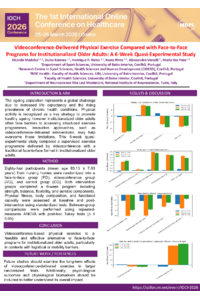
Videoconference-Delivered Physical Exercise Compared with Face-to-Face Programs for Institutionalized Older Adul.pdf
Automatic Identification of First-Degree Atrioventricular Blocks
Integrating Patient-Reported Outcomes and Digital Co-Design to Optimize Dermatologic Care Pathways: Patient-Centered Approaches