Event submissions
Published
This submission belongs to the session S1. Psychiatric, Emotional, and Behavioral Disorders of the event The 1st International Online Conference on Behavioral Sciences
Published date
27 Mar, 2026
Academic Editor
'%3e%3cpath%20d='M12.6657%2010.9104C12.4185%2010.325%2012.0599%209.79327%2011.6097%209.34482C11.1609%208.89508%2010.6293%208.5365%2010.0442%208.28888C10.0389%208.28626%2010.0337%208.28495%2010.0285%208.28233C10.8446%207.69279%2011.3752%206.73249%2011.3752%205.64904C11.3752%203.8542%209.92103%202.39999%208.1262%202.39999C6.33136%202.39999%204.87715%203.8542%204.87715%205.64904C4.87715%206.73249%205.40774%207.69279%206.22393%208.28364C6.21869%208.28626%206.21345%208.28757%206.20821%208.29019C5.62129%208.5378%205.09463%208.89284%204.64265%209.34613C4.1929%209.79493%203.83432%2010.3266%203.58671%2010.9117C3.34345%2011.4845%203.21226%2012.0987%203.20023%2012.7209C3.19988%2012.7349%203.20233%2012.7488%203.20744%2012.7619C3.21255%2012.7749%203.22022%2012.7867%203.22998%2012.7968C3.23975%2012.8068%203.25142%2012.8147%203.26431%2012.8202C3.2772%2012.8256%203.29105%2012.8284%203.30504%2012.8284H4.09109C4.14874%2012.8284%204.19459%2012.7825%204.1959%2012.7262C4.2221%2011.7148%204.62823%2010.7676%205.34617%2010.0497C6.08899%209.30683%207.0755%208.89808%208.1262%208.89808C9.17689%208.89808%2010.1634%209.30683%2010.9062%2010.0497C11.6242%2010.7676%2012.0303%2011.7148%2012.0565%2012.7262C12.0578%2012.7838%2012.1037%2012.8284%2012.1613%2012.8284H12.9474C12.9613%2012.8284%2012.9752%2012.8256%2012.9881%2012.8202C13.001%2012.8147%2013.0126%2012.8068%2013.0224%2012.7968C13.0322%2012.7867%2013.0398%2012.7749%2013.0449%2012.7619C13.0501%2012.7488%2013.0525%2012.7349%2013.0522%2012.7209C13.0391%2012.0947%2012.9094%2011.4855%2012.6657%2010.9104ZM8.1262%207.9024C7.52486%207.9024%206.9589%207.6679%206.53312%207.24211C6.10733%206.81633%205.87283%206.25037%205.87283%205.64904C5.87283%205.0477%206.10733%204.48174%206.53312%204.05596C6.9589%203.63018%207.52486%203.39567%208.1262%203.39567C8.72753%203.39567%209.29349%203.63018%209.71927%204.05596C10.1451%204.48174%2010.3796%205.0477%2010.3796%205.64904C10.3796%206.25037%2010.1451%206.81633%209.71927%207.24211C9.29349%207.6679%208.72753%207.9024%208.1262%207.9024Z'%20fill='%235D1EE1'/%3e%3c/g%3e%3c/svg%3e) Valentina Echeverria Moran
Valentina Echeverria MoranCitation
Zahra Wakif, Nivashi Arulventh, Nuzhat Azim, Mahwish Ali Khan, Fatima Nadeem, Farooq Naeem, Therapeutic Alliance and Post-Intervention Outcomes in a Sample of South Asian Canadians Receiving Culturally-Adapted CBT: Considering Client and Therapist Perceptions , in Proceedings of The 1st International Online Conference on Behavioral Sciences, 1 April–3 April 2026, MDPI: Basel, Switzerland
Share
Email
Facebook
Twitter
LinkedIn
Therapeutic Alliance and Post-Intervention Outcomes in a Sample of South Asian Canadians Receiving Culturally-Adapted CBT: Considering Client and Therapist Perceptions
'%3e%3cpath%20d='M12.6647%2010.9104C12.4176%2010.325%2012.0589%209.7933%2011.6088%209.34485C11.16%208.89511%2010.6283%208.53653%2010.0432%208.28891C10.038%208.28629%2010.0327%208.28498%2010.0275%208.28236C10.8437%207.69282%2011.3743%206.73252%2011.3743%205.64907C11.3743%203.85423%209.92005%202.40002%208.12522%202.40002C6.33038%202.40002%204.87618%203.85423%204.87618%205.64907C4.87618%206.73252%205.40677%207.69282%206.22296%208.28367C6.21772%208.28629%206.21248%208.2876%206.20724%208.29022C5.62031%208.53783%205.09365%208.89287%204.64167%209.34616C4.19192%209.79496%203.83334%2010.3266%203.58573%2010.9117C3.34247%2011.4846%203.21128%2012.0987%203.19925%2012.721C3.1989%2012.735%203.20135%2012.7489%203.20646%2012.7619C3.21157%2012.7749%203.21924%2012.7868%203.22901%2012.7968C3.23877%2012.8068%203.25045%2012.8148%203.26334%2012.8202C3.27623%2012.8256%203.29007%2012.8284%203.30406%2012.8284H4.09012C4.14776%2012.8284%204.19362%2012.7825%204.19493%2012.7262C4.22113%2011.7148%204.62726%2010.7676%205.34519%2010.0497C6.08802%209.30686%207.07452%208.89811%208.12522%208.89811C9.17592%208.89811%2010.1624%209.30686%2010.9052%2010.0497C11.6232%2010.7676%2012.0293%2011.7148%2012.0555%2012.7262C12.0568%2012.7839%2012.1027%2012.8284%2012.1603%2012.8284H12.9464C12.9604%2012.8284%2012.9742%2012.8256%2012.9871%2012.8202C13%2012.8148%2013.0117%2012.8068%2013.0214%2012.7968C13.0312%2012.7868%2013.0389%2012.7749%2013.044%2012.7619C13.0491%2012.7489%2013.0515%2012.735%2013.0512%2012.721C13.0381%2012.0947%2012.9084%2011.4856%2012.6647%2010.9104ZM8.12522%207.90243C7.52388%207.90243%206.95792%207.66793%206.53214%207.24215C6.10636%206.81636%205.87185%206.2504%205.87185%205.64907C5.87185%205.04773%206.10636%204.48177%206.53214%204.05599C6.95792%203.63021%207.52388%203.3957%208.12522%203.3957C8.72655%203.3957%209.29252%203.63021%209.7183%204.05599C10.1441%204.48177%2010.3786%205.04773%2010.3786%205.64907C10.3786%206.2504%2010.1441%206.81636%209.7183%207.24215C9.29252%207.66793%208.72655%207.90243%208.12522%207.90243Z'%20fill='%235D1EE1'/%3e%3c/g%3e%3c/svg%3e)
Zahra Wakif 1
Nivashi Arulventh 2
Nuzhat Azim 3,4
Mahwish Ali Khan 5
Fatima Nadeem 6
Farooq Naeem 3,7
1. Department of Psychology, York University, Toronto, ON M3J 1P3, Canada
2. Daphne Cockwell School of Nursing, Toronto Metropolitan University, Toronto, ON M5B 1Z5, Canada
3. Centre for Addiction and Mental Health, Toronto, ON M6J 1H4, Canada
4. Department of Psychology, University of Toronto, Toronto, ON M1C 1A4, Canada
5. University of Nottingham, Semenyih, Malaysia
6. Global University Systems, Toronto, ON M5G 1K2, Canada
7. Institute of Medical Science, University of Toronto, Toronto, ON M5S 3K3, Canada
Abstract
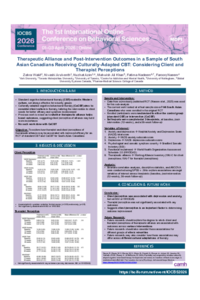
Introduction: Culturally-adapted cognitive behavioural therapy (CaCBT) aims to incorporate cultural considerations into the CBT model, particularly for ethnic minorities. The current state of literature somewhat supports that client perception of therapeutic alliance may be more important in predicting greater improvement post-intervention, however some work may suggest therapist perception is also important. Authors conducted a sub-analysis of a CaCBT RCT for South Asians to explore the influence of therapeutic alliance.
Methods: Bivariate correlational analyses and ANCOVAs are underway, using data from 146 South Asian Canadians enrolled in the original RCT. Variables of interest include depression, anxiety, disability, and somatic symptoms, with timepoints of interest being baseline, 12-weeks (post-intervention), and a 36-week follow-up.
Results: Preliminary results suggest that therapist perception of therapist-client alliance or relationship is not significant in predicting improved client outcomes. However, preliminary results highlight that client perception of therapeutic alliance is statistically significant for depression and anxiety, but not for disability and somatic symptoms.
Conclusions: Preliminary findings suggest that client perception of therapeutic alliance holds more importance in client therapeutic outcome improvement than therapist perception does. Future research should consider whether this is the case for other therapy modalities and ethnicities and aim to integrate qualitative work for client feedback and satisfaction, while this work helps build a foundation for considering how important client perception of therapist-client relationship is for their therapeutic improvement.
Keywords
CaCBT
mental health
therapist-client alliance
Poster
MDPI conference poster.pdf
Association between work schedule type, mental health and quality of life in Greek firefighters. (Protocol number accepted by ethical comitee: 223/ 27-05-2020)
Revalidating Body Image Dynamics in the Body Investment Scale Using Network Analysis: A Clinical and Behavioural Perspective