Event submissions
Published
This submission belongs to the session S1. Psychiatric, Emotional, and Behavioral Disorders of the event The 1st International Online Conference on Behavioral Sciences
Published date
27 Mar, 2026
Academic Editor
'%3e%3cpath%20d='M12.6657%2010.9104C12.4185%2010.325%2012.0599%209.79327%2011.6097%209.34482C11.1609%208.89508%2010.6293%208.5365%2010.0442%208.28888C10.0389%208.28626%2010.0337%208.28495%2010.0285%208.28233C10.8446%207.69279%2011.3752%206.73249%2011.3752%205.64904C11.3752%203.8542%209.92103%202.39999%208.1262%202.39999C6.33136%202.39999%204.87715%203.8542%204.87715%205.64904C4.87715%206.73249%205.40774%207.69279%206.22393%208.28364C6.21869%208.28626%206.21345%208.28757%206.20821%208.29019C5.62129%208.5378%205.09463%208.89284%204.64265%209.34613C4.1929%209.79493%203.83432%2010.3266%203.58671%2010.9117C3.34345%2011.4845%203.21226%2012.0987%203.20023%2012.7209C3.19988%2012.7349%203.20233%2012.7488%203.20744%2012.7619C3.21255%2012.7749%203.22022%2012.7867%203.22998%2012.7968C3.23975%2012.8068%203.25142%2012.8147%203.26431%2012.8202C3.2772%2012.8256%203.29105%2012.8284%203.30504%2012.8284H4.09109C4.14874%2012.8284%204.19459%2012.7825%204.1959%2012.7262C4.2221%2011.7148%204.62823%2010.7676%205.34617%2010.0497C6.08899%209.30683%207.0755%208.89808%208.1262%208.89808C9.17689%208.89808%2010.1634%209.30683%2010.9062%2010.0497C11.6242%2010.7676%2012.0303%2011.7148%2012.0565%2012.7262C12.0578%2012.7838%2012.1037%2012.8284%2012.1613%2012.8284H12.9474C12.9613%2012.8284%2012.9752%2012.8256%2012.9881%2012.8202C13.001%2012.8147%2013.0126%2012.8068%2013.0224%2012.7968C13.0322%2012.7867%2013.0398%2012.7749%2013.0449%2012.7619C13.0501%2012.7488%2013.0525%2012.7349%2013.0522%2012.7209C13.0391%2012.0947%2012.9094%2011.4855%2012.6657%2010.9104ZM8.1262%207.9024C7.52486%207.9024%206.9589%207.6679%206.53312%207.24211C6.10733%206.81633%205.87283%206.25037%205.87283%205.64904C5.87283%205.0477%206.10733%204.48174%206.53312%204.05596C6.9589%203.63018%207.52486%203.39567%208.1262%203.39567C8.72753%203.39567%209.29349%203.63018%209.71927%204.05596C10.1451%204.48174%2010.3796%205.0477%2010.3796%205.64904C10.3796%206.25037%2010.1451%206.81633%209.71927%207.24211C9.29349%207.6679%208.72753%207.9024%208.1262%207.9024Z'%20fill='%235D1EE1'/%3e%3c/g%3e%3c/svg%3e) Valentina Echeverria Moran
Valentina Echeverria MoranCitation
Pedro Henriques, Ricardo Picoito, Olga Valentim, Burnout and Psychological Well-Being among Mental Healthcare Professionals in Portugal: A Cross-Sectional Study., in Proceedings of The 1st International Online Conference on Behavioral Sciences, 1 April–3 April 2026, MDPI: Basel, Switzerland
Share
Email
Facebook
Twitter
LinkedIn
Burnout and Psychological Well-Being among Mental Healthcare Professionals in Portugal: A Cross-Sectional Study.
'%3e%3cpath%20d='M12.6647%2010.9104C12.4176%2010.325%2012.0589%209.7933%2011.6088%209.34485C11.16%208.89511%2010.6283%208.53653%2010.0432%208.28891C10.038%208.28629%2010.0327%208.28498%2010.0275%208.28236C10.8437%207.69282%2011.3743%206.73252%2011.3743%205.64907C11.3743%203.85423%209.92005%202.40002%208.12522%202.40002C6.33038%202.40002%204.87618%203.85423%204.87618%205.64907C4.87618%206.73252%205.40677%207.69282%206.22296%208.28367C6.21772%208.28629%206.21248%208.2876%206.20724%208.29022C5.62031%208.53783%205.09365%208.89287%204.64167%209.34616C4.19192%209.79496%203.83334%2010.3266%203.58573%2010.9117C3.34247%2011.4846%203.21128%2012.0987%203.19925%2012.721C3.1989%2012.735%203.20135%2012.7489%203.20646%2012.7619C3.21157%2012.7749%203.21924%2012.7868%203.22901%2012.7968C3.23877%2012.8068%203.25045%2012.8148%203.26334%2012.8202C3.27623%2012.8256%203.29007%2012.8284%203.30406%2012.8284H4.09012C4.14776%2012.8284%204.19362%2012.7825%204.19493%2012.7262C4.22113%2011.7148%204.62726%2010.7676%205.34519%2010.0497C6.08802%209.30686%207.07452%208.89811%208.12522%208.89811C9.17592%208.89811%2010.1624%209.30686%2010.9052%2010.0497C11.6232%2010.7676%2012.0293%2011.7148%2012.0555%2012.7262C12.0568%2012.7839%2012.1027%2012.8284%2012.1603%2012.8284H12.9464C12.9604%2012.8284%2012.9742%2012.8256%2012.9871%2012.8202C13%2012.8148%2013.0117%2012.8068%2013.0214%2012.7968C13.0312%2012.7868%2013.0389%2012.7749%2013.044%2012.7619C13.0491%2012.7489%2013.0515%2012.735%2013.0512%2012.721C13.0381%2012.0947%2012.9084%2011.4856%2012.6647%2010.9104ZM8.12522%207.90243C7.52388%207.90243%206.95792%207.66793%206.53214%207.24215C6.10636%206.81636%205.87185%206.2504%205.87185%205.64907C5.87185%205.04773%206.10636%204.48177%206.53214%204.05599C6.95792%203.63021%207.52388%203.3957%208.12522%203.3957C8.72655%203.3957%209.29252%203.63021%209.7183%204.05599C10.1441%204.48177%2010.3786%205.04773%2010.3786%205.64907C10.3786%206.2504%2010.1441%206.81636%209.7183%207.24215C9.29252%207.66793%208.72655%207.90243%208.12522%207.90243Z'%20fill='%235D1EE1'/%3e%3c/g%3e%3c/svg%3e)
Pedro Henriques 1,2
Ricardo Picoito 3,4,5

Olga Valentim 1,6,7
1. Escola Superior de Enfermagem da Universidade de Lisboa, Lisboa, Portugal.
2. Unidade de Cuidados Intensivos 4, Serviço de Medicina Intensiva. Hospital São Francisco Xavier, Unidade Local de Saúde Lisboa Ocidental, Lisboa, Portugal.
3. Centro de Inovação e Investigação Clínica | Núcleo de Investigação e Formação em Enfermagem, Unidade Local de Saúde Lisboa Ocidental, Lisboa, Portugal.
4. Universidade Católica Portuguesa – Faculdade de Ciências da Saúde e Enfermage, Lisboa, Portugal
5. Centro de Investigação Interdisciplinar em Saúde (CIIS) – Wounds Research Lab, Porto, Portugal.
6. Centro de Investigação, Inovação e Desenvolvimento em Enfermagem de Lisboa (CIDNUR), Lisboa, Portugal.
7. RISE-Health, Nursing School of Porto, Porto, Portugal.
Abstract
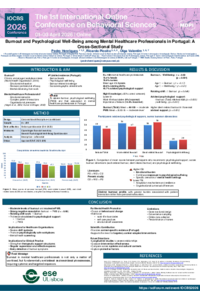
Introduction: Burnout from chronic occupational stress poses a psychosocial risk among mental healthcare professionals exposed to emotional demands (World Health Organization, 2019; Nagle et al., 2024), compromising well-being, care quality and organisational functioning (O’Connor et al., 2018; Bykov et al., 2022). This study assessed knowledge, burnout and psychological well-being among mental healthcare professionals in Portugal and analysed associations and group differences. Methods: A descriptive–correlational cross-sectional study was conducted with 199 professionals using an anonymous online survey in October 2025. The instrument included sociodemographic variables, burnout-related knowledge, the Copenhagen Burnout Inventory and the reduced General Psychological Well-Being Questionnaire (both validated for Portugal). Analyses comprised descriptive measures, normality assessment, parametric/non-parametric tests and internal reliability (α≥0.86). This study was approved by the Ethics Committee (ref. no. 2025-109). Results: Of the 199 participants, 75.4% were female and 50.8% held a bachelor’s or master’s degree (38.2%), with nurses predominating (78.9%). Most worked rotating shifts (60.8%), and 45.7% had been advised to seek psychological support. Participants demonstrated strong burnout knowledge, with only 9% believing that work–life boundaries are irrelevant. Burnout was moderate (M≈46/100) and well-being likewise (M≈3.1/5), with a strong negative correlation (r=−0.80). Older and more experienced professionals showed lower burnout. Burnout was higher in rotating-shift workers (p=0.048) and those advised to seek support (M=49.3 vs 43.1; p=0.003), who also showed lower well-being (p<0.001). Conclusions: Findings indicate a psychological burden among mental health professionals, especially those in rotating shifts and reporting support needs. The inverse burnout–well-being association reinforces the need for organisational strategies that foster healthier work conditions. Limitations include the cross-sectional, self-report design. Future studies should adopt longitudinal approaches and evaluate targeted interventions to mitigate burnout.
Keywords
Burnout
Professional
Psychological Well-Being
Mental Health services
Health Personnel
Poster
Cross-Sectional Study.pdf
Revalidating Body Image Dynamics in the Body Investment Scale Using Network Analysis: A Clinical and Behavioural Perspective
Shielding Neurodivergent and Trauma-Sensitive Users: A Multilingual, Real-Time, Self-Learning Web Content Filtering System