Event submissions
Published
This submission belongs to the session S2. Cognition of the event The 1st International Online Conference on Behavioral Sciences
Published date
27 Mar, 2026
Academic Editor
'%3e%3cpath%20d='M12.6657%2010.9104C12.4185%2010.325%2012.0599%209.79327%2011.6097%209.34482C11.1609%208.89508%2010.6293%208.5365%2010.0442%208.28888C10.0389%208.28626%2010.0337%208.28495%2010.0285%208.28233C10.8446%207.69279%2011.3752%206.73249%2011.3752%205.64904C11.3752%203.8542%209.92103%202.39999%208.1262%202.39999C6.33136%202.39999%204.87715%203.8542%204.87715%205.64904C4.87715%206.73249%205.40774%207.69279%206.22393%208.28364C6.21869%208.28626%206.21345%208.28757%206.20821%208.29019C5.62129%208.5378%205.09463%208.89284%204.64265%209.34613C4.1929%209.79493%203.83432%2010.3266%203.58671%2010.9117C3.34345%2011.4845%203.21226%2012.0987%203.20023%2012.7209C3.19988%2012.7349%203.20233%2012.7488%203.20744%2012.7619C3.21255%2012.7749%203.22022%2012.7867%203.22998%2012.7968C3.23975%2012.8068%203.25142%2012.8147%203.26431%2012.8202C3.2772%2012.8256%203.29105%2012.8284%203.30504%2012.8284H4.09109C4.14874%2012.8284%204.19459%2012.7825%204.1959%2012.7262C4.2221%2011.7148%204.62823%2010.7676%205.34617%2010.0497C6.08899%209.30683%207.0755%208.89808%208.1262%208.89808C9.17689%208.89808%2010.1634%209.30683%2010.9062%2010.0497C11.6242%2010.7676%2012.0303%2011.7148%2012.0565%2012.7262C12.0578%2012.7838%2012.1037%2012.8284%2012.1613%2012.8284H12.9474C12.9613%2012.8284%2012.9752%2012.8256%2012.9881%2012.8202C13.001%2012.8147%2013.0126%2012.8068%2013.0224%2012.7968C13.0322%2012.7867%2013.0398%2012.7749%2013.0449%2012.7619C13.0501%2012.7488%2013.0525%2012.7349%2013.0522%2012.7209C13.0391%2012.0947%2012.9094%2011.4855%2012.6657%2010.9104ZM8.1262%207.9024C7.52486%207.9024%206.9589%207.6679%206.53312%207.24211C6.10733%206.81633%205.87283%206.25037%205.87283%205.64904C5.87283%205.0477%206.10733%204.48174%206.53312%204.05596C6.9589%203.63018%207.52486%203.39567%208.1262%203.39567C8.72753%203.39567%209.29349%203.63018%209.71927%204.05596C10.1451%204.48174%2010.3796%205.0477%2010.3796%205.64904C10.3796%206.25037%2010.1451%206.81633%209.71927%207.24211C9.29349%207.6679%208.72753%207.9024%208.1262%207.9024Z'%20fill='%235D1EE1'/%3e%3c/g%3e%3c/svg%3e) Jerrell Cassady
Jerrell CassadyCitation
SERGIO NAVAS-LEÓN, Jon Andoni Duñabeitia, Reading with Noisy Orthographic Input: Easy-to-Read Formats and Visual Processing Across the Adult Lifespan, in Proceedings of The 1st International Online Conference on Behavioral Sciences, 1 April–3 April 2026, MDPI: Basel, Switzerland
Share
Email
Facebook
Twitter
LinkedIn
Reading with Noisy Orthographic Input: Easy-to-Read Formats and Visual Processing Across the Adult Lifespan
'%3e%3cpath%20d='M12.6647%2010.9104C12.4176%2010.325%2012.0589%209.7933%2011.6088%209.34485C11.16%208.89511%2010.6283%208.53653%2010.0432%208.28891C10.038%208.28629%2010.0327%208.28498%2010.0275%208.28236C10.8437%207.69282%2011.3743%206.73252%2011.3743%205.64907C11.3743%203.85423%209.92005%202.40002%208.12522%202.40002C6.33038%202.40002%204.87618%203.85423%204.87618%205.64907C4.87618%206.73252%205.40677%207.69282%206.22296%208.28367C6.21772%208.28629%206.21248%208.2876%206.20724%208.29022C5.62031%208.53783%205.09365%208.89287%204.64167%209.34616C4.19192%209.79496%203.83334%2010.3266%203.58573%2010.9117C3.34247%2011.4846%203.21128%2012.0987%203.19925%2012.721C3.1989%2012.735%203.20135%2012.7489%203.20646%2012.7619C3.21157%2012.7749%203.21924%2012.7868%203.22901%2012.7968C3.23877%2012.8068%203.25045%2012.8148%203.26334%2012.8202C3.27623%2012.8256%203.29007%2012.8284%203.30406%2012.8284H4.09012C4.14776%2012.8284%204.19362%2012.7825%204.19493%2012.7262C4.22113%2011.7148%204.62726%2010.7676%205.34519%2010.0497C6.08802%209.30686%207.07452%208.89811%208.12522%208.89811C9.17592%208.89811%2010.1624%209.30686%2010.9052%2010.0497C11.6232%2010.7676%2012.0293%2011.7148%2012.0555%2012.7262C12.0568%2012.7839%2012.1027%2012.8284%2012.1603%2012.8284H12.9464C12.9604%2012.8284%2012.9742%2012.8256%2012.9871%2012.8202C13%2012.8148%2013.0117%2012.8068%2013.0214%2012.7968C13.0312%2012.7868%2013.0389%2012.7749%2013.044%2012.7619C13.0491%2012.7489%2013.0515%2012.735%2013.0512%2012.721C13.0381%2012.0947%2012.9084%2011.4856%2012.6647%2010.9104ZM8.12522%207.90243C7.52388%207.90243%206.95792%207.66793%206.53214%207.24215C6.10636%206.81636%205.87185%206.2504%205.87185%205.64907C5.87185%205.04773%206.10636%204.48177%206.53214%204.05599C6.95792%203.63021%207.52388%203.3957%208.12522%203.3957C8.72655%203.3957%209.29252%203.63021%209.7183%204.05599C10.1441%204.48177%2010.3786%205.04773%2010.3786%205.64907C10.3786%206.2504%2010.1441%206.81636%209.7183%207.24215C9.29252%207.66793%208.72655%207.90243%208.12522%207.90243Z'%20fill='%235D1EE1'/%3e%3c/g%3e%3c/svg%3e)
SERGIO NAVAS-LEÓN 1

Jon Andoni Duñabeitia 1
1. Centro de Investigación Nebrija en Cognición (CINC), Facultad de Lenguas y Educación, Universidad Nebrija, 28043, Madrid (Spain)
Abstract
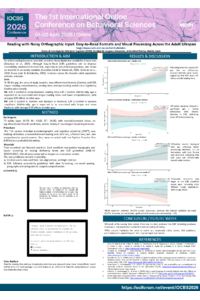
Introduction. Easy-to-Read (E2R) is intended to enhance digital accessibility by reducing cognitive load. However, evidence supporting its effectiveness, particularly in non-disabled adult populations, remains limited. To fill this gap, the present study examines whether E2R is associated with more efficient reading across the adult lifespan. Materials and Methods. A convenience sample of healthy Spanish adults (N = 49; M = 42.2; SD = 20.5) completed a within-subject reading task. Texts were presented in a Control (sans-serif font, justified alignment, and standard spacing) and an E2R format (sans-serif font, left-aligned text, increased spacing, and pictograms). Eye movements were recorded at 500 Hz. Measures included fixation count, fixation duration, saccade amplitude, and reading time. After reading, participants completed a comprehension test. Linear mixed-effects models were fitted, with age entered as a continuous predictor. Results. The E2R condition resulted in shorter fixation durations and larger saccade amplitudes. Fixation count showed a non-significant trend. A significant main effect of age was observed on total reading time, with older participants exhibiting longer reading times. However, main effects of age and condition × age interactions were non-significant across other measures. Finally, non-significant differences in comprehension were found between conditions. Discussion. These results show for the first time that E2R may not represent any benefit for native readers without any marked cognitive difficulty. This pattern highlights the need to revisit and empirically refine current E2R guidelines, particularly when applied beyond their original target populations.
References
- Schmutz, S., Sonderegger, A., & Sauer, J. (2016). Implementing recommendations from web accessibility guidelines: Would they also provide benefits to nondisabled users? Human Factors, 58(4), 611–629. https://doi.org/10.1177/0018720816640962
- Schmutz, S., Sonderegger, A., & Sauer, J. (2019). Easy-to-read language in disability-friendly websites: Effects on nondisabled users. Applied Ergonomics, 74, 97–106. https://doi.org/10.1016/j.apergo.2018.08.023
- World Wide Web Consortium (W3C). (2022). W3C accessibility standards overview: Accessibility guidelines. https://www.w3.org/WAI/standards-guidelines/#guidelines
Keywords
Accessibility
Adult
Cognition
Eyetracking
Reading
Psycholinguistics
Poster
MDPI.pdf
Gender Bias in ADHD Diagnosis and Exploring Predictors for Accurate Diagnosis
The Spatial Updating Mechanism of Different Field-Cognitive Styles in Various Perspective Orientations: Evidence from Behavior and fNIRS