Event submissions
Published
This submission belongs to the session S2. Cognition of the event The 1st International Online Conference on Behavioral Sciences
Published date
27 Mar, 2026
Academic Editor
'%3e%3cpath%20d='M12.6657%2010.9104C12.4185%2010.325%2012.0599%209.79327%2011.6097%209.34482C11.1609%208.89508%2010.6293%208.5365%2010.0442%208.28888C10.0389%208.28626%2010.0337%208.28495%2010.0285%208.28233C10.8446%207.69279%2011.3752%206.73249%2011.3752%205.64904C11.3752%203.8542%209.92103%202.39999%208.1262%202.39999C6.33136%202.39999%204.87715%203.8542%204.87715%205.64904C4.87715%206.73249%205.40774%207.69279%206.22393%208.28364C6.21869%208.28626%206.21345%208.28757%206.20821%208.29019C5.62129%208.5378%205.09463%208.89284%204.64265%209.34613C4.1929%209.79493%203.83432%2010.3266%203.58671%2010.9117C3.34345%2011.4845%203.21226%2012.0987%203.20023%2012.7209C3.19988%2012.7349%203.20233%2012.7488%203.20744%2012.7619C3.21255%2012.7749%203.22022%2012.7867%203.22998%2012.7968C3.23975%2012.8068%203.25142%2012.8147%203.26431%2012.8202C3.2772%2012.8256%203.29105%2012.8284%203.30504%2012.8284H4.09109C4.14874%2012.8284%204.19459%2012.7825%204.1959%2012.7262C4.2221%2011.7148%204.62823%2010.7676%205.34617%2010.0497C6.08899%209.30683%207.0755%208.89808%208.1262%208.89808C9.17689%208.89808%2010.1634%209.30683%2010.9062%2010.0497C11.6242%2010.7676%2012.0303%2011.7148%2012.0565%2012.7262C12.0578%2012.7838%2012.1037%2012.8284%2012.1613%2012.8284H12.9474C12.9613%2012.8284%2012.9752%2012.8256%2012.9881%2012.8202C13.001%2012.8147%2013.0126%2012.8068%2013.0224%2012.7968C13.0322%2012.7867%2013.0398%2012.7749%2013.0449%2012.7619C13.0501%2012.7488%2013.0525%2012.7349%2013.0522%2012.7209C13.0391%2012.0947%2012.9094%2011.4855%2012.6657%2010.9104ZM8.1262%207.9024C7.52486%207.9024%206.9589%207.6679%206.53312%207.24211C6.10733%206.81633%205.87283%206.25037%205.87283%205.64904C5.87283%205.0477%206.10733%204.48174%206.53312%204.05596C6.9589%203.63018%207.52486%203.39567%208.1262%203.39567C8.72753%203.39567%209.29349%203.63018%209.71927%204.05596C10.1451%204.48174%2010.3796%205.0477%2010.3796%205.64904C10.3796%206.25037%2010.1451%206.81633%209.71927%207.24211C9.29349%207.6679%208.72753%207.9024%208.1262%207.9024Z'%20fill='%235D1EE1'/%3e%3c/g%3e%3c/svg%3e) John Parkinson
John ParkinsonCitation
Katherine Packard, Madison A Smith, Veronica B Perez, Does an OPTIMIST (Optimizing Psychosis Transformations Interpersonally with Mood, Insight, and Self-stigma Tracking) Approach Improve Prediction of Social Function in Individuals on the Psychosis Spectrum?, in Proceedings of The 1st International Online Conference on Behavioral Sciences, 1 April–3 April 2026, MDPI: Basel, Switzerland
Share
Email
Facebook
Twitter
LinkedIn
Does an OPTIMIST (Optimizing Psychosis Transformations Interpersonally with Mood, Insight, and Self-stigma Tracking) Approach Improve Prediction of Social Function in Individuals on the Psychosis Spectrum?
'%3e%3cpath%20d='M12.6647%2010.9104C12.4176%2010.325%2012.0589%209.7933%2011.6088%209.34485C11.16%208.89511%2010.6283%208.53653%2010.0432%208.28891C10.038%208.28629%2010.0327%208.28498%2010.0275%208.28236C10.8437%207.69282%2011.3743%206.73252%2011.3743%205.64907C11.3743%203.85423%209.92005%202.40002%208.12522%202.40002C6.33038%202.40002%204.87618%203.85423%204.87618%205.64907C4.87618%206.73252%205.40677%207.69282%206.22296%208.28367C6.21772%208.28629%206.21248%208.2876%206.20724%208.29022C5.62031%208.53783%205.09365%208.89287%204.64167%209.34616C4.19192%209.79496%203.83334%2010.3266%203.58573%2010.9117C3.34247%2011.4846%203.21128%2012.0987%203.19925%2012.721C3.1989%2012.735%203.20135%2012.7489%203.20646%2012.7619C3.21157%2012.7749%203.21924%2012.7868%203.22901%2012.7968C3.23877%2012.8068%203.25045%2012.8148%203.26334%2012.8202C3.27623%2012.8256%203.29007%2012.8284%203.30406%2012.8284H4.09012C4.14776%2012.8284%204.19362%2012.7825%204.19493%2012.7262C4.22113%2011.7148%204.62726%2010.7676%205.34519%2010.0497C6.08802%209.30686%207.07452%208.89811%208.12522%208.89811C9.17592%208.89811%2010.1624%209.30686%2010.9052%2010.0497C11.6232%2010.7676%2012.0293%2011.7148%2012.0555%2012.7262C12.0568%2012.7839%2012.1027%2012.8284%2012.1603%2012.8284H12.9464C12.9604%2012.8284%2012.9742%2012.8256%2012.9871%2012.8202C13%2012.8148%2013.0117%2012.8068%2013.0214%2012.7968C13.0312%2012.7868%2013.0389%2012.7749%2013.044%2012.7619C13.0491%2012.7489%2013.0515%2012.735%2013.0512%2012.721C13.0381%2012.0947%2012.9084%2011.4856%2012.6647%2010.9104ZM8.12522%207.90243C7.52388%207.90243%206.95792%207.66793%206.53214%207.24215C6.10636%206.81636%205.87185%206.2504%205.87185%205.64907C5.87185%205.04773%206.10636%204.48177%206.53214%204.05599C6.95792%203.63021%207.52388%203.3957%208.12522%203.3957C8.72655%203.3957%209.29252%203.63021%209.7183%204.05599C10.1441%204.48177%2010.3786%205.04773%2010.3786%205.64907C10.3786%206.2504%2010.1441%206.81636%209.7183%207.24215C9.29252%207.66793%208.72655%207.90243%208.12522%207.90243Z'%20fill='%235D1EE1'/%3e%3c/g%3e%3c/svg%3e)
Katherine Packard 1
Madison A Smith 1

Veronica B Perez 1
1. California School of Professional Psychology, Alliant University, San Diego 92131, USA
Abstract
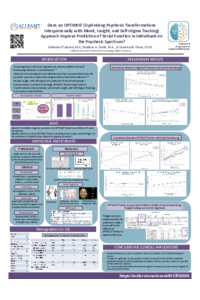
Psychosocial dysfunction in individuals across the psychosis spectrum is well-documented, with neurocognitive and social-cognitive deficits among the strongest predictors. However, mood, insight, and self-stigma may work in tandem with cognitive abilities to improve predictive models of social function. Interventions focused around cognitive remediation for real-world improvements have been inconsistent. Taking an OPTIMIST (Optimizing Psychosis Transformations Interpersonally with Mood, Insight, and Self-stigma Tracking) approach to target layered, compensatory treatments may yield more permanent social efficacy. We aim to clarify the relationship between cognitive processes with OPTIMIST factors to predict social function across the psychosis spectrum, hypothesizing that OPTIMIST factors will uniquely contribute to social functioning outcomes.
Psychosis-spectrum participants were assessed on neurocognitive (Trail Making Test - A & B; D-KEFS Color–Word Interference Test; Wisconsin Card Sort Test) and social cognitive performance (Ambiguous Intentions Hostility Questionnaire; Penn Emotion Recognition Task). OPTIMIST factors were assessed with the Depression and Anxiety Stress Scale and UCLA Loneliness Scale; Birchwood Insight Scale and Beck Cognitive Insight Scale; and the Internalized Stigma of Mental Illness Scale. Social and role functioning were assessed using the Social Integration Survey and Social Adjustment Scale.
Hierarchical regression assessed (Step 1) cognitive processes and (Step 2) OPTIMIST factors (mood, insight, self-stigma) on social functioning. Preliminary findings on a small initial sample (n=8) are promising, and suggest OPTIMIST factors substantially increase explained variance, though data collection is ongoing. Our data support a stronger-fitting predictive model of social disability and highlight alternative targets that may be responsive to therapeutic interventions, with the ultimate aim of enhancing social function across the psychosis spectrum.
Keywords
psychosis
schizophrenia
cognition
social function
mood
insight
stigma
Poster
Packard_International Online Conference on Behavioral Sciences_Poster Final.pdf
Comparing GPT and Human Affective Evaluations of Social Images
Parasympathetic cardiovascular regulation during a worry-related attentional task in individuals with fibromyalgia