Event submissions
Published
This submission belongs to the session S7. Child and Adolescent Psychiatry of the event The 1st International Online Conference on Behavioral Sciences
Published date
27 Mar, 2026
Academic Editor
'%3e%3cpath%20d='M12.6657%2010.9104C12.4185%2010.325%2012.0599%209.79327%2011.6097%209.34482C11.1609%208.89508%2010.6293%208.5365%2010.0442%208.28888C10.0389%208.28626%2010.0337%208.28495%2010.0285%208.28233C10.8446%207.69279%2011.3752%206.73249%2011.3752%205.64904C11.3752%203.8542%209.92103%202.39999%208.1262%202.39999C6.33136%202.39999%204.87715%203.8542%204.87715%205.64904C4.87715%206.73249%205.40774%207.69279%206.22393%208.28364C6.21869%208.28626%206.21345%208.28757%206.20821%208.29019C5.62129%208.5378%205.09463%208.89284%204.64265%209.34613C4.1929%209.79493%203.83432%2010.3266%203.58671%2010.9117C3.34345%2011.4845%203.21226%2012.0987%203.20023%2012.7209C3.19988%2012.7349%203.20233%2012.7488%203.20744%2012.7619C3.21255%2012.7749%203.22022%2012.7867%203.22998%2012.7968C3.23975%2012.8068%203.25142%2012.8147%203.26431%2012.8202C3.2772%2012.8256%203.29105%2012.8284%203.30504%2012.8284H4.09109C4.14874%2012.8284%204.19459%2012.7825%204.1959%2012.7262C4.2221%2011.7148%204.62823%2010.7676%205.34617%2010.0497C6.08899%209.30683%207.0755%208.89808%208.1262%208.89808C9.17689%208.89808%2010.1634%209.30683%2010.9062%2010.0497C11.6242%2010.7676%2012.0303%2011.7148%2012.0565%2012.7262C12.0578%2012.7838%2012.1037%2012.8284%2012.1613%2012.8284H12.9474C12.9613%2012.8284%2012.9752%2012.8256%2012.9881%2012.8202C13.001%2012.8147%2013.0126%2012.8068%2013.0224%2012.7968C13.0322%2012.7867%2013.0398%2012.7749%2013.0449%2012.7619C13.0501%2012.7488%2013.0525%2012.7349%2013.0522%2012.7209C13.0391%2012.0947%2012.9094%2011.4855%2012.6657%2010.9104ZM8.1262%207.9024C7.52486%207.9024%206.9589%207.6679%206.53312%207.24211C6.10733%206.81633%205.87283%206.25037%205.87283%205.64904C5.87283%205.0477%206.10733%204.48174%206.53312%204.05596C6.9589%203.63018%207.52486%203.39567%208.1262%203.39567C8.72753%203.39567%209.29349%203.63018%209.71927%204.05596C10.1451%204.48174%2010.3796%205.0477%2010.3796%205.64904C10.3796%206.25037%2010.1451%206.81633%209.71927%207.24211C9.29349%207.6679%208.72753%207.9024%208.1262%207.9024Z'%20fill='%235D1EE1'/%3e%3c/g%3e%3c/svg%3e) Michele Roccella
Michele RoccellaCitation
Wiktoria Maria Wójcik, Integrative Insights into ODD: Neurocognitive and Social Mechanisms, in Proceedings of The 1st International Online Conference on Behavioral Sciences, 1 April–3 April 2026, MDPI: Basel, Switzerland
Share
Email
Facebook
Twitter
LinkedIn
Integrative Insights into ODD: Neurocognitive and Social Mechanisms
'%3e%3cpath%20d='M12.6647%2010.9104C12.4176%2010.325%2012.0589%209.7933%2011.6088%209.34485C11.16%208.89511%2010.6283%208.53653%2010.0432%208.28891C10.038%208.28629%2010.0327%208.28498%2010.0275%208.28236C10.8437%207.69282%2011.3743%206.73252%2011.3743%205.64907C11.3743%203.85423%209.92005%202.40002%208.12522%202.40002C6.33038%202.40002%204.87618%203.85423%204.87618%205.64907C4.87618%206.73252%205.40677%207.69282%206.22296%208.28367C6.21772%208.28629%206.21248%208.2876%206.20724%208.29022C5.62031%208.53783%205.09365%208.89287%204.64167%209.34616C4.19192%209.79496%203.83334%2010.3266%203.58573%2010.9117C3.34247%2011.4846%203.21128%2012.0987%203.19925%2012.721C3.1989%2012.735%203.20135%2012.7489%203.20646%2012.7619C3.21157%2012.7749%203.21924%2012.7868%203.22901%2012.7968C3.23877%2012.8068%203.25045%2012.8148%203.26334%2012.8202C3.27623%2012.8256%203.29007%2012.8284%203.30406%2012.8284H4.09012C4.14776%2012.8284%204.19362%2012.7825%204.19493%2012.7262C4.22113%2011.7148%204.62726%2010.7676%205.34519%2010.0497C6.08802%209.30686%207.07452%208.89811%208.12522%208.89811C9.17592%208.89811%2010.1624%209.30686%2010.9052%2010.0497C11.6232%2010.7676%2012.0293%2011.7148%2012.0555%2012.7262C12.0568%2012.7839%2012.1027%2012.8284%2012.1603%2012.8284H12.9464C12.9604%2012.8284%2012.9742%2012.8256%2012.9871%2012.8202C13%2012.8148%2013.0117%2012.8068%2013.0214%2012.7968C13.0312%2012.7868%2013.0389%2012.7749%2013.044%2012.7619C13.0491%2012.7489%2013.0515%2012.735%2013.0512%2012.721C13.0381%2012.0947%2012.9084%2011.4856%2012.6647%2010.9104ZM8.12522%207.90243C7.52388%207.90243%206.95792%207.66793%206.53214%207.24215C6.10636%206.81636%205.87185%206.2504%205.87185%205.64907C5.87185%205.04773%206.10636%204.48177%206.53214%204.05599C6.95792%203.63021%207.52388%203.3957%208.12522%203.3957C8.72655%203.3957%209.29252%203.63021%209.7183%204.05599C10.1441%204.48177%2010.3786%205.04773%2010.3786%205.64907C10.3786%206.2504%2010.1441%206.81636%209.7183%207.24215C9.29252%207.66793%208.72655%207.90243%208.12522%207.90243Z'%20fill='%235D1EE1'/%3e%3c/g%3e%3c/svg%3e)
Wiktoria Maria Wójcik 1
1. Psychology Department, The Maria Grzegorzewska University, Warsaw 02-353, Poland
Abstract
Oppositional Defiant Disorder (ODD) is increasingly conceptualized as a condition driven by interacting emotional, social–cognitive, and neurocognitive mechanisms that disrupt daily functioning [2]. This integrative review summarizes current evidence on therapeutic interventions that target these interconnected domains [6].
Methods:
Literature Search. Peer-reviewed studies and clinical guidelines published between 2014 and 2025 were identified through structured searches in EBSCO, ScienceDirect, PubMed, and the National Library of Medicine, as well as professional organizational websites. The literature primarily comprised cross-sectional, longitudinal, neuroimaging, and intervention studies focusing on emotional-processing interventions, Theory of Mind (ToM), executive functions, neurodevelopmental risk factors, and parent–child interpersonal neural synchrony (INS).
Results:
Children with ODD frequently exhibit ToM impairments—nearly two-thirds exceed clinical cutoffs—highlighting a core socio-cognitive mechanism underlying oppositional behaviour [3]. Training in facial-emotion recognition improves ToM and behavioural inhibition [5], while emotion-oriented therapy significantly reduces ODD and anxiety symptoms by reorganizing maladaptive emotional responses [1]. Neurodevelopmental findings show that autistic-like social interaction difficulties and ADHD-related attentional/impulsivity profiles represent gender-specific risk pathways [4]. Neuroimaging evidence further indicates that reduced mother–child INS during interaction tasks is associated with higher ODD severity, reflecting diminished attunement and weaker shared emotion-regulation processes [7].
Conclusions:
Taken together, the evidence most strongly supports emotional processing, Theory of Mind, executive functioning, and parent–child neural synchrony as core domains implicated in ODD and as primary targets for developmentally informed, multimodal interventions.
Keywords
Oppositional Defiant Disorder (ODD)
Theory of Mind (ToM)
Emotion Recognition Executive Functions (EF)
Parent–Child Neural Synchrony (INS)
Social-Cognitive Mechanisms
Poster
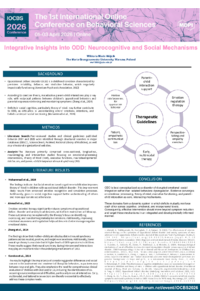
PosterWiktoriaWójcik 2.pdf
Associative Cognitive Networks: A Meta-Analysis of Their Impact on Science and Mathematics Education
Pedagogical Content Knowledge of Measurement through the Analysis of Associative Cognitive Networks