Event submissions
Published
This submission belongs to the session S2. Cognition of the event The 1st International Online Conference on Behavioral Sciences
Published date
27 Mar, 2026
Academic Editor
'%3e%3cpath%20d='M12.6657%2010.9104C12.4185%2010.325%2012.0599%209.79327%2011.6097%209.34482C11.1609%208.89508%2010.6293%208.5365%2010.0442%208.28888C10.0389%208.28626%2010.0337%208.28495%2010.0285%208.28233C10.8446%207.69279%2011.3752%206.73249%2011.3752%205.64904C11.3752%203.8542%209.92103%202.39999%208.1262%202.39999C6.33136%202.39999%204.87715%203.8542%204.87715%205.64904C4.87715%206.73249%205.40774%207.69279%206.22393%208.28364C6.21869%208.28626%206.21345%208.28757%206.20821%208.29019C5.62129%208.5378%205.09463%208.89284%204.64265%209.34613C4.1929%209.79493%203.83432%2010.3266%203.58671%2010.9117C3.34345%2011.4845%203.21226%2012.0987%203.20023%2012.7209C3.19988%2012.7349%203.20233%2012.7488%203.20744%2012.7619C3.21255%2012.7749%203.22022%2012.7867%203.22998%2012.7968C3.23975%2012.8068%203.25142%2012.8147%203.26431%2012.8202C3.2772%2012.8256%203.29105%2012.8284%203.30504%2012.8284H4.09109C4.14874%2012.8284%204.19459%2012.7825%204.1959%2012.7262C4.2221%2011.7148%204.62823%2010.7676%205.34617%2010.0497C6.08899%209.30683%207.0755%208.89808%208.1262%208.89808C9.17689%208.89808%2010.1634%209.30683%2010.9062%2010.0497C11.6242%2010.7676%2012.0303%2011.7148%2012.0565%2012.7262C12.0578%2012.7838%2012.1037%2012.8284%2012.1613%2012.8284H12.9474C12.9613%2012.8284%2012.9752%2012.8256%2012.9881%2012.8202C13.001%2012.8147%2013.0126%2012.8068%2013.0224%2012.7968C13.0322%2012.7867%2013.0398%2012.7749%2013.0449%2012.7619C13.0501%2012.7488%2013.0525%2012.7349%2013.0522%2012.7209C13.0391%2012.0947%2012.9094%2011.4855%2012.6657%2010.9104ZM8.1262%207.9024C7.52486%207.9024%206.9589%207.6679%206.53312%207.24211C6.10733%206.81633%205.87283%206.25037%205.87283%205.64904C5.87283%205.0477%206.10733%204.48174%206.53312%204.05596C6.9589%203.63018%207.52486%203.39567%208.1262%203.39567C8.72753%203.39567%209.29349%203.63018%209.71927%204.05596C10.1451%204.48174%2010.3796%205.0477%2010.3796%205.64904C10.3796%206.25037%2010.1451%206.81633%209.71927%207.24211C9.29349%207.6679%208.72753%207.9024%208.1262%207.9024Z'%20fill='%235D1EE1'/%3e%3c/g%3e%3c/svg%3e) John Parkinson
John ParkinsonCitation
Elena González Cortés, Lina Viviana Melo Niño, Alejandro de la Hoz, Miguel Ángel Ángel González Maestre, Luis Luis Manuel Soto Ardila, Adrián Gordillo Merino, Raúl Martínez Bohórquez, Carlos José Prieto Vera, Susana Sánchez Herrera, Javier Cubero Juánez, Pedagogical Content Knowledge of Measurement through the Analysis of Associative Cognitive Networks , in Proceedings of The 1st International Online Conference on Behavioral Sciences, 1 April–3 April 2026, MDPI: Basel, Switzerland
Share
Email
Facebook
Twitter
LinkedIn
Pedagogical Content Knowledge of Measurement through the Analysis of Associative Cognitive Networks
'%3e%3cpath%20d='M12.6647%2010.9104C12.4176%2010.325%2012.0589%209.7933%2011.6088%209.34485C11.16%208.89511%2010.6283%208.53653%2010.0432%208.28891C10.038%208.28629%2010.0327%208.28498%2010.0275%208.28236C10.8437%207.69282%2011.3743%206.73252%2011.3743%205.64907C11.3743%203.85423%209.92005%202.40002%208.12522%202.40002C6.33038%202.40002%204.87618%203.85423%204.87618%205.64907C4.87618%206.73252%205.40677%207.69282%206.22296%208.28367C6.21772%208.28629%206.21248%208.2876%206.20724%208.29022C5.62031%208.53783%205.09365%208.89287%204.64167%209.34616C4.19192%209.79496%203.83334%2010.3266%203.58573%2010.9117C3.34247%2011.4846%203.21128%2012.0987%203.19925%2012.721C3.1989%2012.735%203.20135%2012.7489%203.20646%2012.7619C3.21157%2012.7749%203.21924%2012.7868%203.22901%2012.7968C3.23877%2012.8068%203.25045%2012.8148%203.26334%2012.8202C3.27623%2012.8256%203.29007%2012.8284%203.30406%2012.8284H4.09012C4.14776%2012.8284%204.19362%2012.7825%204.19493%2012.7262C4.22113%2011.7148%204.62726%2010.7676%205.34519%2010.0497C6.08802%209.30686%207.07452%208.89811%208.12522%208.89811C9.17592%208.89811%2010.1624%209.30686%2010.9052%2010.0497C11.6232%2010.7676%2012.0293%2011.7148%2012.0555%2012.7262C12.0568%2012.7839%2012.1027%2012.8284%2012.1603%2012.8284H12.9464C12.9604%2012.8284%2012.9742%2012.8256%2012.9871%2012.8202C13%2012.8148%2013.0117%2012.8068%2013.0214%2012.7968C13.0312%2012.7868%2013.0389%2012.7749%2013.044%2012.7619C13.0491%2012.7489%2013.0515%2012.735%2013.0512%2012.721C13.0381%2012.0947%2012.9084%2011.4856%2012.6647%2010.9104ZM8.12522%207.90243C7.52388%207.90243%206.95792%207.66793%206.53214%207.24215C6.10636%206.81636%205.87185%206.2504%205.87185%205.64907C5.87185%205.04773%206.10636%204.48177%206.53214%204.05599C6.95792%203.63021%207.52388%203.3957%208.12522%203.3957C8.72655%203.3957%209.29252%203.63021%209.7183%204.05599C10.1441%204.48177%2010.3786%205.04773%2010.3786%205.64907C10.3786%206.2504%2010.1441%206.81636%209.7183%207.24215C9.29252%207.66793%208.72655%207.90243%208.12522%207.90243Z'%20fill='%235D1EE1'/%3e%3c/g%3e%3c/svg%3e)
Elena González Cortés 1
Lina Viviana Melo Niño 1
Alejandro de la Hoz 1
Miguel Ángel Ángel González Maestre 1
Luis Luis Manuel Soto Ardila 1
Adrián Gordillo Merino 1
Raúl Martínez Bohórquez 1
Carlos José Prieto Vera 2
Susana Sánchez Herrera 3
Javier Cubero Juánez 1
1. Department of Didactics of Experimental Sciences and Mathematics, Faculty of Education and Psychology, University of Extremadura (UEX), Badajoz 06006, Spain
2. Department of Medical-Surgical Therapeutics, Faculty of Medicine and Health Sciences, University of Extremadura (UEX), Badajoz 06006, Spain
3. Department of Psychology and Anthropology, Faculty of Education and Psychology, University of Extremadura (UEX), Badajoz 06006, Spain
Abstract
Measurement estimation is a fundamental mathematical skill, yet teaching it presents significant challenges, largely due to weaknesses in teachers' Pedagogical Content Knowledge (PCK). This study proposes a structural approach to analyze the knowledge organization of 31 pre-service elementary school teachers regarding measurement estimation. Based on an open-ended questionnaire, a qualitative analysis was conducted, resulting in 68 subcategories, which were modeled as nodes in an Associative Cognitive Network (ACN). The co-occurrences between subcategories in the pre-service teachers' responses generated 1,959 weighted edges. Quantitative graph analysis reveals a highly dense and efficient network (density = 0.860; ASPL = 1.087), featuring a hyper-connected core of practical and procedural ideas. The conceptual hubs, identified by their high Weighted Degree, correspond mainly to instructional actions and basic measurement concepts—such as extensive quantities and quantitative magnitudes—as well as measurement as a comparison process and the use of physical objects (all with weighted degree values close to 1000). In contrast, key formal mathematical concepts, such as proportionality (Weighted Degree = 146) and transitivity (Weighted Degree = 84), occupy peripheral positions and rarely serve as bridges. Modularity analysis (Q ≈ 0.042) identifies two large functional communities: a Didactic–Operational Core and a Peripheral Conceptual Belt, which are strongly interconnected. These results quantify the gap between concrete pedagogical knowledge and abstract mathematical foundations, underscoring the need for initial teacher education to focus not only on introducing new concepts but also on reinforcing the structural connections between practical knowledge and the formal mathematical principles that underpin it.
Keywords
Pedagogical Content Knowledge
Measurement estimation
Associative Cognitive Networks
Pre-service teachers
Mathematics Education
Poster
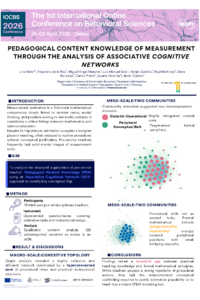
PEDAGOGICAL CONTENT KNOWLEDGE OF MEASUREMENT THROUGH THE ANALYSIS OF ASSOCIATIVE COGNITIVE NETWORKS.pdf
Integrative Insights into ODD: Neurocognitive and Social Mechanisms
Real-Time Modulation of Cerebral Blood Flow by tDCS During a Cognitive Task