Event submissions
Published
This submission belongs to the session S2. Cognition of the event The 1st International Online Conference on Behavioral Sciences
Published date
27 Mar, 2026
Academic Editor
'%3e%3cpath%20d='M12.6657%2010.9104C12.4185%2010.325%2012.0599%209.79327%2011.6097%209.34482C11.1609%208.89508%2010.6293%208.5365%2010.0442%208.28888C10.0389%208.28626%2010.0337%208.28495%2010.0285%208.28233C10.8446%207.69279%2011.3752%206.73249%2011.3752%205.64904C11.3752%203.8542%209.92103%202.39999%208.1262%202.39999C6.33136%202.39999%204.87715%203.8542%204.87715%205.64904C4.87715%206.73249%205.40774%207.69279%206.22393%208.28364C6.21869%208.28626%206.21345%208.28757%206.20821%208.29019C5.62129%208.5378%205.09463%208.89284%204.64265%209.34613C4.1929%209.79493%203.83432%2010.3266%203.58671%2010.9117C3.34345%2011.4845%203.21226%2012.0987%203.20023%2012.7209C3.19988%2012.7349%203.20233%2012.7488%203.20744%2012.7619C3.21255%2012.7749%203.22022%2012.7867%203.22998%2012.7968C3.23975%2012.8068%203.25142%2012.8147%203.26431%2012.8202C3.2772%2012.8256%203.29105%2012.8284%203.30504%2012.8284H4.09109C4.14874%2012.8284%204.19459%2012.7825%204.1959%2012.7262C4.2221%2011.7148%204.62823%2010.7676%205.34617%2010.0497C6.08899%209.30683%207.0755%208.89808%208.1262%208.89808C9.17689%208.89808%2010.1634%209.30683%2010.9062%2010.0497C11.6242%2010.7676%2012.0303%2011.7148%2012.0565%2012.7262C12.0578%2012.7838%2012.1037%2012.8284%2012.1613%2012.8284H12.9474C12.9613%2012.8284%2012.9752%2012.8256%2012.9881%2012.8202C13.001%2012.8147%2013.0126%2012.8068%2013.0224%2012.7968C13.0322%2012.7867%2013.0398%2012.7749%2013.0449%2012.7619C13.0501%2012.7488%2013.0525%2012.7349%2013.0522%2012.7209C13.0391%2012.0947%2012.9094%2011.4855%2012.6657%2010.9104ZM8.1262%207.9024C7.52486%207.9024%206.9589%207.6679%206.53312%207.24211C6.10733%206.81633%205.87283%206.25037%205.87283%205.64904C5.87283%205.0477%206.10733%204.48174%206.53312%204.05596C6.9589%203.63018%207.52486%203.39567%208.1262%203.39567C8.72753%203.39567%209.29349%203.63018%209.71927%204.05596C10.1451%204.48174%2010.3796%205.0477%2010.3796%205.64904C10.3796%206.25037%2010.1451%206.81633%209.71927%207.24211C9.29349%207.6679%208.72753%207.9024%208.1262%207.9024Z'%20fill='%235D1EE1'/%3e%3c/g%3e%3c/svg%3e) John Parkinson
John ParkinsonCitation
Casandra I. Montoro Aguilar, Pilar Ruiz-Medina, Stefan Duschek, Gustavo Adolfo Reyes del Paso, Real-Time Modulation of Cerebral Blood Flow by tDCS During a Cognitive Task, in Proceedings of The 1st International Online Conference on Behavioral Sciences, 1 April–3 April 2026, MDPI: Basel, Switzerland
Share
Email
Facebook
Twitter
LinkedIn
Real-Time Modulation of Cerebral Blood Flow by tDCS During a Cognitive Task
'%3e%3cpath%20d='M12.6647%2010.9104C12.4176%2010.325%2012.0589%209.7933%2011.6088%209.34485C11.16%208.89511%2010.6283%208.53653%2010.0432%208.28891C10.038%208.28629%2010.0327%208.28498%2010.0275%208.28236C10.8437%207.69282%2011.3743%206.73252%2011.3743%205.64907C11.3743%203.85423%209.92005%202.40002%208.12522%202.40002C6.33038%202.40002%204.87618%203.85423%204.87618%205.64907C4.87618%206.73252%205.40677%207.69282%206.22296%208.28367C6.21772%208.28629%206.21248%208.2876%206.20724%208.29022C5.62031%208.53783%205.09365%208.89287%204.64167%209.34616C4.19192%209.79496%203.83334%2010.3266%203.58573%2010.9117C3.34247%2011.4846%203.21128%2012.0987%203.19925%2012.721C3.1989%2012.735%203.20135%2012.7489%203.20646%2012.7619C3.21157%2012.7749%203.21924%2012.7868%203.22901%2012.7968C3.23877%2012.8068%203.25045%2012.8148%203.26334%2012.8202C3.27623%2012.8256%203.29007%2012.8284%203.30406%2012.8284H4.09012C4.14776%2012.8284%204.19362%2012.7825%204.19493%2012.7262C4.22113%2011.7148%204.62726%2010.7676%205.34519%2010.0497C6.08802%209.30686%207.07452%208.89811%208.12522%208.89811C9.17592%208.89811%2010.1624%209.30686%2010.9052%2010.0497C11.6232%2010.7676%2012.0293%2011.7148%2012.0555%2012.7262C12.0568%2012.7839%2012.1027%2012.8284%2012.1603%2012.8284H12.9464C12.9604%2012.8284%2012.9742%2012.8256%2012.9871%2012.8202C13%2012.8148%2013.0117%2012.8068%2013.0214%2012.7968C13.0312%2012.7868%2013.0389%2012.7749%2013.044%2012.7619C13.0491%2012.7489%2013.0515%2012.735%2013.0512%2012.721C13.0381%2012.0947%2012.9084%2011.4856%2012.6647%2010.9104ZM8.12522%207.90243C7.52388%207.90243%206.95792%207.66793%206.53214%207.24215C6.10636%206.81636%205.87185%206.2504%205.87185%205.64907C5.87185%205.04773%206.10636%204.48177%206.53214%204.05599C6.95792%203.63021%207.52388%203.3957%208.12522%203.3957C8.72655%203.3957%209.29252%203.63021%209.7183%204.05599C10.1441%204.48177%2010.3786%205.04773%2010.3786%205.64907C10.3786%206.2504%2010.1441%206.81636%209.7183%207.24215C9.29252%207.66793%208.72655%207.90243%208.12522%207.90243Z'%20fill='%235D1EE1'/%3e%3c/g%3e%3c/svg%3e)
Casandra I. Montoro Aguilar 1
Pilar Ruiz-Medina 1
Stefan Duschek 2
Gustavo Adolfo Reyes del Paso 1
1. Department of Psychology, Faculty of Humanities and Education Sciences, University of Jaén, Jaén, 23071, Spain
2. Department of Psychology and Medical Sciences, UMIT – Private University for Health Sciences, Medical Informatics and Technology, Hall in Tirol, 6060, Austria
Abstract
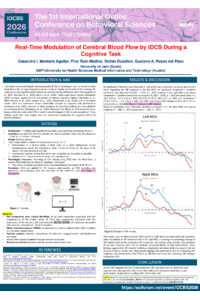
Transcranial direct current stimulation (tDCS) has shown promise for enhancing cognition, yet its underlying mechanisms remain poorly understood, limiting its clinical application. To gain deeper insight into these mechanisms, we conducted a study combining tDCS with continuous monitoring of cerebral blood flow (CBF) using Doppler ultrasonography during a cognitive task. Thirty-five right-handed participants were randomly assigned to receive 20 minutes of active or sham tDCS over the left inferior parietal cortex, followed by a mental arithmetic task. CBF in the middle cerebral arteries (MCA) was continuously recorded throughout the task. Velocity signals revealed three distinct phases: an early increase coinciding with stimulus presentation, a secondary peak approximately 5 seconds later, and a gradual decline below baseline. Peak amplitudes were analyzed within defined time windows (5–6 s, 14–18 s, 21–24 s). Preliminary results indicate that active tDCS enhanced the early CBF response bilaterally, while the late response in the right MCA was attenuated compared to sham. These findings suggest that tDCS may facilitate arithmetic performance by amplifying preparatory activation and suppressing irrelevant neural activity, thereby focusing resources on task-relevant regions supplied by the left MCA. Furthermore, this study demonstrates that Doppler ultrasonography provides a reliable, real-time measure of neurovascular changes induced by tDCS, offering a valuable window into its underlying mechanisms. Overall, these results support the notion that tDCS can modulate distributed brain networks to optimize cognitive function, highlighting its potential for targeted cognitive enhancement interventions.
Keywords
Transcranial Direct Current Stimulation (tDCS)
Cerebral Blood Flow (CBF)
Doppler Ultrasonography
Cognitive Task
Mental Arithmetic
Neurovascular Modulation
Middle Cerebral Artery (MCA)
Brain Networks
Poster
v1_ Poster_Sciforum_Doppler (1).pdf
Pedagogical Content Knowledge of Measurement through the Analysis of Associative Cognitive Networks
Emotional Mechanisms of Oppositional Defiant Disorder (ODD) in Adults: Links to Functional Impairment