Event submissions
Published
This submission belongs to the session S3. Developmental Psychology of the event The 1st International Online Conference on Behavioral Sciences
Published date
27 Mar, 2026
Academic Editor
'%3e%3cpath%20d='M12.6657%2010.9104C12.4185%2010.325%2012.0599%209.79327%2011.6097%209.34482C11.1609%208.89508%2010.6293%208.5365%2010.0442%208.28888C10.0389%208.28626%2010.0337%208.28495%2010.0285%208.28233C10.8446%207.69279%2011.3752%206.73249%2011.3752%205.64904C11.3752%203.8542%209.92103%202.39999%208.1262%202.39999C6.33136%202.39999%204.87715%203.8542%204.87715%205.64904C4.87715%206.73249%205.40774%207.69279%206.22393%208.28364C6.21869%208.28626%206.21345%208.28757%206.20821%208.29019C5.62129%208.5378%205.09463%208.89284%204.64265%209.34613C4.1929%209.79493%203.83432%2010.3266%203.58671%2010.9117C3.34345%2011.4845%203.21226%2012.0987%203.20023%2012.7209C3.19988%2012.7349%203.20233%2012.7488%203.20744%2012.7619C3.21255%2012.7749%203.22022%2012.7867%203.22998%2012.7968C3.23975%2012.8068%203.25142%2012.8147%203.26431%2012.8202C3.2772%2012.8256%203.29105%2012.8284%203.30504%2012.8284H4.09109C4.14874%2012.8284%204.19459%2012.7825%204.1959%2012.7262C4.2221%2011.7148%204.62823%2010.7676%205.34617%2010.0497C6.08899%209.30683%207.0755%208.89808%208.1262%208.89808C9.17689%208.89808%2010.1634%209.30683%2010.9062%2010.0497C11.6242%2010.7676%2012.0303%2011.7148%2012.0565%2012.7262C12.0578%2012.7838%2012.1037%2012.8284%2012.1613%2012.8284H12.9474C12.9613%2012.8284%2012.9752%2012.8256%2012.9881%2012.8202C13.001%2012.8147%2013.0126%2012.8068%2013.0224%2012.7968C13.0322%2012.7867%2013.0398%2012.7749%2013.0449%2012.7619C13.0501%2012.7488%2013.0525%2012.7349%2013.0522%2012.7209C13.0391%2012.0947%2012.9094%2011.4855%2012.6657%2010.9104ZM8.1262%207.9024C7.52486%207.9024%206.9589%207.6679%206.53312%207.24211C6.10733%206.81633%205.87283%206.25037%205.87283%205.64904C5.87283%205.0477%206.10733%204.48174%206.53312%204.05596C6.9589%203.63018%207.52486%203.39567%208.1262%203.39567C8.72753%203.39567%209.29349%203.63018%209.71927%204.05596C10.1451%204.48174%2010.3796%205.0477%2010.3796%205.64904C10.3796%206.25037%2010.1451%206.81633%209.71927%207.24211C9.29349%207.6679%208.72753%207.9024%208.1262%207.9024Z'%20fill='%235D1EE1'/%3e%3c/g%3e%3c/svg%3e) Stacey Neuharth-Pritchett
Stacey Neuharth-PritchettCitation
Jesús Martínez-Calvo, Diego Diaz-Milanes, Jose Manuel Guerra, Psychometric Evaluation of a Spanish Telepressure Measure in Primary School Students, in Proceedings of The 1st International Online Conference on Behavioral Sciences, 1 April–3 April 2026, MDPI: Basel, Switzerland
Share
Email
Facebook
Twitter
LinkedIn
Psychometric Evaluation of a Spanish Telepressure Measure in Primary School Students
'%3e%3cpath%20d='M12.6647%2010.9104C12.4176%2010.325%2012.0589%209.7933%2011.6088%209.34485C11.16%208.89511%2010.6283%208.53653%2010.0432%208.28891C10.038%208.28629%2010.0327%208.28498%2010.0275%208.28236C10.8437%207.69282%2011.3743%206.73252%2011.3743%205.64907C11.3743%203.85423%209.92005%202.40002%208.12522%202.40002C6.33038%202.40002%204.87618%203.85423%204.87618%205.64907C4.87618%206.73252%205.40677%207.69282%206.22296%208.28367C6.21772%208.28629%206.21248%208.2876%206.20724%208.29022C5.62031%208.53783%205.09365%208.89287%204.64167%209.34616C4.19192%209.79496%203.83334%2010.3266%203.58573%2010.9117C3.34247%2011.4846%203.21128%2012.0987%203.19925%2012.721C3.1989%2012.735%203.20135%2012.7489%203.20646%2012.7619C3.21157%2012.7749%203.21924%2012.7868%203.22901%2012.7968C3.23877%2012.8068%203.25045%2012.8148%203.26334%2012.8202C3.27623%2012.8256%203.29007%2012.8284%203.30406%2012.8284H4.09012C4.14776%2012.8284%204.19362%2012.7825%204.19493%2012.7262C4.22113%2011.7148%204.62726%2010.7676%205.34519%2010.0497C6.08802%209.30686%207.07452%208.89811%208.12522%208.89811C9.17592%208.89811%2010.1624%209.30686%2010.9052%2010.0497C11.6232%2010.7676%2012.0293%2011.7148%2012.0555%2012.7262C12.0568%2012.7839%2012.1027%2012.8284%2012.1603%2012.8284H12.9464C12.9604%2012.8284%2012.9742%2012.8256%2012.9871%2012.8202C13%2012.8148%2013.0117%2012.8068%2013.0214%2012.7968C13.0312%2012.7868%2013.0389%2012.7749%2013.044%2012.7619C13.0491%2012.7489%2013.0515%2012.735%2013.0512%2012.721C13.0381%2012.0947%2012.9084%2011.4856%2012.6647%2010.9104ZM8.12522%207.90243C7.52388%207.90243%206.95792%207.66793%206.53214%207.24215C6.10636%206.81636%205.87185%206.2504%205.87185%205.64907C5.87185%205.04773%206.10636%204.48177%206.53214%204.05599C6.95792%203.63021%207.52388%203.3957%208.12522%203.3957C8.72655%203.3957%209.29252%203.63021%209.7183%204.05599C10.1441%204.48177%2010.3786%205.04773%2010.3786%205.64907C10.3786%206.2504%2010.1441%206.81636%209.7183%207.24215C9.29252%207.66793%208.72655%207.90243%208.12522%207.90243Z'%20fill='%235D1EE1'/%3e%3c/g%3e%3c/svg%3e)
Jesús Martínez-Calvo 1
Diego Diaz-Milanes 1,2

Jose Manuel Guerra 3
1. Department of Quantitative Methods, Universidad Loyola Andalucía, Seville, Spain
2. Health Research Institute, University of Canberra, Canberra, Australia
3. Department of Social Psychology, University of Seville, Seville, Spain
Abstract
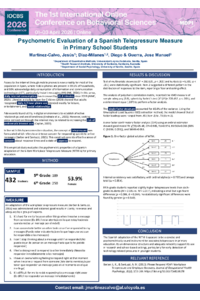
Introduction: Telepressure—the perceived urge to respond quickly to digital messages—may undermine students’ attention and well-being, yet brief validated tools are limited in school settings. This empirical study evaluates the psychometric properties of a Spanish adaptation of the 6-item Workplace Telepressure Measure (WTM-6) for primary education. Materials and Methods: Participants were 439 Spanish primary students (5th grade n=189; 6th grade n=250; 53.99% females) who completed the WTM-6 on a 1–5 Likert scale. Factorability was assessed using the Kaiser–Meyer–Olkin (KMO) index and Bartlett’s test. Dimensionality was examined with multiple factor-retention procedures and then tested with a one-factor confirmatory factor analysis (CFA) using an ordinal estimator. Model fit was evaluated with χ², CFI, TLI, RMSEA (90% CI), and SRMR. Internal consistency was estimated with ordinal alpha, split-half reliability, and omega total. Group differences by gender and grade were examined using independent-sample t-tests with Cohen’s d. Results and Discussion: The data were suitable for factor analysis (KMO=0.800; Bartlett χ²(15)=728.45, p<.001). Retention criteria converged on a single latent factor. The one-factor CFA showed good fit: χ²(9)=25.48, CFI=0.985, TLI=0.974, RMSEA=0.065 (90% CI [0.036, 0.095]), and SRMR=0.053. Reliability was satisfactory in the total sample (ordinal α =0.797; ω=0.854). Telepressure did not differ by gender (total score p=0.540), but 5th-grade students reported slightly higher telepressure than 6th-grade students (M=2.595 vs 2.377; p=0.006; d=0.264). These findings support the use of the adapted WTM-6 as a brief, reliable measure of telepressure in primary educational contexts.
Keywords
telepressure
psychometric
primary school
smartphone
instant messaging
Poster
Poster MPDI Congress.pdf
When and How do Iconic Gestures Impact Early Word Learning?
Cognitive Correlates of Language Performance in Tunisian Dyslexic Pupils