Event submissions
Published
This submission belongs to the session S9. Experimental and Clinical Neurosciences of the event The 1st International Online Conference on Behavioral Sciences
Published date
27 Mar, 2026
Academic Editor
'%3e%3cpath%20d='M12.6657%2010.9104C12.4185%2010.325%2012.0599%209.79327%2011.6097%209.34482C11.1609%208.89508%2010.6293%208.5365%2010.0442%208.28888C10.0389%208.28626%2010.0337%208.28495%2010.0285%208.28233C10.8446%207.69279%2011.3752%206.73249%2011.3752%205.64904C11.3752%203.8542%209.92103%202.39999%208.1262%202.39999C6.33136%202.39999%204.87715%203.8542%204.87715%205.64904C4.87715%206.73249%205.40774%207.69279%206.22393%208.28364C6.21869%208.28626%206.21345%208.28757%206.20821%208.29019C5.62129%208.5378%205.09463%208.89284%204.64265%209.34613C4.1929%209.79493%203.83432%2010.3266%203.58671%2010.9117C3.34345%2011.4845%203.21226%2012.0987%203.20023%2012.7209C3.19988%2012.7349%203.20233%2012.7488%203.20744%2012.7619C3.21255%2012.7749%203.22022%2012.7867%203.22998%2012.7968C3.23975%2012.8068%203.25142%2012.8147%203.26431%2012.8202C3.2772%2012.8256%203.29105%2012.8284%203.30504%2012.8284H4.09109C4.14874%2012.8284%204.19459%2012.7825%204.1959%2012.7262C4.2221%2011.7148%204.62823%2010.7676%205.34617%2010.0497C6.08899%209.30683%207.0755%208.89808%208.1262%208.89808C9.17689%208.89808%2010.1634%209.30683%2010.9062%2010.0497C11.6242%2010.7676%2012.0303%2011.7148%2012.0565%2012.7262C12.0578%2012.7838%2012.1037%2012.8284%2012.1613%2012.8284H12.9474C12.9613%2012.8284%2012.9752%2012.8256%2012.9881%2012.8202C13.001%2012.8147%2013.0126%2012.8068%2013.0224%2012.7968C13.0322%2012.7867%2013.0398%2012.7749%2013.0449%2012.7619C13.0501%2012.7488%2013.0525%2012.7349%2013.0522%2012.7209C13.0391%2012.0947%2012.9094%2011.4855%2012.6657%2010.9104ZM8.1262%207.9024C7.52486%207.9024%206.9589%207.6679%206.53312%207.24211C6.10733%206.81633%205.87283%206.25037%205.87283%205.64904C5.87283%205.0477%206.10733%204.48174%206.53312%204.05596C6.9589%203.63018%207.52486%203.39567%208.1262%203.39567C8.72753%203.39567%209.29349%203.63018%209.71927%204.05596C10.1451%204.48174%2010.3796%205.0477%2010.3796%205.64904C10.3796%206.25037%2010.1451%206.81633%209.71927%207.24211C9.29349%207.6679%208.72753%207.9024%208.1262%207.9024Z'%20fill='%235D1EE1'/%3e%3c/g%3e%3c/svg%3e) Bin Hu
Bin HuCitation
Casandra I. Montoro Aguilar, Pilar Ruiz-Medina, Laura Fischer-Jbali, Gustavo Adolfo Reyes del Paso, Alterations in Emotional Processing in Fibromyalgia Syndrome: Event-Related Potentials and Modulatory Effects of tDCS, in Proceedings of The 1st International Online Conference on Behavioral Sciences, 1 April–3 April 2026, MDPI: Basel, Switzerland
Share
Email
Facebook
Twitter
LinkedIn
Alterations in Emotional Processing in Fibromyalgia Syndrome: Event-Related Potentials and Modulatory Effects of tDCS
'%3e%3cpath%20d='M12.6647%2010.9104C12.4176%2010.325%2012.0589%209.7933%2011.6088%209.34485C11.16%208.89511%2010.6283%208.53653%2010.0432%208.28891C10.038%208.28629%2010.0327%208.28498%2010.0275%208.28236C10.8437%207.69282%2011.3743%206.73252%2011.3743%205.64907C11.3743%203.85423%209.92005%202.40002%208.12522%202.40002C6.33038%202.40002%204.87618%203.85423%204.87618%205.64907C4.87618%206.73252%205.40677%207.69282%206.22296%208.28367C6.21772%208.28629%206.21248%208.2876%206.20724%208.29022C5.62031%208.53783%205.09365%208.89287%204.64167%209.34616C4.19192%209.79496%203.83334%2010.3266%203.58573%2010.9117C3.34247%2011.4846%203.21128%2012.0987%203.19925%2012.721C3.1989%2012.735%203.20135%2012.7489%203.20646%2012.7619C3.21157%2012.7749%203.21924%2012.7868%203.22901%2012.7968C3.23877%2012.8068%203.25045%2012.8148%203.26334%2012.8202C3.27623%2012.8256%203.29007%2012.8284%203.30406%2012.8284H4.09012C4.14776%2012.8284%204.19362%2012.7825%204.19493%2012.7262C4.22113%2011.7148%204.62726%2010.7676%205.34519%2010.0497C6.08802%209.30686%207.07452%208.89811%208.12522%208.89811C9.17592%208.89811%2010.1624%209.30686%2010.9052%2010.0497C11.6232%2010.7676%2012.0293%2011.7148%2012.0555%2012.7262C12.0568%2012.7839%2012.1027%2012.8284%2012.1603%2012.8284H12.9464C12.9604%2012.8284%2012.9742%2012.8256%2012.9871%2012.8202C13%2012.8148%2013.0117%2012.8068%2013.0214%2012.7968C13.0312%2012.7868%2013.0389%2012.7749%2013.044%2012.7619C13.0491%2012.7489%2013.0515%2012.735%2013.0512%2012.721C13.0381%2012.0947%2012.9084%2011.4856%2012.6647%2010.9104ZM8.12522%207.90243C7.52388%207.90243%206.95792%207.66793%206.53214%207.24215C6.10636%206.81636%205.87185%206.2504%205.87185%205.64907C5.87185%205.04773%206.10636%204.48177%206.53214%204.05599C6.95792%203.63021%207.52388%203.3957%208.12522%203.3957C8.72655%203.3957%209.29252%203.63021%209.7183%204.05599C10.1441%204.48177%2010.3786%205.04773%2010.3786%205.64907C10.3786%206.2504%2010.1441%206.81636%209.7183%207.24215C9.29252%207.66793%208.72655%207.90243%208.12522%207.90243Z'%20fill='%235D1EE1'/%3e%3c/g%3e%3c/svg%3e)
Casandra I. Montoro Aguilar 1
Pilar Ruiz-Medina 1
Laura Fischer-Jbali 2
Gustavo Adolfo Reyes del Paso 1
1. Department of Psychology, Faculty of Humanities and Education Sciences, University of Jaén, Jaén, 23071, Spain
2. Department of Clinical Psychology, Psychology Institute, University of Innsbruck, Innsbruck, 6020, Austria
Abstract
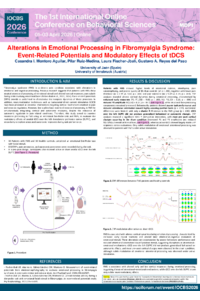
Introduction: Fibromyalgia syndrome (FMS) is characterized by chronic widespread pain, altered emotional processing, and central sensitization, which may share neurophysiological mechanisms. Transcranial direct current stimulation (tDCS) shows potential to modulate these disturbances, yet few studies have assessed its effects on emotional and cognitive processing using objective neurophysiological measures. Methods: We examined emotional processing, pain, and central sensitization, as well as the effects of tDCS over the left dorsolateral prefrontal cortex, in FMS patients and healthy controls. Participants completed the dot-probe task twice with neutral, happy, anger, and pain-related images while event-related potentials (ERPs) were recorded with electroencephalography (EEG). Between sessions, anodal or sham tDCS was applied. Pain threshold, tolerance, and central sensitization were also assessed. Results: At baseline, FMS patients exhibited increased N1, N170, and N250 amplitudes and reduced P1, P3, P5, and P6 amplitudes in frontal and centro-parietal regions relative to controls. After sham, P1, P3, and P5 increased and N170 and N250 decreased across the sample, whereas these components remained stable after tDCS, except for P3 and N250 responses to pain images at centro-parietal sites, showing opposite effects to sham. Minor frontal differences in sham effects were observed between groups. Sequential processing delays from fronto-central to parieto-occipital regions were also noted. In patients, higher pain and greater central sensitization were associated with increased amplitudes of P1, P3, N1, N170, and N250 for both pain and anger images. Conclusions: FMS patients show early hyper-reactivity and altered attentional processing, with reduced late evaluative responses and compensatory increases in early attentional and facial encoding processes. tDCS selectively enhanced intermediate affective recognition (↑N250) while reducing attentional/evaluative demands (↓P3) for pain images. Patients with higher pain and central sensitization levels exhibited compensatory cortical hyperactivation, highlighting tDCS as a promising tool to modulate neural processing of pain-related and emotional stimuli in FMS.
Keywords
Fibromyalgia Syndrome (FMS)
Emotional Processing
Pain
Central Sensitization
Transcranial Direct Current Stimulation (tDCS)
EEG
Event-Related Potentials (ERP)
Poster
v1_ Poster_Sciforum_EEG-2.pdf
How Psychological Experiences Shape Metaverse Adoption in Professional Settings: Evidence from China
Reflection of phobic scenarios in virtual reality based on EEG data and intelligent video streaming