Event submissions
Published
This submission belongs to the session S6. Health Psychology of the event The 1st International Online Conference on Behavioral Sciences
Published date
27 Mar, 2026
Academic Editor
'%3e%3cpath%20d='M12.6657%2010.9104C12.4185%2010.325%2012.0599%209.79327%2011.6097%209.34482C11.1609%208.89508%2010.6293%208.5365%2010.0442%208.28888C10.0389%208.28626%2010.0337%208.28495%2010.0285%208.28233C10.8446%207.69279%2011.3752%206.73249%2011.3752%205.64904C11.3752%203.8542%209.92103%202.39999%208.1262%202.39999C6.33136%202.39999%204.87715%203.8542%204.87715%205.64904C4.87715%206.73249%205.40774%207.69279%206.22393%208.28364C6.21869%208.28626%206.21345%208.28757%206.20821%208.29019C5.62129%208.5378%205.09463%208.89284%204.64265%209.34613C4.1929%209.79493%203.83432%2010.3266%203.58671%2010.9117C3.34345%2011.4845%203.21226%2012.0987%203.20023%2012.7209C3.19988%2012.7349%203.20233%2012.7488%203.20744%2012.7619C3.21255%2012.7749%203.22022%2012.7867%203.22998%2012.7968C3.23975%2012.8068%203.25142%2012.8147%203.26431%2012.8202C3.2772%2012.8256%203.29105%2012.8284%203.30504%2012.8284H4.09109C4.14874%2012.8284%204.19459%2012.7825%204.1959%2012.7262C4.2221%2011.7148%204.62823%2010.7676%205.34617%2010.0497C6.08899%209.30683%207.0755%208.89808%208.1262%208.89808C9.17689%208.89808%2010.1634%209.30683%2010.9062%2010.0497C11.6242%2010.7676%2012.0303%2011.7148%2012.0565%2012.7262C12.0578%2012.7838%2012.1037%2012.8284%2012.1613%2012.8284H12.9474C12.9613%2012.8284%2012.9752%2012.8256%2012.9881%2012.8202C13.001%2012.8147%2013.0126%2012.8068%2013.0224%2012.7968C13.0322%2012.7867%2013.0398%2012.7749%2013.0449%2012.7619C13.0501%2012.7488%2013.0525%2012.7349%2013.0522%2012.7209C13.0391%2012.0947%2012.9094%2011.4855%2012.6657%2010.9104ZM8.1262%207.9024C7.52486%207.9024%206.9589%207.6679%206.53312%207.24211C6.10733%206.81633%205.87283%206.25037%205.87283%205.64904C5.87283%205.0477%206.10733%204.48174%206.53312%204.05596C6.9589%203.63018%207.52486%203.39567%208.1262%203.39567C8.72753%203.39567%209.29349%203.63018%209.71927%204.05596C10.1451%204.48174%2010.3796%205.0477%2010.3796%205.64904C10.3796%206.25037%2010.1451%206.81633%209.71927%207.24211C9.29349%207.6679%208.72753%207.9024%208.1262%207.9024Z'%20fill='%235D1EE1'/%3e%3c/g%3e%3c/svg%3e) Andrew Soundy
Andrew SoundyCitation
Monica Tarcea, Anamaria Hambetiu, Liana Contiu, Tiberiu Szekely, Calin Craciun, Empathy and Cognitive Behavior Therapy in Oncology—strategies for intervention, in Proceedings of The 1st International Online Conference on Behavioral Sciences, 1 April–3 April 2026, MDPI: Basel, Switzerland
Share
Email
Facebook
Twitter
LinkedIn
Empathy and Cognitive Behavior Therapy in Oncology—strategies for intervention

Monica Tarcea 1
'%3e%3cpath%20d='M12.6647%2010.9104C12.4176%2010.325%2012.0589%209.7933%2011.6088%209.34485C11.16%208.89511%2010.6283%208.53653%2010.0432%208.28891C10.038%208.28629%2010.0327%208.28498%2010.0275%208.28236C10.8437%207.69282%2011.3743%206.73252%2011.3743%205.64907C11.3743%203.85423%209.92005%202.40002%208.12522%202.40002C6.33038%202.40002%204.87618%203.85423%204.87618%205.64907C4.87618%206.73252%205.40677%207.69282%206.22296%208.28367C6.21772%208.28629%206.21248%208.2876%206.20724%208.29022C5.62031%208.53783%205.09365%208.89287%204.64167%209.34616C4.19192%209.79496%203.83334%2010.3266%203.58573%2010.9117C3.34247%2011.4846%203.21128%2012.0987%203.19925%2012.721C3.1989%2012.735%203.20135%2012.7489%203.20646%2012.7619C3.21157%2012.7749%203.21924%2012.7868%203.22901%2012.7968C3.23877%2012.8068%203.25045%2012.8148%203.26334%2012.8202C3.27623%2012.8256%203.29007%2012.8284%203.30406%2012.8284H4.09012C4.14776%2012.8284%204.19362%2012.7825%204.19493%2012.7262C4.22113%2011.7148%204.62726%2010.7676%205.34519%2010.0497C6.08802%209.30686%207.07452%208.89811%208.12522%208.89811C9.17592%208.89811%2010.1624%209.30686%2010.9052%2010.0497C11.6232%2010.7676%2012.0293%2011.7148%2012.0555%2012.7262C12.0568%2012.7839%2012.1027%2012.8284%2012.1603%2012.8284H12.9464C12.9604%2012.8284%2012.9742%2012.8256%2012.9871%2012.8202C13%2012.8148%2013.0117%2012.8068%2013.0214%2012.7968C13.0312%2012.7868%2013.0389%2012.7749%2013.044%2012.7619C13.0491%2012.7489%2013.0515%2012.735%2013.0512%2012.721C13.0381%2012.0947%2012.9084%2011.4856%2012.6647%2010.9104ZM8.12522%207.90243C7.52388%207.90243%206.95792%207.66793%206.53214%207.24215C6.10636%206.81636%205.87185%206.2504%205.87185%205.64907C5.87185%205.04773%206.10636%204.48177%206.53214%204.05599C6.95792%203.63021%207.52388%203.3957%208.12522%203.3957C8.72655%203.3957%209.29252%203.63021%209.7183%204.05599C10.1441%204.48177%2010.3786%205.04773%2010.3786%205.64907C10.3786%206.2504%2010.1441%206.81636%209.7183%207.24215C9.29252%207.66793%208.72655%207.90243%208.12522%207.90243Z'%20fill='%235D1EE1'/%3e%3c/g%3e%3c/svg%3e)
Anamaria Hambetiu 2
Liana Contiu 2
Tiberiu Szekely 3
Calin Craciun 4
1. Department of Community Nutrition, Faculty of Medicine, “George Emil Palade” University of Medicine, Pharmacy, Science and Technology of Târgu Mures, 540142 Târgu Mures, Romania
2. PhD School, Faculty of Medicine, “George Emil Palade” University of Medicine, Pharmacy, Science and Technology of Târgu Mures, 540142 Târgu Mures, Romania
3. Department of Oncology, Faculty of Medicine, “George Emil Palade” University of Medicine, Pharmacy, Science and Technology of Târgu Mures, 540142 Târgu Mures, Romania
4. Department of General Surgery no 3, Faculty of Medicine, G.E. Palade University of Medicine, Pharmacy, Science and Technology from Targu-Mures, Romania
Abstract
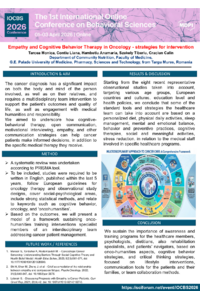
Introduction: Cancer diagnosis has a significant impact on both the body and mind of the person involved, as well as on their relatives, and requires multidisciplinary team intervention to support the patient's outcomes and quality of life, as well as engagement with medical humanities and responsibility. We aimed to underscore in what manner cognitive–behavioral therapy, open communication, empathy, motivational interviewing, and other communication strategies can make a difference and help cancer patients make informed decisions, in addition to the specific medical therapy they receive.
Methods: A systematic review was undertaken according to PRISMA guidelines. To be included, studies were required to be written in English, published in the last five years, follow European guidelines for oncology therapy and observational study designs, cover social–psychological areas, include strong statistics, and relate to keywords such as cognitive behavior, oncology, and oncohumanities. Based on the outcomes, we will present a model of a framework sustaining onco-humanities training interventions for students and specialist members of an interdisciplinary team addressing cancer patient management.
Results: Starting from the eight recent representative observational studies taken into account, targeting various age groups, European countries and cultures, education level and health policies, we conclude that some of the standard tools and strategies the healthcare team can take into account are based on a personalized diet, physical daily activities, sleep management, mental and emotional balance, behavior and preventive practices, cognitive therapies, social and meaningful activities, and stress reduction, in relation to the medical staff involved in specific healthcare programs.
Conclusions: We sustain the importance of awareness and training programs for the healthcare members, psychologists, dietitians, kinetotherapists, and patients’ navigators, based on onco-humanities aspects, cognitive behavior strategies, and critical thinking strategies, focused on lifestyle interventions, communication tools for the patients and their families, or team collaboration methods.
Keywords
behavior
communication
cancer
empathy
strategies
Poster
Poster_CBS_Tarcea Monica.pdf
Central Sensitization as a Predictor of Poor Outcomes After Peripheral Treatments in Chronic Pain: A Systematic Review and Meta-Analysis
Democratizing Urban Well-being: Virtual Biophilic Interventions Mitigate Socioeconomic Disparities in Environmental Perception and Affect