Event submissions
Published
This submission belongs to the session S5. Photoluminescent Materials of the event The 1st International Online Conference on Photochemistry
Published date
03 Apr, 2026
Academic Editor
'%3e%3cpath%20d='M12.6657%2010.9104C12.4185%2010.325%2012.0599%209.79327%2011.6097%209.34482C11.1609%208.89508%2010.6293%208.5365%2010.0442%208.28888C10.0389%208.28626%2010.0337%208.28495%2010.0285%208.28233C10.8446%207.69279%2011.3752%206.73249%2011.3752%205.64904C11.3752%203.8542%209.92103%202.39999%208.1262%202.39999C6.33136%202.39999%204.87715%203.8542%204.87715%205.64904C4.87715%206.73249%205.40774%207.69279%206.22393%208.28364C6.21869%208.28626%206.21345%208.28757%206.20821%208.29019C5.62129%208.5378%205.09463%208.89284%204.64265%209.34613C4.1929%209.79493%203.83432%2010.3266%203.58671%2010.9117C3.34345%2011.4845%203.21226%2012.0987%203.20023%2012.7209C3.19988%2012.7349%203.20233%2012.7488%203.20744%2012.7619C3.21255%2012.7749%203.22022%2012.7867%203.22998%2012.7968C3.23975%2012.8068%203.25142%2012.8147%203.26431%2012.8202C3.2772%2012.8256%203.29105%2012.8284%203.30504%2012.8284H4.09109C4.14874%2012.8284%204.19459%2012.7825%204.1959%2012.7262C4.2221%2011.7148%204.62823%2010.7676%205.34617%2010.0497C6.08899%209.30683%207.0755%208.89808%208.1262%208.89808C9.17689%208.89808%2010.1634%209.30683%2010.9062%2010.0497C11.6242%2010.7676%2012.0303%2011.7148%2012.0565%2012.7262C12.0578%2012.7838%2012.1037%2012.8284%2012.1613%2012.8284H12.9474C12.9613%2012.8284%2012.9752%2012.8256%2012.9881%2012.8202C13.001%2012.8147%2013.0126%2012.8068%2013.0224%2012.7968C13.0322%2012.7867%2013.0398%2012.7749%2013.0449%2012.7619C13.0501%2012.7488%2013.0525%2012.7349%2013.0522%2012.7209C13.0391%2012.0947%2012.9094%2011.4855%2012.6657%2010.9104ZM8.1262%207.9024C7.52486%207.9024%206.9589%207.6679%206.53312%207.24211C6.10733%206.81633%205.87283%206.25037%205.87283%205.64904C5.87283%205.0477%206.10733%204.48174%206.53312%204.05596C6.9589%203.63018%207.52486%203.39567%208.1262%203.39567C8.72753%203.39567%209.29349%203.63018%209.71927%204.05596C10.1451%204.48174%2010.3796%205.0477%2010.3796%205.64904C10.3796%206.25037%2010.1451%206.81633%209.71927%207.24211C9.29349%207.6679%208.72753%207.9024%208.1262%207.9024Z'%20fill='%235D1EE1'/%3e%3c/g%3e%3c/svg%3e) Dirk Poelman
Dirk PoelmanCitation
Rutu Patel, Vasanti Suvarna, Development of Sulfur- and nitrogen-doped carbon dots (S,N-CDs) dual biosensor from Ricinus communis (castor) seeds for the estimation of Protamine and Uric acid in biological samples, in Proceedings of The 1st International Online Conference on Photochemistry, 8 April–9 April 2026, MDPI: Basel, Switzerland
Share
Email
Facebook
Twitter
LinkedIn
Development of Sulfur- and nitrogen-doped carbon dots (S,N-CDs) dual biosensor from Ricinus communis (castor) seeds for the estimation of Protamine and Uric acid in biological samples
'%3e%3cpath%20d='M12.6647%2010.9104C12.4176%2010.325%2012.0589%209.7933%2011.6088%209.34485C11.16%208.89511%2010.6283%208.53653%2010.0432%208.28891C10.038%208.28629%2010.0327%208.28498%2010.0275%208.28236C10.8437%207.69282%2011.3743%206.73252%2011.3743%205.64907C11.3743%203.85423%209.92005%202.40002%208.12522%202.40002C6.33038%202.40002%204.87618%203.85423%204.87618%205.64907C4.87618%206.73252%205.40677%207.69282%206.22296%208.28367C6.21772%208.28629%206.21248%208.2876%206.20724%208.29022C5.62031%208.53783%205.09365%208.89287%204.64167%209.34616C4.19192%209.79496%203.83334%2010.3266%203.58573%2010.9117C3.34247%2011.4846%203.21128%2012.0987%203.19925%2012.721C3.1989%2012.735%203.20135%2012.7489%203.20646%2012.7619C3.21157%2012.7749%203.21924%2012.7868%203.22901%2012.7968C3.23877%2012.8068%203.25045%2012.8148%203.26334%2012.8202C3.27623%2012.8256%203.29007%2012.8284%203.30406%2012.8284H4.09012C4.14776%2012.8284%204.19362%2012.7825%204.19493%2012.7262C4.22113%2011.7148%204.62726%2010.7676%205.34519%2010.0497C6.08802%209.30686%207.07452%208.89811%208.12522%208.89811C9.17592%208.89811%2010.1624%209.30686%2010.9052%2010.0497C11.6232%2010.7676%2012.0293%2011.7148%2012.0555%2012.7262C12.0568%2012.7839%2012.1027%2012.8284%2012.1603%2012.8284H12.9464C12.9604%2012.8284%2012.9742%2012.8256%2012.9871%2012.8202C13%2012.8148%2013.0117%2012.8068%2013.0214%2012.7968C13.0312%2012.7868%2013.0389%2012.7749%2013.044%2012.7619C13.0491%2012.7489%2013.0515%2012.735%2013.0512%2012.721C13.0381%2012.0947%2012.9084%2011.4856%2012.6647%2010.9104ZM8.12522%207.90243C7.52388%207.90243%206.95792%207.66793%206.53214%207.24215C6.10636%206.81636%205.87185%206.2504%205.87185%205.64907C5.87185%205.04773%206.10636%204.48177%206.53214%204.05599C6.95792%203.63021%207.52388%203.3957%208.12522%203.3957C8.72655%203.3957%209.29252%203.63021%209.7183%204.05599C10.1441%204.48177%2010.3786%205.04773%2010.3786%205.64907C10.3786%206.2504%2010.1441%206.81636%209.7183%207.24215C9.29252%207.66793%208.72655%207.90243%208.12522%207.90243Z'%20fill='%235D1EE1'/%3e%3c/g%3e%3c/svg%3e)
Rutu Patel 1
Vasanti Suvarna 1
1. Department of Pharmaceutical Analysis, SVKM’s Dr. Bhanuben Nanavati College of Pharmacy, Mumbai, Maharashtra 400056, India.
Abstract
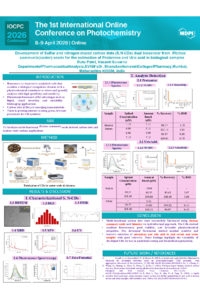
Introduction: Sustainable, biocompatible fluorescent probes are increasingly needed for clinically relevant analytes. Protamine, the only clinically used antidote for heparin overdose, and uric acid, a key biomarker for metabolic, renal, and cardiovascular disorders, both require reliable quantification in biological fluids for effective clinical management.
Methods: Sulfur- and nitrogen-doped carbon dots (S,N-CDs) were synthesized via a one-step hydrothermal method using Ricinus communis (castor) seeds as a carbon source and thiourea as the nitrogen and sulfur dopant. Finely ground castor seed powder was mixed with thiourea in distilled water and heated in a sealed autoclave at 180 °C for 6 h to obtain S,N-CDs suitable for fluorescence-based sensing.
Results: The S,N-CDs showed uniform spherical morphology (2–8 nm), green emission (λ_em = 520 nm), and good stability toward pH variation, ionic strength, and photobleaching. Surface functional groups enabled a fluorescence turn-off response to both targets. Protamine was quantified over 3.2–7.2 µM (limit of detection 0.45 µM), with recoveries of 98.9–103.1% in spiked human serum. Uric acid was detected over 50–124.8 µM (limit of detection 16.7 µM), with recoveries of 94.9–101.8% in serum and 92.6–95.3% in urine. These results indicate that the probe can operate in complex biological matrices using a simple, low-cost fluorescence readout.
Conclusion: Castor seed-derived S,N-CDs function as an application-focused fluorescent probe for dual detection of protamine and uric acid in biological fluids. This study demonstrates a sustainable synthesis route and links the surface functionality of the CDs to their fluorescence response, supporting their utility for applied biosensing rather than mechanistic photophysical advancement.
Keywords
Carbon dots
castor seeds
sulfur/nitrogen doping
hydrothermal
protamine detection
uric acid detection
fluorescent biosensor
Poster
sciforum-152818- Banner Update.pdf.pdf
One-pot amination–arylation synthesis and structure–property relationships of luminescent and redox-active aryl-triarylamines and -phenothiazines
Exploring photochemical potential of a new Cd(II) complex with pyrazole derivative