Event submissions
Published
This submission belongs to the session S5. Photoluminescent Materials of the event The 1st International Online Conference on Photochemistry
Published date
03 Apr, 2026
Academic Editor
'%3e%3cpath%20d='M12.6657%2010.9104C12.4185%2010.325%2012.0599%209.79327%2011.6097%209.34482C11.1609%208.89508%2010.6293%208.5365%2010.0442%208.28888C10.0389%208.28626%2010.0337%208.28495%2010.0285%208.28233C10.8446%207.69279%2011.3752%206.73249%2011.3752%205.64904C11.3752%203.8542%209.92103%202.39999%208.1262%202.39999C6.33136%202.39999%204.87715%203.8542%204.87715%205.64904C4.87715%206.73249%205.40774%207.69279%206.22393%208.28364C6.21869%208.28626%206.21345%208.28757%206.20821%208.29019C5.62129%208.5378%205.09463%208.89284%204.64265%209.34613C4.1929%209.79493%203.83432%2010.3266%203.58671%2010.9117C3.34345%2011.4845%203.21226%2012.0987%203.20023%2012.7209C3.19988%2012.7349%203.20233%2012.7488%203.20744%2012.7619C3.21255%2012.7749%203.22022%2012.7867%203.22998%2012.7968C3.23975%2012.8068%203.25142%2012.8147%203.26431%2012.8202C3.2772%2012.8256%203.29105%2012.8284%203.30504%2012.8284H4.09109C4.14874%2012.8284%204.19459%2012.7825%204.1959%2012.7262C4.2221%2011.7148%204.62823%2010.7676%205.34617%2010.0497C6.08899%209.30683%207.0755%208.89808%208.1262%208.89808C9.17689%208.89808%2010.1634%209.30683%2010.9062%2010.0497C11.6242%2010.7676%2012.0303%2011.7148%2012.0565%2012.7262C12.0578%2012.7838%2012.1037%2012.8284%2012.1613%2012.8284H12.9474C12.9613%2012.8284%2012.9752%2012.8256%2012.9881%2012.8202C13.001%2012.8147%2013.0126%2012.8068%2013.0224%2012.7968C13.0322%2012.7867%2013.0398%2012.7749%2013.0449%2012.7619C13.0501%2012.7488%2013.0525%2012.7349%2013.0522%2012.7209C13.0391%2012.0947%2012.9094%2011.4855%2012.6657%2010.9104ZM8.1262%207.9024C7.52486%207.9024%206.9589%207.6679%206.53312%207.24211C6.10733%206.81633%205.87283%206.25037%205.87283%205.64904C5.87283%205.0477%206.10733%204.48174%206.53312%204.05596C6.9589%203.63018%207.52486%203.39567%208.1262%203.39567C8.72753%203.39567%209.29349%203.63018%209.71927%204.05596C10.1451%204.48174%2010.3796%205.0477%2010.3796%205.64904C10.3796%206.25037%2010.1451%206.81633%209.71927%207.24211C9.29349%207.6679%208.72753%207.9024%208.1262%207.9024Z'%20fill='%235D1EE1'/%3e%3c/g%3e%3c/svg%3e) Dirk Poelman
Dirk PoelmanCitation
Marijana Regojevic, Mirjana Radanovic, Berta Barta Holló, Kende Attila Béres, Zsolt Dürvanger, Spiros Gardelis, Exploring photochemical potential of a new Cd(II) complex with pyrazole derivative, in Proceedings of The 1st International Online Conference on Photochemistry, 8 April–9 April 2026, MDPI: Basel, Switzerland
Share
Email
Facebook
Twitter
LinkedIn
Exploring photochemical potential of a new Cd(II) complex with pyrazole derivative
'%3e%3cpath%20d='M12.6647%2010.9104C12.4176%2010.325%2012.0589%209.7933%2011.6088%209.34485C11.16%208.89511%2010.6283%208.53653%2010.0432%208.28891C10.038%208.28629%2010.0327%208.28498%2010.0275%208.28236C10.8437%207.69282%2011.3743%206.73252%2011.3743%205.64907C11.3743%203.85423%209.92005%202.40002%208.12522%202.40002C6.33038%202.40002%204.87618%203.85423%204.87618%205.64907C4.87618%206.73252%205.40677%207.69282%206.22296%208.28367C6.21772%208.28629%206.21248%208.2876%206.20724%208.29022C5.62031%208.53783%205.09365%208.89287%204.64167%209.34616C4.19192%209.79496%203.83334%2010.3266%203.58573%2010.9117C3.34247%2011.4846%203.21128%2012.0987%203.19925%2012.721C3.1989%2012.735%203.20135%2012.7489%203.20646%2012.7619C3.21157%2012.7749%203.21924%2012.7868%203.22901%2012.7968C3.23877%2012.8068%203.25045%2012.8148%203.26334%2012.8202C3.27623%2012.8256%203.29007%2012.8284%203.30406%2012.8284H4.09012C4.14776%2012.8284%204.19362%2012.7825%204.19493%2012.7262C4.22113%2011.7148%204.62726%2010.7676%205.34519%2010.0497C6.08802%209.30686%207.07452%208.89811%208.12522%208.89811C9.17592%208.89811%2010.1624%209.30686%2010.9052%2010.0497C11.6232%2010.7676%2012.0293%2011.7148%2012.0555%2012.7262C12.0568%2012.7839%2012.1027%2012.8284%2012.1603%2012.8284H12.9464C12.9604%2012.8284%2012.9742%2012.8256%2012.9871%2012.8202C13%2012.8148%2013.0117%2012.8068%2013.0214%2012.7968C13.0312%2012.7868%2013.0389%2012.7749%2013.044%2012.7619C13.0491%2012.7489%2013.0515%2012.735%2013.0512%2012.721C13.0381%2012.0947%2012.9084%2011.4856%2012.6647%2010.9104ZM8.12522%207.90243C7.52388%207.90243%206.95792%207.66793%206.53214%207.24215C6.10636%206.81636%205.87185%206.2504%205.87185%205.64907C5.87185%205.04773%206.10636%204.48177%206.53214%204.05599C6.95792%203.63021%207.52388%203.3957%208.12522%203.3957C8.72655%203.3957%209.29252%203.63021%209.7183%204.05599C10.1441%204.48177%2010.3786%205.04773%2010.3786%205.64907C10.3786%206.2504%2010.1441%206.81636%209.7183%207.24215C9.29252%207.66793%208.72655%207.90243%208.12522%207.90243Z'%20fill='%235D1EE1'/%3e%3c/g%3e%3c/svg%3e)
Marijana Regojevic 1

Mirjana Radanovic 1
Berta Barta Holló 1
Kende Attila Béres 2,3
Zsolt Dürvanger 4

Spiros Gardelis 5
1. Department of Chemistry, Biochemistry and Environmental Protection, Faculty of Sciences, University of Novi Sad, 21000 Novi Sad, Serbia
2. Research Centre for Natural Sciences, Institute of Materials and Environmental Chemistry, Magyar Tudosok Krt. 2, Budapest 1117, Hungary
3. György Hevesy PhD School of Chemistry, Institute of Chemistry, Eötvös Loránd University, Pázmány Péter S. 1/A, Budapest 1117, Hungary
4. Laboratory of Structural Chemistry and Biology, Institute of Chemistry, Eötvös Loránd University, Pázmány Péter S. 1/A, Budapest 1117, Hungary
5. Department of Physics, National and Kapodistrian University of Athens, Athens, Greece
Abstract
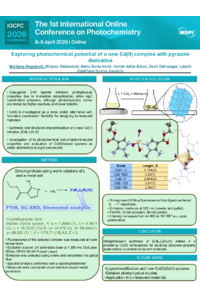
Organic ligands containing conjugated C=N bonds can significantly enhance photophysical behavior [1]. While Ag(I) coordination polymers exhibit intriguing photophysical properties [2], Ag(I) is more reactive and less stable than Cd(II), motivating the exploration of Cd(II)-based systems as viable alternatives. In this work, we report the synthesis, photochemical, and photoluminescent properties of a new Cd(II) complex, [CdL₂I₂H₂O], L = ethyl-5-amino-1-methyl-1H-pyrazole-4-carboxylate.
The obtained compound was characterized by ATR-FTIR, molar conductivity in DMF, and X-ray diffraction. Room temperature fluorescence of the samples was measured using a 355 nm UV solid-state pulsed laser.
White crystals of the complex [CdL₂I₂H₂O] were obtained by reacting CdI₂ with L in methanol and in its mixture with other solvents as MeCN, Me2CO, and H2O. In the obtained complex, L coordinates through the unsubstituted nitrogen atom of the pyrazole ring. The asymmetric unit of this mononuclear complex comprises one Cd(II), two N-coordinated pyrazole ligands, two iodido ligands, and one coordinated water molecule. The Cd(II) center adopts a distorted trigonal-bipyramidal geometry.
Complex shows strong near-UV to blue fluorescence. The compound emits at 393 nm (powder/pellet) with FWHM 72/80 nm; intensity rises from 44,600 to 151,687 a.u.
A novel mononuclear Cd(II) complex pyrazole derivative ligand was synthesized and characterized. With its simple and accessible synthesis, [CdL₂I₂(H₂O)] represents a promising candidate for advancing existing Cd(II)-based luminophores and exploring structure–property relationships in photoluminescent materials.
[1] Ristić, P.; Sreekala, C. O.; Kulkarni, N. V.; Senthurpandi, D.; Mathew, J. J. Mol. Struct. 2022, 1266, 133512. https://doi.org/10.1016/j.molstruc.2022.133512
[2] Ristić, P.; Filipović, N.; Blagojević, V. A.; Ćirković, J.; Barta Holló, B.; Đokić, V. R.; Donnard, M.; Gulea, M.; Marjanović, I.; Klisurić, O. R.; Todorović, T. R. CrystEngComm 2021, 23, 4799–4815. https://doi.org/10.1039/d1ce00394a
Keywords
cadmium complex
pyrazole derivatives
coordination compounds
DSSC
photoluminescence
Poster
IOCPC Poster.pdf
Development of Sulfur- and nitrogen-doped carbon dots (S,N-CDs) dual biosensor from Ricinus communis (castor) seeds for the estimation of Protamine and Uric acid in biological samples
White-Emitting Dy³⁺/Eu³⁺ Co-Doped Fluorapatite Nanoparticles for Multispectral Biomedical Applications