Event submissions
Published
This submission belongs to the session S5. Photoluminescent Materials of the event The 1st International Online Conference on Photochemistry
Published date
03 Apr, 2026
Academic Editor
'%3e%3cpath%20d='M12.6657%2010.9104C12.4185%2010.325%2012.0599%209.79327%2011.6097%209.34482C11.1609%208.89508%2010.6293%208.5365%2010.0442%208.28888C10.0389%208.28626%2010.0337%208.28495%2010.0285%208.28233C10.8446%207.69279%2011.3752%206.73249%2011.3752%205.64904C11.3752%203.8542%209.92103%202.39999%208.1262%202.39999C6.33136%202.39999%204.87715%203.8542%204.87715%205.64904C4.87715%206.73249%205.40774%207.69279%206.22393%208.28364C6.21869%208.28626%206.21345%208.28757%206.20821%208.29019C5.62129%208.5378%205.09463%208.89284%204.64265%209.34613C4.1929%209.79493%203.83432%2010.3266%203.58671%2010.9117C3.34345%2011.4845%203.21226%2012.0987%203.20023%2012.7209C3.19988%2012.7349%203.20233%2012.7488%203.20744%2012.7619C3.21255%2012.7749%203.22022%2012.7867%203.22998%2012.7968C3.23975%2012.8068%203.25142%2012.8147%203.26431%2012.8202C3.2772%2012.8256%203.29105%2012.8284%203.30504%2012.8284H4.09109C4.14874%2012.8284%204.19459%2012.7825%204.1959%2012.7262C4.2221%2011.7148%204.62823%2010.7676%205.34617%2010.0497C6.08899%209.30683%207.0755%208.89808%208.1262%208.89808C9.17689%208.89808%2010.1634%209.30683%2010.9062%2010.0497C11.6242%2010.7676%2012.0303%2011.7148%2012.0565%2012.7262C12.0578%2012.7838%2012.1037%2012.8284%2012.1613%2012.8284H12.9474C12.9613%2012.8284%2012.9752%2012.8256%2012.9881%2012.8202C13.001%2012.8147%2013.0126%2012.8068%2013.0224%2012.7968C13.0322%2012.7867%2013.0398%2012.7749%2013.0449%2012.7619C13.0501%2012.7488%2013.0525%2012.7349%2013.0522%2012.7209C13.0391%2012.0947%2012.9094%2011.4855%2012.6657%2010.9104ZM8.1262%207.9024C7.52486%207.9024%206.9589%207.6679%206.53312%207.24211C6.10733%206.81633%205.87283%206.25037%205.87283%205.64904C5.87283%205.0477%206.10733%204.48174%206.53312%204.05596C6.9589%203.63018%207.52486%203.39567%208.1262%203.39567C8.72753%203.39567%209.29349%203.63018%209.71927%204.05596C10.1451%204.48174%2010.3796%205.0477%2010.3796%205.64904C10.3796%206.25037%2010.1451%206.81633%209.71927%207.24211C9.29349%207.6679%208.72753%207.9024%208.1262%207.9024Z'%20fill='%235D1EE1'/%3e%3c/g%3e%3c/svg%3e) Dirk Poelman
Dirk PoelmanCitation
Dušan V. Milojkov, White-Emitting Dy³⁺/Eu³⁺ Co-Doped Fluorapatite Nanoparticles for Multispectral Biomedical Applications, in Proceedings of The 1st International Online Conference on Photochemistry, 8 April–9 April 2026, MDPI: Basel, Switzerland
Share
Email
Facebook
Twitter
LinkedIn
White-Emitting Dy³⁺/Eu³⁺ Co-Doped Fluorapatite Nanoparticles for Multispectral Biomedical Applications

Dušan V. Milojkov 1
1. Sector for Metallurgical Technology and Environmental Protection, Institute for Technology of Nuclear and Other Mineral Raw Materials, Belgrade, 11000, Serbia.
Abstract
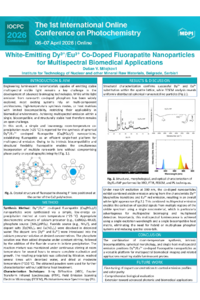
Engineering luminescent nanomaterials capable of emitting stable multispectral visible light remains a key challenge in the development of advanced bioimaging technologies. While white-light emission from rare-earth co-doped phosphors has been widely explored, most existing systems rely on multi-component architectures, high-temperature synthesis routes, or host matrices with limited biocompatibility, restricting their applicability in biomedical environments. Achieving multispectral emission within a single, biocompatible, and structurally stable host therefore remains an open challenge.
In this work, a simple and low-energy room-temperature co-precipitation route (≈25 °C) is reported for the synthesis of spherical Dy³⁺/Eu³⁺ co-doped fluorapatite (Ca₅(PO₄)₃F) nanoparticles, establishing fluorapatite as an efficient single-host platform for multispectral emission. Owing to its intrinsic biocompatibility and structural flexibility, fluorapatite enables the simultaneous incorporation of multiple rare-earth ions without compromising phase purity or crystallographic integrity. Structural characterization confirms successful Dy³⁺ and Eu³⁺ substitution within the apatite lattice, while FESEM analysis reveals uniformly distributed spherical nanocrystalline particles.
Under near-UV excitation at 380 nm, the co-doped nanoparticles exhibit combined visible emission arising from the characteristic Dy³⁺ blue/yellow transitions and Eu³⁺ red emission, resulting in an overall white-light appearance. This combined multispectral emission enables the collection of spectral signals from multiple regions of the visible spectrum using a single nanomaterial, which is particularly advantageous for multispectral bioimaging and multiplexed detection. Importantly, this multispectral luminescence is achieved using a single excitation wavelength and a single biocompatible host matrix, eliminating the need for hybrid or multi-phase phosphor systems and reducing spectral cross-talk.
The combination of room-temperature synthesis, intrinsic biocompatibility, spherical morphology, and single-host multispectral emission positions Dy³⁺/Eu³⁺ co-doped fluorapatite nanoparticles as a versatile platform for multispectral biomedical imaging and related applications requiring stable luminescent probes.
Keywords
Fluorapatite nanoparticles
White light emission
Dy³⁺/Eu³⁺ co-doping
Multispectral bioimaging
Biocompatibility.
Poster
IOCPC2026-Milojkov.pdf
Exploring photochemical potential of a new Cd(II) complex with pyrazole derivative
Structure–Property Relationships in Triphenylamine-Based p-Type Organic Dyes for Dye-Sensitized Solar Cells: A Theoretical Study