Event submissions
Published
This submission belongs to the session S1. Photocatalysis of the event The 1st International Online Conference on Photochemistry
Published date
03 Apr, 2026
Academic Editor
'%3e%3cpath%20d='M12.6657%2010.9104C12.4185%2010.325%2012.0599%209.79327%2011.6097%209.34482C11.1609%208.89508%2010.6293%208.5365%2010.0442%208.28888C10.0389%208.28626%2010.0337%208.28495%2010.0285%208.28233C10.8446%207.69279%2011.3752%206.73249%2011.3752%205.64904C11.3752%203.8542%209.92103%202.39999%208.1262%202.39999C6.33136%202.39999%204.87715%203.8542%204.87715%205.64904C4.87715%206.73249%205.40774%207.69279%206.22393%208.28364C6.21869%208.28626%206.21345%208.28757%206.20821%208.29019C5.62129%208.5378%205.09463%208.89284%204.64265%209.34613C4.1929%209.79493%203.83432%2010.3266%203.58671%2010.9117C3.34345%2011.4845%203.21226%2012.0987%203.20023%2012.7209C3.19988%2012.7349%203.20233%2012.7488%203.20744%2012.7619C3.21255%2012.7749%203.22022%2012.7867%203.22998%2012.7968C3.23975%2012.8068%203.25142%2012.8147%203.26431%2012.8202C3.2772%2012.8256%203.29105%2012.8284%203.30504%2012.8284H4.09109C4.14874%2012.8284%204.19459%2012.7825%204.1959%2012.7262C4.2221%2011.7148%204.62823%2010.7676%205.34617%2010.0497C6.08899%209.30683%207.0755%208.89808%208.1262%208.89808C9.17689%208.89808%2010.1634%209.30683%2010.9062%2010.0497C11.6242%2010.7676%2012.0303%2011.7148%2012.0565%2012.7262C12.0578%2012.7838%2012.1037%2012.8284%2012.1613%2012.8284H12.9474C12.9613%2012.8284%2012.9752%2012.8256%2012.9881%2012.8202C13.001%2012.8147%2013.0126%2012.8068%2013.0224%2012.7968C13.0322%2012.7867%2013.0398%2012.7749%2013.0449%2012.7619C13.0501%2012.7488%2013.0525%2012.7349%2013.0522%2012.7209C13.0391%2012.0947%2012.9094%2011.4855%2012.6657%2010.9104ZM8.1262%207.9024C7.52486%207.9024%206.9589%207.6679%206.53312%207.24211C6.10733%206.81633%205.87283%206.25037%205.87283%205.64904C5.87283%205.0477%206.10733%204.48174%206.53312%204.05596C6.9589%203.63018%207.52486%203.39567%208.1262%203.39567C8.72753%203.39567%209.29349%203.63018%209.71927%204.05596C10.1451%204.48174%2010.3796%205.0477%2010.3796%205.64904C10.3796%206.25037%2010.1451%206.81633%209.71927%207.24211C9.29349%207.6679%208.72753%207.9024%208.1262%207.9024Z'%20fill='%235D1EE1'/%3e%3c/g%3e%3c/svg%3e) Vincenzo Vaiano
Vincenzo VaianoCitation
Valentina Guimarães Silva, Marta Cabero Otero, Vânia Calisto, Diana L. D. Lima, Matrix influence on antibiotics photocatalytic removal from water by magnetic TiO₂–Carbon Quantum Dots composites, in Proceedings of The 1st International Online Conference on Photochemistry, 8 April–9 April 2026, MDPI: Basel, Switzerland
Share
Email
Facebook
Twitter
LinkedIn
Matrix influence on antibiotics photocatalytic removal from water by magnetic TiO2–Carbon Quantum Dots composites
'%3e%3cpath%20d='M12.6647%2010.9104C12.4176%2010.325%2012.0589%209.7933%2011.6088%209.34485C11.16%208.89511%2010.6283%208.53653%2010.0432%208.28891C10.038%208.28629%2010.0327%208.28498%2010.0275%208.28236C10.8437%207.69282%2011.3743%206.73252%2011.3743%205.64907C11.3743%203.85423%209.92005%202.40002%208.12522%202.40002C6.33038%202.40002%204.87618%203.85423%204.87618%205.64907C4.87618%206.73252%205.40677%207.69282%206.22296%208.28367C6.21772%208.28629%206.21248%208.2876%206.20724%208.29022C5.62031%208.53783%205.09365%208.89287%204.64167%209.34616C4.19192%209.79496%203.83334%2010.3266%203.58573%2010.9117C3.34247%2011.4846%203.21128%2012.0987%203.19925%2012.721C3.1989%2012.735%203.20135%2012.7489%203.20646%2012.7619C3.21157%2012.7749%203.21924%2012.7868%203.22901%2012.7968C3.23877%2012.8068%203.25045%2012.8148%203.26334%2012.8202C3.27623%2012.8256%203.29007%2012.8284%203.30406%2012.8284H4.09012C4.14776%2012.8284%204.19362%2012.7825%204.19493%2012.7262C4.22113%2011.7148%204.62726%2010.7676%205.34519%2010.0497C6.08802%209.30686%207.07452%208.89811%208.12522%208.89811C9.17592%208.89811%2010.1624%209.30686%2010.9052%2010.0497C11.6232%2010.7676%2012.0293%2011.7148%2012.0555%2012.7262C12.0568%2012.7839%2012.1027%2012.8284%2012.1603%2012.8284H12.9464C12.9604%2012.8284%2012.9742%2012.8256%2012.9871%2012.8202C13%2012.8148%2013.0117%2012.8068%2013.0214%2012.7968C13.0312%2012.7868%2013.0389%2012.7749%2013.044%2012.7619C13.0491%2012.7489%2013.0515%2012.735%2013.0512%2012.721C13.0381%2012.0947%2012.9084%2011.4856%2012.6647%2010.9104ZM8.12522%207.90243C7.52388%207.90243%206.95792%207.66793%206.53214%207.24215C6.10636%206.81636%205.87185%206.2504%205.87185%205.64907C5.87185%205.04773%206.10636%204.48177%206.53214%204.05599C6.95792%203.63021%207.52388%203.3957%208.12522%203.3957C8.72655%203.3957%209.29252%203.63021%209.7183%204.05599C10.1441%204.48177%2010.3786%205.04773%2010.3786%205.64907C10.3786%206.2504%2010.1441%206.81636%209.7183%207.24215C9.29252%207.66793%208.72655%207.90243%208.12522%207.90243Z'%20fill='%235D1EE1'/%3e%3c/g%3e%3c/svg%3e)
Valentina Guimarães Silva 1

Marta Cabero Otero 2
Vânia Calisto 1
Diana L. D. Lima 3,4
1. CESAM & Department of Chemistry, University of Aveiro, Campus de Santiago, 3810-193 Aveiro, Portugal
2. Department of Chemistry and Applied Physics, University of León, León, 24071, Spain.
3. Polytechnic University of Coimbra, Coimbra, 3045-093, Portugal.
4. H&TRC - Health & Technology Research Center, Coimbra Health School, Polytechnic University of Coimbra, Coimbra, 3046-854, Portugal.
Abstract
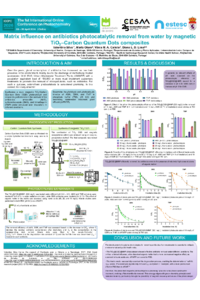
Over the years, global consumption of antibiotics has increased, as has their presence in the environment, mainly due to the discharge of ineffectively treated wastewater. Until 2045, Urban Wastewater Treatment Plants (UWWTP) with a population equivalent load of 150,000 or more must implement quaternary treatments to promote the removal of micropollutants, such as antibiotics. For such a purpose, solar-driven photocatalysis is considered promising. In this study, a novel photocatalyst composed of TiO2, Carbon Quantum Dots (CQD), and magnetic nanoparticles was produced using co-precipitation. The produced magnetic TiO2/CQD composite was tested for the removal of 3 antibiotics (amoxicillin (AMX), sulfamethoxazole (SMX) and trimethoprim (TMP)) under simulated solar irradiation and different operation conditions: pH (6, 7, 8 and 9), dissolved organic matter (10, 20 and 40 mg/L), and water matrices with distinct complexity (phosphate-buffered ultrapure water at pH 8 and secondary UWWTP effluent (sUWWTPe)). Tests at different pH levels revealed no significant effect of pH for most antibiotics. Conversely, 10 mg/L of dissolved organic matter enhanced the photodegradation of the tested antibiotics, whereas higher concentrations slowed the removal of all antibiotics and decreased photocatalyst efficiency. In PBS, the magnetic TiO2/CQD photocatalyst resulted in a 154-fold increase in the photodegradation kinetic rate compared to photolysis. Meanwhile, in sWWTPe, the photodegradation kinetic rate increased by 2 times for both TMP and SMX, whereas external factors hindered precise quantification of the kinetic rate enhancement for AMX. Furthermore, the magnetic TiO2/CQD photocatalyst improved antibiotics mineralisation, reaching 80% after 15 h of irradiation for AMX and TMP and 30 h for SMX, compared with only 20% without the photocatalyst. Therefore, the applied photocatalyst is a promising option for solar-driven quaternary wastewater treatments in UWWTP, enabling the sustainable removal of antibiotics.
Keywords
Water treatment
Amoxicilin
Sulfametoxazole
Trimetoprim
Solar-driven treatment
Poster
Poster_1_flash_VGS_IOCPC_final.pdf
Investigation of the Photocatalytic Degradation Efficiency of Methylene Blue Using TiO₂:Sm³⁺ Luminescent Nanoparticles
Investigation of new Additive Manufacturing DED application for waste-to-hydrogen conversion