Event submissions
Published
This submission belongs to the session S2. Photochemistry for Environmental Remediation of the event The 1st International Online Conference on Photochemistry
Published date
03 Apr, 2026
Academic Editor
'%3e%3cpath%20d='M12.6657%2010.9104C12.4185%2010.325%2012.0599%209.79327%2011.6097%209.34482C11.1609%208.89508%2010.6293%208.5365%2010.0442%208.28888C10.0389%208.28626%2010.0337%208.28495%2010.0285%208.28233C10.8446%207.69279%2011.3752%206.73249%2011.3752%205.64904C11.3752%203.8542%209.92103%202.39999%208.1262%202.39999C6.33136%202.39999%204.87715%203.8542%204.87715%205.64904C4.87715%206.73249%205.40774%207.69279%206.22393%208.28364C6.21869%208.28626%206.21345%208.28757%206.20821%208.29019C5.62129%208.5378%205.09463%208.89284%204.64265%209.34613C4.1929%209.79493%203.83432%2010.3266%203.58671%2010.9117C3.34345%2011.4845%203.21226%2012.0987%203.20023%2012.7209C3.19988%2012.7349%203.20233%2012.7488%203.20744%2012.7619C3.21255%2012.7749%203.22022%2012.7867%203.22998%2012.7968C3.23975%2012.8068%203.25142%2012.8147%203.26431%2012.8202C3.2772%2012.8256%203.29105%2012.8284%203.30504%2012.8284H4.09109C4.14874%2012.8284%204.19459%2012.7825%204.1959%2012.7262C4.2221%2011.7148%204.62823%2010.7676%205.34617%2010.0497C6.08899%209.30683%207.0755%208.89808%208.1262%208.89808C9.17689%208.89808%2010.1634%209.30683%2010.9062%2010.0497C11.6242%2010.7676%2012.0303%2011.7148%2012.0565%2012.7262C12.0578%2012.7838%2012.1037%2012.8284%2012.1613%2012.8284H12.9474C12.9613%2012.8284%2012.9752%2012.8256%2012.9881%2012.8202C13.001%2012.8147%2013.0126%2012.8068%2013.0224%2012.7968C13.0322%2012.7867%2013.0398%2012.7749%2013.0449%2012.7619C13.0501%2012.7488%2013.0525%2012.7349%2013.0522%2012.7209C13.0391%2012.0947%2012.9094%2011.4855%2012.6657%2010.9104ZM8.1262%207.9024C7.52486%207.9024%206.9589%207.6679%206.53312%207.24211C6.10733%206.81633%205.87283%206.25037%205.87283%205.64904C5.87283%205.0477%206.10733%204.48174%206.53312%204.05596C6.9589%203.63018%207.52486%203.39567%208.1262%203.39567C8.72753%203.39567%209.29349%203.63018%209.71927%204.05596C10.1451%204.48174%2010.3796%205.0477%2010.3796%205.64904C10.3796%206.25037%2010.1451%206.81633%209.71927%207.24211C9.29349%207.6679%208.72753%207.9024%208.1262%207.9024Z'%20fill='%235D1EE1'/%3e%3c/g%3e%3c/svg%3e) Olga Sacco
Olga SaccoCitation
Leonardo López-Cóndor, Víctor Pozo-Gavara, Raúl Losantos, Diego Sampedro, Design and Synthesis of the Next Generation of UV Filters with Enhanced Efficacy, Safety, and Antioxidant Properties, in Proceedings of The 1st International Online Conference on Photochemistry, 8 April–9 April 2026, MDPI: Basel, Switzerland
Share
Email
Facebook
Twitter
LinkedIn
Design and Synthesis of the Next Generation of UV Filters with Enhanced Efficacy, Safety, and Antioxidant Properties
'%3e%3cpath%20d='M12.6647%2010.9104C12.4176%2010.325%2012.0589%209.7933%2011.6088%209.34485C11.16%208.89511%2010.6283%208.53653%2010.0432%208.28891C10.038%208.28629%2010.0327%208.28498%2010.0275%208.28236C10.8437%207.69282%2011.3743%206.73252%2011.3743%205.64907C11.3743%203.85423%209.92005%202.40002%208.12522%202.40002C6.33038%202.40002%204.87618%203.85423%204.87618%205.64907C4.87618%206.73252%205.40677%207.69282%206.22296%208.28367C6.21772%208.28629%206.21248%208.2876%206.20724%208.29022C5.62031%208.53783%205.09365%208.89287%204.64167%209.34616C4.19192%209.79496%203.83334%2010.3266%203.58573%2010.9117C3.34247%2011.4846%203.21128%2012.0987%203.19925%2012.721C3.1989%2012.735%203.20135%2012.7489%203.20646%2012.7619C3.21157%2012.7749%203.21924%2012.7868%203.22901%2012.7968C3.23877%2012.8068%203.25045%2012.8148%203.26334%2012.8202C3.27623%2012.8256%203.29007%2012.8284%203.30406%2012.8284H4.09012C4.14776%2012.8284%204.19362%2012.7825%204.19493%2012.7262C4.22113%2011.7148%204.62726%2010.7676%205.34519%2010.0497C6.08802%209.30686%207.07452%208.89811%208.12522%208.89811C9.17592%208.89811%2010.1624%209.30686%2010.9052%2010.0497C11.6232%2010.7676%2012.0293%2011.7148%2012.0555%2012.7262C12.0568%2012.7839%2012.1027%2012.8284%2012.1603%2012.8284H12.9464C12.9604%2012.8284%2012.9742%2012.8256%2012.9871%2012.8202C13%2012.8148%2013.0117%2012.8068%2013.0214%2012.7968C13.0312%2012.7868%2013.0389%2012.7749%2013.044%2012.7619C13.0491%2012.7489%2013.0515%2012.735%2013.0512%2012.721C13.0381%2012.0947%2012.9084%2011.4856%2012.6647%2010.9104ZM8.12522%207.90243C7.52388%207.90243%206.95792%207.66793%206.53214%207.24215C6.10636%206.81636%205.87185%206.2504%205.87185%205.64907C5.87185%205.04773%206.10636%204.48177%206.53214%204.05599C6.95792%203.63021%207.52388%203.3957%208.12522%203.3957C8.72655%203.3957%209.29252%203.63021%209.7183%204.05599C10.1441%204.48177%2010.3786%205.04773%2010.3786%205.64907C10.3786%206.2504%2010.1441%206.81636%209.7183%207.24215C9.29252%207.66793%208.72655%207.90243%208.12522%207.90243Z'%20fill='%235D1EE1'/%3e%3c/g%3e%3c/svg%3e)
Leonardo López-Cóndor 1
Víctor Pozo-Gavara 1
Raúl Losantos 1

Diego Sampedro 1
1. Department of Chemistry, University of La Rioja, Logroño, 26007, Spain.
Abstract
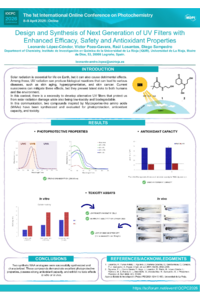
Solar radiation contains ultraviolet (UV) radiation (100–400 nm) and is classified into UVC, UVB, and UVA regions. While UVC radiation is blocked by the ozone layer, UVA and UVB reach the Earth’s surface. Although this radiation is essential for life, it is also responsible for acute and chronic skin damage, including erythema, permanent pigmentation, and skin cancer. Skin cancer is currently one of the most prevalent cancers worldwide, with its incidence steadily increasing over recent decades as a consequence of excessive and prolonged exposure to solar radiation. According to the American Cancer Society, more than three million new cases are diagnosed each year.
Sunscreens remain the most effective strategy to mitigate the risks associated with solar exposure; however, many commercially available UV filters have not evolved sufficiently to meet current safety, efficacy, and environmental standards. Moreover, several widely used UV filters raise concerns regarding photostability, photoreactivity, potential toxicity, and environmental persistence. To address these limitations, there is an urgent need for the development of next-generation UV filters that combine strong UV absorption with robust photoprotection mechanisms and improved safety profiles. Ideal UV filters should exhibit high chemical and thermal stability, efficient and non-reactive energy dissipation pathways, low phototoxicity, and biodegradability.
Inspired by naturally occurring molecules, our research group has rationally designed a new family of photoprotective compounds featuring enhanced photoprotective performance. Their efficacy has been evaluated through detailed studies of UV absorption, photostability, antioxidant capacity, and toxicity. The results demonstrate improved stability, enhanced photoprotection, and increased safety, highlighting the potential of these compounds as a new generation of UV filters.
Keywords
Photoprotection
UV filter
sunscreen
Poster
IOCPC_2026_Leonardo López-Cóndor.pdf
Aerobic and Anaerobic Borylation of (Hetero)arenes Triggered by Visible-Light Irradiation
Photocatalytic upcycling of bio-based microplastics under ambient conditions using nanostructured titania-based catalysts