Event submissions
Published
This submission belongs to the session S1. Photocatalysis of the event The 1st International Online Conference on Photochemistry
Published date
03 Apr, 2026
Academic Editor
'%3e%3cpath%20d='M12.6657%2010.9104C12.4185%2010.325%2012.0599%209.79327%2011.6097%209.34482C11.1609%208.89508%2010.6293%208.5365%2010.0442%208.28888C10.0389%208.28626%2010.0337%208.28495%2010.0285%208.28233C10.8446%207.69279%2011.3752%206.73249%2011.3752%205.64904C11.3752%203.8542%209.92103%202.39999%208.1262%202.39999C6.33136%202.39999%204.87715%203.8542%204.87715%205.64904C4.87715%206.73249%205.40774%207.69279%206.22393%208.28364C6.21869%208.28626%206.21345%208.28757%206.20821%208.29019C5.62129%208.5378%205.09463%208.89284%204.64265%209.34613C4.1929%209.79493%203.83432%2010.3266%203.58671%2010.9117C3.34345%2011.4845%203.21226%2012.0987%203.20023%2012.7209C3.19988%2012.7349%203.20233%2012.7488%203.20744%2012.7619C3.21255%2012.7749%203.22022%2012.7867%203.22998%2012.7968C3.23975%2012.8068%203.25142%2012.8147%203.26431%2012.8202C3.2772%2012.8256%203.29105%2012.8284%203.30504%2012.8284H4.09109C4.14874%2012.8284%204.19459%2012.7825%204.1959%2012.7262C4.2221%2011.7148%204.62823%2010.7676%205.34617%2010.0497C6.08899%209.30683%207.0755%208.89808%208.1262%208.89808C9.17689%208.89808%2010.1634%209.30683%2010.9062%2010.0497C11.6242%2010.7676%2012.0303%2011.7148%2012.0565%2012.7262C12.0578%2012.7838%2012.1037%2012.8284%2012.1613%2012.8284H12.9474C12.9613%2012.8284%2012.9752%2012.8256%2012.9881%2012.8202C13.001%2012.8147%2013.0126%2012.8068%2013.0224%2012.7968C13.0322%2012.7867%2013.0398%2012.7749%2013.0449%2012.7619C13.0501%2012.7488%2013.0525%2012.7349%2013.0522%2012.7209C13.0391%2012.0947%2012.9094%2011.4855%2012.6657%2010.9104ZM8.1262%207.9024C7.52486%207.9024%206.9589%207.6679%206.53312%207.24211C6.10733%206.81633%205.87283%206.25037%205.87283%205.64904C5.87283%205.0477%206.10733%204.48174%206.53312%204.05596C6.9589%203.63018%207.52486%203.39567%208.1262%203.39567C8.72753%203.39567%209.29349%203.63018%209.71927%204.05596C10.1451%204.48174%2010.3796%205.0477%2010.3796%205.64904C10.3796%206.25037%2010.1451%206.81633%209.71927%207.24211C9.29349%207.6679%208.72753%207.9024%208.1262%207.9024Z'%20fill='%235D1EE1'/%3e%3c/g%3e%3c/svg%3e) Vincenzo Vaiano
Vincenzo VaianoCitation
Beatriz Valadares, Valentina Silva, Vânia Calisto, Diana L. D. Lima, Goreti Pereira, Magnetic carbon-based photosensitizers for the removal of antibiotics from water, in Proceedings of The 1st International Online Conference on Photochemistry, 8 April–9 April 2026, MDPI: Basel, Switzerland
Share
Email
Facebook
Twitter
LinkedIn
Magnetic carbon-based photosensitizers for the removal of antibiotics from water
'%3e%3cpath%20d='M12.6647%2010.9104C12.4176%2010.325%2012.0589%209.7933%2011.6088%209.34485C11.16%208.89511%2010.6283%208.53653%2010.0432%208.28891C10.038%208.28629%2010.0327%208.28498%2010.0275%208.28236C10.8437%207.69282%2011.3743%206.73252%2011.3743%205.64907C11.3743%203.85423%209.92005%202.40002%208.12522%202.40002C6.33038%202.40002%204.87618%203.85423%204.87618%205.64907C4.87618%206.73252%205.40677%207.69282%206.22296%208.28367C6.21772%208.28629%206.21248%208.2876%206.20724%208.29022C5.62031%208.53783%205.09365%208.89287%204.64167%209.34616C4.19192%209.79496%203.83334%2010.3266%203.58573%2010.9117C3.34247%2011.4846%203.21128%2012.0987%203.19925%2012.721C3.1989%2012.735%203.20135%2012.7489%203.20646%2012.7619C3.21157%2012.7749%203.21924%2012.7868%203.22901%2012.7968C3.23877%2012.8068%203.25045%2012.8148%203.26334%2012.8202C3.27623%2012.8256%203.29007%2012.8284%203.30406%2012.8284H4.09012C4.14776%2012.8284%204.19362%2012.7825%204.19493%2012.7262C4.22113%2011.7148%204.62726%2010.7676%205.34519%2010.0497C6.08802%209.30686%207.07452%208.89811%208.12522%208.89811C9.17592%208.89811%2010.1624%209.30686%2010.9052%2010.0497C11.6232%2010.7676%2012.0293%2011.7148%2012.0555%2012.7262C12.0568%2012.7839%2012.1027%2012.8284%2012.1603%2012.8284H12.9464C12.9604%2012.8284%2012.9742%2012.8256%2012.9871%2012.8202C13%2012.8148%2013.0117%2012.8068%2013.0214%2012.7968C13.0312%2012.7868%2013.0389%2012.7749%2013.044%2012.7619C13.0491%2012.7489%2013.0515%2012.735%2013.0512%2012.721C13.0381%2012.0947%2012.9084%2011.4856%2012.6647%2010.9104ZM8.12522%207.90243C7.52388%207.90243%206.95792%207.66793%206.53214%207.24215C6.10636%206.81636%205.87185%206.2504%205.87185%205.64907C5.87185%205.04773%206.10636%204.48177%206.53214%204.05599C6.95792%203.63021%207.52388%203.3957%208.12522%203.3957C8.72655%203.3957%209.29252%203.63021%209.7183%204.05599C10.1441%204.48177%2010.3786%205.04773%2010.3786%205.64907C10.3786%206.2504%2010.1441%206.81636%209.7183%207.24215C9.29252%207.66793%208.72655%207.90243%208.12522%207.90243Z'%20fill='%235D1EE1'/%3e%3c/g%3e%3c/svg%3e)
Beatriz Valadares 1,2
Valentina Silva 3
Vânia Calisto 3

Diana L. D. Lima 3,4

Goreti Pereira 3
1. Department of Chemistry, University of Aveiro, Campus de Santiago, 3810-193 Aveiro, Portugal.
2. Polytechnic University of Coimbra, Coimbra Health School, Rua 5 de Outubro – S. Martinho do Bispo, Apartado 7006, 3046-854 Coimbra, Portugal.
3. CESAM & Department of Chemistry, University of Aveiro, Campus de Santiago, 3810-193 Aveiro, Portugal.
4. H&TRC – Health and Technology Research Center, Coimbra Health School, Polytechnic University of Coimbra, 3045-043, Coimbra, Portugal.
Abstract
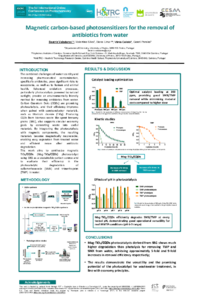
Water scarcity combined with the increasing presence of pharmaceuticals, such as antibiotics, in aquatic systems poses a significant threat to environmental integrity and human and animal health. The increasing demand for efficient and sustainable materials for water treatment has driven research towards photocatalytic technologies. In this work, magnetic TiO2/Carbon Quantum Dot (CQD) nanocomposites were synthesised and evaluated to assess the influence of synthesis methodology on the final material’s photocatalytic performance. CQDs were synthesised via a hydrothermal method using spent brewery grains (SBGs) as a sustainable carbon precursor. The process involved hydrothermal carbonisation at 200 ºC, with or without prior stirring at 70ºC of the precursors, followed by filtration and purification. Magnetic TiO2/CQDs nanocomposites were then prepared via co-precipitation of iron salts, either in situ or ex situ, enabling facile recovery of the materials by means of magnetic separation. For the ex situ methodology, TiO2/CQD nanocomposites were previously prepared through ultrasonication, followed by co-precipitation with iron oxide. In the in situ synthesis, CQDs, TiO2, and iron salts were added together. Four magnetic TiO2/CQDs composites were obtained by combining stirring and the synthesis route (in situ or ex situ).
The prepared materials were evaluated for the photocatalytic degradation of 10 mg/L trimethoprim (TMP) and sulfamethoxazole (SMX) in phosphate buffer (0.001 mg/L, pH 8) under simulated solar irradiation. The results show that all nanocomposites enhanced the degradation of both TMP and SMX compared to photolysis. The best-performing photocatalysts removed more than 70% after 1 h of irradiation, compared to less then 20% removal in photolysis. Under the tested conditions (500 mg/L), the ex situ photocatalyst with prior stirring exhibited the highest activity, yet the results were comparable to the in situ photocatalyst without prior stirring, which was selected as the most suitable photocatalyst due to simpler and faster synthesis.
Keywords
Photocatalysis
sulfamethoxazole
trimethoprim
carbon quantum dots
titanium dioxide
biomass
Poster
Poster_IOCPC2_BV.pdf
Titanate nanotubes for the selective cleavage of lignin inspired β-Ο-4 linkages towards value-added aromatics under visible light
Carbon dots/TiO2 hybrids for photocatalytic degradation of drugs in the aquatic environment