Event submissions
Published
This submission belongs to the session S2. Photochemistry for Environmental Remediation of the event The 1st International Online Conference on Photochemistry
Published date
03 Apr, 2026
Academic Editor
'%3e%3cpath%20d='M12.6657%2010.9104C12.4185%2010.325%2012.0599%209.79327%2011.6097%209.34482C11.1609%208.89508%2010.6293%208.5365%2010.0442%208.28888C10.0389%208.28626%2010.0337%208.28495%2010.0285%208.28233C10.8446%207.69279%2011.3752%206.73249%2011.3752%205.64904C11.3752%203.8542%209.92103%202.39999%208.1262%202.39999C6.33136%202.39999%204.87715%203.8542%204.87715%205.64904C4.87715%206.73249%205.40774%207.69279%206.22393%208.28364C6.21869%208.28626%206.21345%208.28757%206.20821%208.29019C5.62129%208.5378%205.09463%208.89284%204.64265%209.34613C4.1929%209.79493%203.83432%2010.3266%203.58671%2010.9117C3.34345%2011.4845%203.21226%2012.0987%203.20023%2012.7209C3.19988%2012.7349%203.20233%2012.7488%203.20744%2012.7619C3.21255%2012.7749%203.22022%2012.7867%203.22998%2012.7968C3.23975%2012.8068%203.25142%2012.8147%203.26431%2012.8202C3.2772%2012.8256%203.29105%2012.8284%203.30504%2012.8284H4.09109C4.14874%2012.8284%204.19459%2012.7825%204.1959%2012.7262C4.2221%2011.7148%204.62823%2010.7676%205.34617%2010.0497C6.08899%209.30683%207.0755%208.89808%208.1262%208.89808C9.17689%208.89808%2010.1634%209.30683%2010.9062%2010.0497C11.6242%2010.7676%2012.0303%2011.7148%2012.0565%2012.7262C12.0578%2012.7838%2012.1037%2012.8284%2012.1613%2012.8284H12.9474C12.9613%2012.8284%2012.9752%2012.8256%2012.9881%2012.8202C13.001%2012.8147%2013.0126%2012.8068%2013.0224%2012.7968C13.0322%2012.7867%2013.0398%2012.7749%2013.0449%2012.7619C13.0501%2012.7488%2013.0525%2012.7349%2013.0522%2012.7209C13.0391%2012.0947%2012.9094%2011.4855%2012.6657%2010.9104ZM8.1262%207.9024C7.52486%207.9024%206.9589%207.6679%206.53312%207.24211C6.10733%206.81633%205.87283%206.25037%205.87283%205.64904C5.87283%205.0477%206.10733%204.48174%206.53312%204.05596C6.9589%203.63018%207.52486%203.39567%208.1262%203.39567C8.72753%203.39567%209.29349%203.63018%209.71927%204.05596C10.1451%204.48174%2010.3796%205.0477%2010.3796%205.64904C10.3796%206.25037%2010.1451%206.81633%209.71927%207.24211C9.29349%207.6679%208.72753%207.9024%208.1262%207.9024Z'%20fill='%235D1EE1'/%3e%3c/g%3e%3c/svg%3e) Olga Sacco
Olga SaccoCitation
Dominika Czekanowska, Hugo Salazar, Jorge Saiz Galindo, Anatolijs Šarakovskis, Andrei Kholkin, Paweł Głuchowski, From Heterojunction Design to Real-Water Performance: Bi₂WO₆@WS₂-PVDF-HFP Sonophotocatalytic Membranes, in Proceedings of The 1st International Online Conference on Photochemistry, 8 April–9 April 2026, MDPI: Basel, Switzerland
Share
Email
Facebook
Twitter
LinkedIn
From Heterojunction Design to Real-Water Performance: Bi2WO6@WS2-PVDF-HFP Sonophotocatalytic Membranes
'%3e%3cpath%20d='M12.6647%2010.9104C12.4176%2010.325%2012.0589%209.7933%2011.6088%209.34485C11.16%208.89511%2010.6283%208.53653%2010.0432%208.28891C10.038%208.28629%2010.0327%208.28498%2010.0275%208.28236C10.8437%207.69282%2011.3743%206.73252%2011.3743%205.64907C11.3743%203.85423%209.92005%202.40002%208.12522%202.40002C6.33038%202.40002%204.87618%203.85423%204.87618%205.64907C4.87618%206.73252%205.40677%207.69282%206.22296%208.28367C6.21772%208.28629%206.21248%208.2876%206.20724%208.29022C5.62031%208.53783%205.09365%208.89287%204.64167%209.34616C4.19192%209.79496%203.83334%2010.3266%203.58573%2010.9117C3.34247%2011.4846%203.21128%2012.0987%203.19925%2012.721C3.1989%2012.735%203.20135%2012.7489%203.20646%2012.7619C3.21157%2012.7749%203.21924%2012.7868%203.22901%2012.7968C3.23877%2012.8068%203.25045%2012.8148%203.26334%2012.8202C3.27623%2012.8256%203.29007%2012.8284%203.30406%2012.8284H4.09012C4.14776%2012.8284%204.19362%2012.7825%204.19493%2012.7262C4.22113%2011.7148%204.62726%2010.7676%205.34519%2010.0497C6.08802%209.30686%207.07452%208.89811%208.12522%208.89811C9.17592%208.89811%2010.1624%209.30686%2010.9052%2010.0497C11.6232%2010.7676%2012.0293%2011.7148%2012.0555%2012.7262C12.0568%2012.7839%2012.1027%2012.8284%2012.1603%2012.8284H12.9464C12.9604%2012.8284%2012.9742%2012.8256%2012.9871%2012.8202C13%2012.8148%2013.0117%2012.8068%2013.0214%2012.7968C13.0312%2012.7868%2013.0389%2012.7749%2013.044%2012.7619C13.0491%2012.7489%2013.0515%2012.735%2013.0512%2012.721C13.0381%2012.0947%2012.9084%2011.4856%2012.6647%2010.9104ZM8.12522%207.90243C7.52388%207.90243%206.95792%207.66793%206.53214%207.24215C6.10636%206.81636%205.87185%206.2504%205.87185%205.64907C5.87185%205.04773%206.10636%204.48177%206.53214%204.05599C6.95792%203.63021%207.52388%203.3957%208.12522%203.3957C8.72655%203.3957%209.29252%203.63021%209.7183%204.05599C10.1441%204.48177%2010.3786%205.04773%2010.3786%205.64907C10.3786%206.2504%2010.1441%206.81636%209.7183%207.24215C9.29252%207.66793%208.72655%207.90243%208.12522%207.90243Z'%20fill='%235D1EE1'/%3e%3c/g%3e%3c/svg%3e)
Dominika Czekanowska 1,2

Hugo Salazar 3
Jorge Saiz Galindo 3
Anatolijs Šarakovskis 4

Andrei Kholkin 4,5

Paweł Głuchowski 1,2
1. Division of Optical Spectroscopy, Institute of Low Temperature and Structure Research, Polish Academy of Sciences, Wrocław, 50-422, Poland.
2. Graphene Energy, Ltd., Wrocław, 50-422, Poland.
3. BCMaterials, Basque Center for Materials, Applications and Nanostructures, Leioa, 48940, Spain.
4. Institute of Solid State Physics, University of Latvia, Riga, LV-1063, Latvia.
5. Department of Physics & CICECO−Aveiro Institute of Materials, University of Aveiro, Aveiro, 3810-193, Portugal.
Abstract
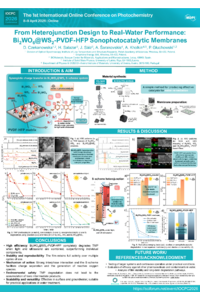
The persistence of pharmaceutical contaminants in aquatic environments, coupled with their inefficient removal by conventional treatment technologies, poses escalating risks to ecosystems and public health. Herein, we report the development of a hybrid Bi2WO6@WS2-PVDF-HFP composite membrane as an efficient and reusable platform for the sonophotocatalytic degradation of the antibiotic trimethoprim (TMP). The membrane integrates a type-II Bi2WO6@WS2 heterojunction within a piezoelectric PVDF-HFP matrix, enabling synergistic coupling between photocatalytic and sonocatalytic processes.
Comprehensive structural, optical, and electrochemical characterizations confirm strong interfacial coupling, broadened visible-light absorption, enhanced charge separation, and reduced recombination. Under combined light irradiation and ultrasound, the hybrid membrane achieves complete TMP degradation, outperforming membranes containing individual components. Kinetic analyses indicate predominantly pseudo-second-order behavior, while adsorption isotherms suggest favorable, mainly monolayer-type interactions between TMP and the catalytic surface.
Importantly, the membrane maintains high degradation efficiency in complex matrices, including surface water and groundwater, demonstrating robustness beyond model solutions. Reusability tests show 100% degradation efficiency over three consecutive cycles, highlighting excellent structural and functional stability. Liquid chromatography–mass spectrometry analyses indicate that hybrid sonophotocatalysis promotes extensive degradation of trimethoprim, preventing the accumulation of persistent and toxic transformation products.
Overall, this work demonstrates a scalable and environmentally friendly membrane-based strategy that combines photoactivity, piezoelectricity, and material stability, offering a promising solution for the remediation of emerging pharmaceutical contaminants in real water systems.
Keywords
sonophotocatalysis
Bi₂WO₆@WS₂ heterojunction
PVDF-HFP composite membrane
trimethoprim degradation
Advanced Oxidation Processes (AOPs)
Poster
IOCPC_2026_updated_version_Dominika_Czekanowska.pdf
Carbon dots/TiO2 hybrids for photocatalytic degradation of drugs in the aquatic environment
Dy3+, Mn4+ co-doped Sr4GaNbO8 materials towards dual-mode thermometry, anti-counterfeiting and information encryption applications