Event submissions
Published
This submission belongs to the session S5. Photoluminescent Materials of the event The 1st International Online Conference on Photochemistry
Published date
03 Apr, 2026
Academic Editor
'%3e%3cpath%20d='M12.6657%2010.9104C12.4185%2010.325%2012.0599%209.79327%2011.6097%209.34482C11.1609%208.89508%2010.6293%208.5365%2010.0442%208.28888C10.0389%208.28626%2010.0337%208.28495%2010.0285%208.28233C10.8446%207.69279%2011.3752%206.73249%2011.3752%205.64904C11.3752%203.8542%209.92103%202.39999%208.1262%202.39999C6.33136%202.39999%204.87715%203.8542%204.87715%205.64904C4.87715%206.73249%205.40774%207.69279%206.22393%208.28364C6.21869%208.28626%206.21345%208.28757%206.20821%208.29019C5.62129%208.5378%205.09463%208.89284%204.64265%209.34613C4.1929%209.79493%203.83432%2010.3266%203.58671%2010.9117C3.34345%2011.4845%203.21226%2012.0987%203.20023%2012.7209C3.19988%2012.7349%203.20233%2012.7488%203.20744%2012.7619C3.21255%2012.7749%203.22022%2012.7867%203.22998%2012.7968C3.23975%2012.8068%203.25142%2012.8147%203.26431%2012.8202C3.2772%2012.8256%203.29105%2012.8284%203.30504%2012.8284H4.09109C4.14874%2012.8284%204.19459%2012.7825%204.1959%2012.7262C4.2221%2011.7148%204.62823%2010.7676%205.34617%2010.0497C6.08899%209.30683%207.0755%208.89808%208.1262%208.89808C9.17689%208.89808%2010.1634%209.30683%2010.9062%2010.0497C11.6242%2010.7676%2012.0303%2011.7148%2012.0565%2012.7262C12.0578%2012.7838%2012.1037%2012.8284%2012.1613%2012.8284H12.9474C12.9613%2012.8284%2012.9752%2012.8256%2012.9881%2012.8202C13.001%2012.8147%2013.0126%2012.8068%2013.0224%2012.7968C13.0322%2012.7867%2013.0398%2012.7749%2013.0449%2012.7619C13.0501%2012.7488%2013.0525%2012.7349%2013.0522%2012.7209C13.0391%2012.0947%2012.9094%2011.4855%2012.6657%2010.9104ZM8.1262%207.9024C7.52486%207.9024%206.9589%207.6679%206.53312%207.24211C6.10733%206.81633%205.87283%206.25037%205.87283%205.64904C5.87283%205.0477%206.10733%204.48174%206.53312%204.05596C6.9589%203.63018%207.52486%203.39567%208.1262%203.39567C8.72753%203.39567%209.29349%203.63018%209.71927%204.05596C10.1451%204.48174%2010.3796%205.0477%2010.3796%205.64904C10.3796%206.25037%2010.1451%206.81633%209.71927%207.24211C9.29349%207.6679%208.72753%207.9024%208.1262%207.9024Z'%20fill='%235D1EE1'/%3e%3c/g%3e%3c/svg%3e) Dirk Poelman
Dirk PoelmanCitation
Fernando Rivera-López, Christian Hernández-Álvarez, Inocencio R. Martín, Rubén Sahuquillo Redondo, Development of 3D-Printed Parts for Photonic Applications, in Proceedings of The 1st International Online Conference on Photochemistry, 8 April–9 April 2026, MDPI: Basel, Switzerland
Share
Email
Facebook
Twitter
LinkedIn
Development of 3D-Printed Parts for Photonic Applications

Fernando Rivera-López 1

Christian Hernández-Álvarez 2
'%3e%3cpath%20d='M12.6647%2010.9104C12.4176%2010.325%2012.0589%209.7933%2011.6088%209.34485C11.16%208.89511%2010.6283%208.53653%2010.0432%208.28891C10.038%208.28629%2010.0327%208.28498%2010.0275%208.28236C10.8437%207.69282%2011.3743%206.73252%2011.3743%205.64907C11.3743%203.85423%209.92005%202.40002%208.12522%202.40002C6.33038%202.40002%204.87618%203.85423%204.87618%205.64907C4.87618%206.73252%205.40677%207.69282%206.22296%208.28367C6.21772%208.28629%206.21248%208.2876%206.20724%208.29022C5.62031%208.53783%205.09365%208.89287%204.64167%209.34616C4.19192%209.79496%203.83334%2010.3266%203.58573%2010.9117C3.34247%2011.4846%203.21128%2012.0987%203.19925%2012.721C3.1989%2012.735%203.20135%2012.7489%203.20646%2012.7619C3.21157%2012.7749%203.21924%2012.7868%203.22901%2012.7968C3.23877%2012.8068%203.25045%2012.8148%203.26334%2012.8202C3.27623%2012.8256%203.29007%2012.8284%203.30406%2012.8284H4.09012C4.14776%2012.8284%204.19362%2012.7825%204.19493%2012.7262C4.22113%2011.7148%204.62726%2010.7676%205.34519%2010.0497C6.08802%209.30686%207.07452%208.89811%208.12522%208.89811C9.17592%208.89811%2010.1624%209.30686%2010.9052%2010.0497C11.6232%2010.7676%2012.0293%2011.7148%2012.0555%2012.7262C12.0568%2012.7839%2012.1027%2012.8284%2012.1603%2012.8284H12.9464C12.9604%2012.8284%2012.9742%2012.8256%2012.9871%2012.8202C13%2012.8148%2013.0117%2012.8068%2013.0214%2012.7968C13.0312%2012.7868%2013.0389%2012.7749%2013.044%2012.7619C13.0491%2012.7489%2013.0515%2012.735%2013.0512%2012.721C13.0381%2012.0947%2012.9084%2011.4856%2012.6647%2010.9104ZM8.12522%207.90243C7.52388%207.90243%206.95792%207.66793%206.53214%207.24215C6.10636%206.81636%205.87185%206.2504%205.87185%205.64907C5.87185%205.04773%206.10636%204.48177%206.53214%204.05599C6.95792%203.63021%207.52388%203.3957%208.12522%203.3957C8.72655%203.3957%209.29252%203.63021%209.7183%204.05599C10.1441%204.48177%2010.3786%205.04773%2010.3786%205.64907C10.3786%206.2504%2010.1441%206.81636%209.7183%207.24215C9.29252%207.66793%208.72655%207.90243%208.12522%207.90243Z'%20fill='%235D1EE1'/%3e%3c/g%3e%3c/svg%3e)
Inocencio R. Martín 2

Rubén Sahuquillo Redondo 1
1. Departamento de Ingeniería Industrial, Escuela Superior de Ingeniería y Tecnología, Universidad de La Laguna. Apdo. 456. E-38200 San Cristóbal de La Laguna, Santa Cruz de Tenerife, Spain
2. Departamento de Física, Instituto de Materiales y Nanotecnología and MALTA- Consolider Team, Universidad de La Laguna. Apdo. Correos 456, E-38206, San Cristóbal de La Laguna, Santa Cruz de Tenerife, Spain
Abstract
The development of advanced functional materials through additive manufacturing has opened new opportunities in photonic applications [1,2]. In this work, we report the fabrication of 3D-printed parts using a photo-curable resin doped with rare-earth ions, enabling the production of optically active structures with tailored luminescent properties. By incorporating rare-earth elements into the resin formulation, the resulting manufactured components exhibit characteristic optical emissions when illuminated under appropriate excitation conditions.
The primary objective of this research is the development of 3D-printed parts for information encoding and visual communication. Specifically, structures such as QR codes and ASCII-based patterns are fabricated, in which the encoded information is revealed through luminescent responses arising from the optically active ions. This approach enables secure and contactless information retrieval, with potential applications in anti-counterfeiting, data storage and smart labeling. In addition, the versatility of the printing process allows the fabrication of customized photonic elements for signaling and safety applications.
References
1. Rivera‑López, F.; Hernández‑Álvarez, C.; Domínguez‑Crosa, M. C.; Martín, I. R.; González‑Rodríguez, M.; Nuñez, P.; Ríos, S. 3D‑Printed Gd₃NbO₇: Yb³⁺, Tm³⁺ Remote Temperature Sensor with High Sensitivity for Industrial and Biological Applications. Mater. Today Adv. 2025, 28, 100642.
2. Hernández‑Álvarez, C.; Martín‑Hernández, P. I.; Martín, I. R.; Rivera‑López, F.; Hemmerich, H.; Grzegorczyk, M.; Mahlik, S.; Runowski, M. Optical Temperature Sensor Evaluation in a Working Gear Motor: Application of Luminescence Thermometry in Industrial Technology. Adv. Opt. Mater. 2024, 12 (17), 2303328.
Acknowledgmens
This work has been partially supported by the Proyecto ProID2024010034 funded by the Agencia Canaria de Investigación, Innovación y Sociedad de la Información (ACIISI) and by the Fondo Europeo de Desarrollo Regional en el marco del programa FEDER Canarias 2021-2027.
Keywords
Additive manufacturing
3D printing
Rare-earths
Luminescent materials
Information encoding
Poster
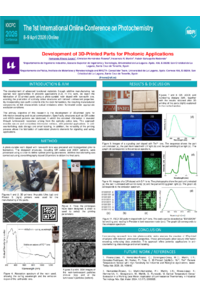
IOCPC 2026 Development of 3D-Printed Parts for Photonic Applications.pdf
Dy3+, Mn4+ co-doped Sr4GaNbO8 materials towards dual-mode thermometry, anti-counterfeiting and information encryption applications
Advances in Excited-State Dynamics: Bridging Small Molecules and Large Systems