Event submissions
Published
This submission belongs to the session S4. Photodynamic and Photothermal Therapy of the event The 1st International Online Conference on Photochemistry
Published date
03 Apr, 2026
Academic Editor
'%3e%3cpath%20d='M12.6657%2010.9104C12.4185%2010.325%2012.0599%209.79327%2011.6097%209.34482C11.1609%208.89508%2010.6293%208.5365%2010.0442%208.28888C10.0389%208.28626%2010.0337%208.28495%2010.0285%208.28233C10.8446%207.69279%2011.3752%206.73249%2011.3752%205.64904C11.3752%203.8542%209.92103%202.39999%208.1262%202.39999C6.33136%202.39999%204.87715%203.8542%204.87715%205.64904C4.87715%206.73249%205.40774%207.69279%206.22393%208.28364C6.21869%208.28626%206.21345%208.28757%206.20821%208.29019C5.62129%208.5378%205.09463%208.89284%204.64265%209.34613C4.1929%209.79493%203.83432%2010.3266%203.58671%2010.9117C3.34345%2011.4845%203.21226%2012.0987%203.20023%2012.7209C3.19988%2012.7349%203.20233%2012.7488%203.20744%2012.7619C3.21255%2012.7749%203.22022%2012.7867%203.22998%2012.7968C3.23975%2012.8068%203.25142%2012.8147%203.26431%2012.8202C3.2772%2012.8256%203.29105%2012.8284%203.30504%2012.8284H4.09109C4.14874%2012.8284%204.19459%2012.7825%204.1959%2012.7262C4.2221%2011.7148%204.62823%2010.7676%205.34617%2010.0497C6.08899%209.30683%207.0755%208.89808%208.1262%208.89808C9.17689%208.89808%2010.1634%209.30683%2010.9062%2010.0497C11.6242%2010.7676%2012.0303%2011.7148%2012.0565%2012.7262C12.0578%2012.7838%2012.1037%2012.8284%2012.1613%2012.8284H12.9474C12.9613%2012.8284%2012.9752%2012.8256%2012.9881%2012.8202C13.001%2012.8147%2013.0126%2012.8068%2013.0224%2012.7968C13.0322%2012.7867%2013.0398%2012.7749%2013.0449%2012.7619C13.0501%2012.7488%2013.0525%2012.7349%2013.0522%2012.7209C13.0391%2012.0947%2012.9094%2011.4855%2012.6657%2010.9104ZM8.1262%207.9024C7.52486%207.9024%206.9589%207.6679%206.53312%207.24211C6.10733%206.81633%205.87283%206.25037%205.87283%205.64904C5.87283%205.0477%206.10733%204.48174%206.53312%204.05596C6.9589%203.63018%207.52486%203.39567%208.1262%203.39567C8.72753%203.39567%209.29349%203.63018%209.71927%204.05596C10.1451%204.48174%2010.3796%205.0477%2010.3796%205.64904C10.3796%206.25037%2010.1451%206.81633%209.71927%207.24211C9.29349%207.6679%208.72753%207.9024%208.1262%207.9024Z'%20fill='%235D1EE1'/%3e%3c/g%3e%3c/svg%3e) Rui Fausto
Rui FaustoCitation
Daria Prilutskaya, Maria Mollaeva, Nikita Yabbarov, Maria Sokol, Margarita Chirkina, Maksim Klimenko, Ivan Gulyaev, Yulia Bortnevskaya, Natal’ya Bragina, Kseniya Zhdanova, Elena Nikolskaya, Extracellular vesicles for improved intracellular accumulation of photosensitizers, in Proceedings of The 1st International Online Conference on Photochemistry, 8 April–9 April 2026, MDPI: Basel, Switzerland
Share
Email
Facebook
Twitter
LinkedIn
Extracellular vesicles for improved intracellular accumulation of photosensitizers
'%3e%3cpath%20d='M12.6647%2010.9104C12.4176%2010.325%2012.0589%209.7933%2011.6088%209.34485C11.16%208.89511%2010.6283%208.53653%2010.0432%208.28891C10.038%208.28629%2010.0327%208.28498%2010.0275%208.28236C10.8437%207.69282%2011.3743%206.73252%2011.3743%205.64907C11.3743%203.85423%209.92005%202.40002%208.12522%202.40002C6.33038%202.40002%204.87618%203.85423%204.87618%205.64907C4.87618%206.73252%205.40677%207.69282%206.22296%208.28367C6.21772%208.28629%206.21248%208.2876%206.20724%208.29022C5.62031%208.53783%205.09365%208.89287%204.64167%209.34616C4.19192%209.79496%203.83334%2010.3266%203.58573%2010.9117C3.34247%2011.4846%203.21128%2012.0987%203.19925%2012.721C3.1989%2012.735%203.20135%2012.7489%203.20646%2012.7619C3.21157%2012.7749%203.21924%2012.7868%203.22901%2012.7968C3.23877%2012.8068%203.25045%2012.8148%203.26334%2012.8202C3.27623%2012.8256%203.29007%2012.8284%203.30406%2012.8284H4.09012C4.14776%2012.8284%204.19362%2012.7825%204.19493%2012.7262C4.22113%2011.7148%204.62726%2010.7676%205.34519%2010.0497C6.08802%209.30686%207.07452%208.89811%208.12522%208.89811C9.17592%208.89811%2010.1624%209.30686%2010.9052%2010.0497C11.6232%2010.7676%2012.0293%2011.7148%2012.0555%2012.7262C12.0568%2012.7839%2012.1027%2012.8284%2012.1603%2012.8284H12.9464C12.9604%2012.8284%2012.9742%2012.8256%2012.9871%2012.8202C13%2012.8148%2013.0117%2012.8068%2013.0214%2012.7968C13.0312%2012.7868%2013.0389%2012.7749%2013.044%2012.7619C13.0491%2012.7489%2013.0515%2012.735%2013.0512%2012.721C13.0381%2012.0947%2012.9084%2011.4856%2012.6647%2010.9104ZM8.12522%207.90243C7.52388%207.90243%206.95792%207.66793%206.53214%207.24215C6.10636%206.81636%205.87185%206.2504%205.87185%205.64907C5.87185%205.04773%206.10636%204.48177%206.53214%204.05599C6.95792%203.63021%207.52388%203.3957%208.12522%203.3957C8.72655%203.3957%209.29252%203.63021%209.7183%204.05599C10.1441%204.48177%2010.3786%205.04773%2010.3786%205.64907C10.3786%206.2504%2010.1441%206.81636%209.7183%207.24215C9.29252%207.66793%208.72655%207.90243%208.12522%207.90243Z'%20fill='%235D1EE1'/%3e%3c/g%3e%3c/svg%3e)
Daria Prilutskaya 1,2
Maria Mollaeva 2

Nikita Yabbarov 2
Maria Sokol 2
Margarita Chirkina 2
Maksim Klimenko 2
Ivan Gulyaev 2
Yulia Bortnevskaya 3
Natal’ya Bragina 3
Kseniya Zhdanova 3

Elena Nikolskaya 2
1. Faculty of Chemical and Pharmaceutical Technologies and Biomedical Products, D. Mendeleev University of Chemical Technology of Russia, Moscow, 125047, Russia.
2. Laboratory of Quantitative Oncology, Institute of Biochemical Physics NM Emanuel, Moscow, 119991, Russia.
3. Department of Chemistry and Technology of Biologically Active Compounds, Medicinal and Organic Chemistry, MIREA – Russian Technological University, Institute of Fine Chemical Technology, Moscow, 119454, Russia.
Abstract
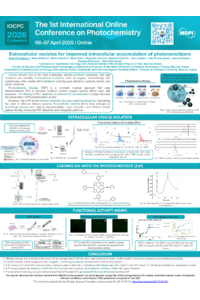
Introduction. Photodynamic therapy (PDT) is based on the use of photosensitizers (PS) that generate cytotoxic reactive oxygen species (ROS) upon light exposure. The efficacy of PDT depends on the efficient PS intracellular accumulation and preservation of their photodynamic activity. However, the limited solubility and poor pharmacokinetics of many PS necessitate the development of efficient delivery systems. Extracellular vesicles (EVs) have been proposed as promising nanocarriers for PS delivery.
Materials and methods. EVs were isolated from human embryonic kidney (HEK293) cells using ultrafiltration. The photosensitizer 5,15-bis(3-methoxy(4-(6-pyridylhexyloxy)phenyl)-10,20-di(ethynylphenyl)porphyrinato zinc (ZnP) was loaded in EVs by sonication, followed by removal of non-encapsulated ZnP by size-exclusion chromatography. Photodynamic activity of ZnP-EVs was assessed using the MTT assay on A549 cells after irradiation with red light (660 nm). ZnP-EV-induced ROS formation in A549 (human lung adenocarcinoma) cells was evaluated by flow cytometry. ZnP release was studied in a model medium (phosphate-buffered saline supplemented with 10% fetal bovine serum, pH 7.4).
Results. After ZnP-loading, EV recovery rate was approximately 40%. ZnP encapsulation resulted in a slight increase in EV size and zeta potential, consistent with membrane incorporation. Both free ZnP and ZnP-loaded EVs showed no dark toxicity in A549 cells at tested concentrations. Photoactivity assay confirmed that ZnP remains functional within EVs, while flow cytometry revealed that ZnP-EVs generate ROS more efficiently than free ZnP. Analysis of ZnP release from EVs demonstrated that only 16% of ZnP was released within the first 24 h, suggesting more selective PS accumulation in target tissues.
Conclusions. The results demonstrate that EVs derived from HEK293 cells preserve the photodynamic properties of the encapsulated PS, enable controlled release under biologically relevant conditions and enhance ROS generation compared to free ZnP.
This work was supported by the Russian Science Foundation research grant No. 25-75-00151, https://rscf.ru/project/25-75-00151/
Keywords
Cancer
photosensitizer
extracellular vesicles
photodynamic therapy
Poster
Prilutskaya DL.pdf
Decarboxylative Borylation of Aliphatic Esters via Visible-Light Photoredox Catalysis
FT-Based Study of Photoinduced Charge Transfer in Functional Carbon Materials