Event submissions
Published
This submission belongs to the session S1. Photocatalysis of the event The 1st International Online Conference on Photochemistry
Published date
03 Apr, 2026
Academic Editor
'%3e%3cpath%20d='M12.6657%2010.9104C12.4185%2010.325%2012.0599%209.79327%2011.6097%209.34482C11.1609%208.89508%2010.6293%208.5365%2010.0442%208.28888C10.0389%208.28626%2010.0337%208.28495%2010.0285%208.28233C10.8446%207.69279%2011.3752%206.73249%2011.3752%205.64904C11.3752%203.8542%209.92103%202.39999%208.1262%202.39999C6.33136%202.39999%204.87715%203.8542%204.87715%205.64904C4.87715%206.73249%205.40774%207.69279%206.22393%208.28364C6.21869%208.28626%206.21345%208.28757%206.20821%208.29019C5.62129%208.5378%205.09463%208.89284%204.64265%209.34613C4.1929%209.79493%203.83432%2010.3266%203.58671%2010.9117C3.34345%2011.4845%203.21226%2012.0987%203.20023%2012.7209C3.19988%2012.7349%203.20233%2012.7488%203.20744%2012.7619C3.21255%2012.7749%203.22022%2012.7867%203.22998%2012.7968C3.23975%2012.8068%203.25142%2012.8147%203.26431%2012.8202C3.2772%2012.8256%203.29105%2012.8284%203.30504%2012.8284H4.09109C4.14874%2012.8284%204.19459%2012.7825%204.1959%2012.7262C4.2221%2011.7148%204.62823%2010.7676%205.34617%2010.0497C6.08899%209.30683%207.0755%208.89808%208.1262%208.89808C9.17689%208.89808%2010.1634%209.30683%2010.9062%2010.0497C11.6242%2010.7676%2012.0303%2011.7148%2012.0565%2012.7262C12.0578%2012.7838%2012.1037%2012.8284%2012.1613%2012.8284H12.9474C12.9613%2012.8284%2012.9752%2012.8256%2012.9881%2012.8202C13.001%2012.8147%2013.0126%2012.8068%2013.0224%2012.7968C13.0322%2012.7867%2013.0398%2012.7749%2013.0449%2012.7619C13.0501%2012.7488%2013.0525%2012.7349%2013.0522%2012.7209C13.0391%2012.0947%2012.9094%2011.4855%2012.6657%2010.9104ZM8.1262%207.9024C7.52486%207.9024%206.9589%207.6679%206.53312%207.24211C6.10733%206.81633%205.87283%206.25037%205.87283%205.64904C5.87283%205.0477%206.10733%204.48174%206.53312%204.05596C6.9589%203.63018%207.52486%203.39567%208.1262%203.39567C8.72753%203.39567%209.29349%203.63018%209.71927%204.05596C10.1451%204.48174%2010.3796%205.0477%2010.3796%205.64904C10.3796%206.25037%2010.1451%206.81633%209.71927%207.24211C9.29349%207.6679%208.72753%207.9024%208.1262%207.9024Z'%20fill='%235D1EE1'/%3e%3c/g%3e%3c/svg%3e) Vincenzo Vaiano
Vincenzo VaianoCitation
Valentina Guimarães Silva, João Costa, Nuno J. O. Silva, Goreti Pereira, Marta Cabero Otero, Vânia Calisto, Diana L. D. Lima, Development and optimisation of a novel magnetic TiO₂ and Carbon Quantum Dots photocatalyst for water remediation, in Proceedings of The 1st International Online Conference on Photochemistry, 8 April–9 April 2026, MDPI: Basel, Switzerland
Share
Email
Facebook
Twitter
LinkedIn
Development and optimisation of a novel magnetic TiO2 and Carbon Quantum Dots photocatalyst for water remediation
Development and optimisation of a novel magnetic TiO2 and Carbon Quantum Dots photocatalyst for water remediation
'%3e%3cpath%20d='M12.6647%2010.9104C12.4176%2010.325%2012.0589%209.7933%2011.6088%209.34485C11.16%208.89511%2010.6283%208.53653%2010.0432%208.28891C10.038%208.28629%2010.0327%208.28498%2010.0275%208.28236C10.8437%207.69282%2011.3743%206.73252%2011.3743%205.64907C11.3743%203.85423%209.92005%202.40002%208.12522%202.40002C6.33038%202.40002%204.87618%203.85423%204.87618%205.64907C4.87618%206.73252%205.40677%207.69282%206.22296%208.28367C6.21772%208.28629%206.21248%208.2876%206.20724%208.29022C5.62031%208.53783%205.09365%208.89287%204.64167%209.34616C4.19192%209.79496%203.83334%2010.3266%203.58573%2010.9117C3.34247%2011.4846%203.21128%2012.0987%203.19925%2012.721C3.1989%2012.735%203.20135%2012.7489%203.20646%2012.7619C3.21157%2012.7749%203.21924%2012.7868%203.22901%2012.7968C3.23877%2012.8068%203.25045%2012.8148%203.26334%2012.8202C3.27623%2012.8256%203.29007%2012.8284%203.30406%2012.8284H4.09012C4.14776%2012.8284%204.19362%2012.7825%204.19493%2012.7262C4.22113%2011.7148%204.62726%2010.7676%205.34519%2010.0497C6.08802%209.30686%207.07452%208.89811%208.12522%208.89811C9.17592%208.89811%2010.1624%209.30686%2010.9052%2010.0497C11.6232%2010.7676%2012.0293%2011.7148%2012.0555%2012.7262C12.0568%2012.7839%2012.1027%2012.8284%2012.1603%2012.8284H12.9464C12.9604%2012.8284%2012.9742%2012.8256%2012.9871%2012.8202C13%2012.8148%2013.0117%2012.8068%2013.0214%2012.7968C13.0312%2012.7868%2013.0389%2012.7749%2013.044%2012.7619C13.0491%2012.7489%2013.0515%2012.735%2013.0512%2012.721C13.0381%2012.0947%2012.9084%2011.4856%2012.6647%2010.9104ZM8.12522%207.90243C7.52388%207.90243%206.95792%207.66793%206.53214%207.24215C6.10636%206.81636%205.87185%206.2504%205.87185%205.64907C5.87185%205.04773%206.10636%204.48177%206.53214%204.05599C6.95792%203.63021%207.52388%203.3957%208.12522%203.3957C8.72655%203.3957%209.29252%203.63021%209.7183%204.05599C10.1441%204.48177%2010.3786%205.04773%2010.3786%205.64907C10.3786%206.2504%2010.1441%206.81636%209.7183%207.24215C9.29252%207.66793%208.72655%207.90243%208.12522%207.90243Z'%20fill='%235D1EE1'/%3e%3c/g%3e%3c/svg%3e)
Valentina Guimarães Silva 1
João Costa 2
Nuno J. O. Silva 3

Goreti Pereira 1

Marta Cabero Otero 4
Vânia Calisto 1
Diana L. D. Lima 5,6
1. CESAM & Department of Chemistry, University of Aveiro, Campus de Santiago, 3810-193 Aveiro, Portugal
2. Department of Chemistry & CICECO, University of Aveiro, Campus de Santiago, 3810-193 Aveiro, Portugal
3. Department of Physics, Department of Chemistry & CICECO, University of Aveiro, Campus de Santiago, 3810-193 Aveiro, Portugal
4. Department of Chemistry and Applied Physics, University of León, León, 24071, Spain.
5. Polytechnic University of Coimbra, Coimbra, 3045-093, Portugal.
6. H&TRC - Health & Technology Research Center, Coimbra Health School, Polytechnic University of Coimbra, Coimbra, 3046-854, Portugal.
Abstract
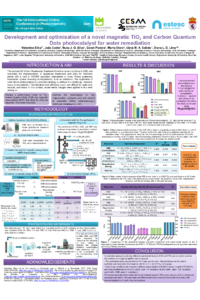
The revised EU Urban Wastewater Treatment Directive came into force in 2025 and mandates the implementation of quaternary treatments until 2045 for treatment plants with a load equivalent to a population of 150,000 or more. These quaternary treatments involve removing micropollutants, such as antibiotics. The application of solar-driven photocatalysis is a possible strategy to address this challenge. However, many photocatalysts in the literature lack efficiency and/or are difficult to implement, recover, and reuse. First, in this work, different synthesis methodologies (oxidative hydrolysis, hydrothermal treatment, co-precipitation, sonication and calcination, and functionalization and coupling via carbodiimide chemistry) were evaluated to produce a novel photocatalyst based on TiO2, Carbon Quantum Dots (CQD) and magnetic nanoparticles were proposed for the removal of three antibiotics: amoxicillin (AMX), sulfamethoxazole (SMX), and trimethoprim (TMP). Then, experimental conditions for the selected synthesis methodology (co-precipitation) were optimised using two experimental designs: a central composite design and a full factorial design to maximise antibiotic removal, photocatalyst magnetisation saturation, and synthesis yield. The optimal conditions were tested in triplicate, and the results were compared with the predicted values from the applied experimental designs. Among the synthesis methodologies, the co-precipitation provided photocatalysts with consistent properties and high efficiency in antibiotic removal. The optimal synthesis conditions were a molar ratio of 1.2:1 for Fe:Ti and a mass ratio of 4.0% for CQD:TiO2. Only 100 mg/L of the so-synthesised magnetic TiO2/CQD composite removed 34±2% of AMX and 64±5% of TMP in 1 h of irradiation and 46±5% of SMX in 1.5 h of irradiation, presenting a Ms of 38.8±0.6 emu/g and a synthesis yield of 70.5±0.4%. The obtained results provide an excellent starting point for developing a sustainable solution for removing antibiotics from water using magnetic TiO2/CQD photocatalysts and further application as a quaternary treatment in urban wastewater treatment plants.
Keywords
Antibiotics
Quaternary treatement
Experimental design
Poster
Poster_2_VGS_IOCPC_final.pdf
FT-Based Study of Photoinduced Charge Transfer in Functional Carbon Materials
A High-Entropy Zirconate Pyrochlore for Multifunctional Photocatalysis