Event submissions
Published
This submission belongs to the session S1. Photocatalysis of the event The 1st International Online Conference on Photochemistry
Published date
03 Apr, 2026
Academic Editor
'%3e%3cpath%20d='M12.6657%2010.9104C12.4185%2010.325%2012.0599%209.79327%2011.6097%209.34482C11.1609%208.89508%2010.6293%208.5365%2010.0442%208.28888C10.0389%208.28626%2010.0337%208.28495%2010.0285%208.28233C10.8446%207.69279%2011.3752%206.73249%2011.3752%205.64904C11.3752%203.8542%209.92103%202.39999%208.1262%202.39999C6.33136%202.39999%204.87715%203.8542%204.87715%205.64904C4.87715%206.73249%205.40774%207.69279%206.22393%208.28364C6.21869%208.28626%206.21345%208.28757%206.20821%208.29019C5.62129%208.5378%205.09463%208.89284%204.64265%209.34613C4.1929%209.79493%203.83432%2010.3266%203.58671%2010.9117C3.34345%2011.4845%203.21226%2012.0987%203.20023%2012.7209C3.19988%2012.7349%203.20233%2012.7488%203.20744%2012.7619C3.21255%2012.7749%203.22022%2012.7867%203.22998%2012.7968C3.23975%2012.8068%203.25142%2012.8147%203.26431%2012.8202C3.2772%2012.8256%203.29105%2012.8284%203.30504%2012.8284H4.09109C4.14874%2012.8284%204.19459%2012.7825%204.1959%2012.7262C4.2221%2011.7148%204.62823%2010.7676%205.34617%2010.0497C6.08899%209.30683%207.0755%208.89808%208.1262%208.89808C9.17689%208.89808%2010.1634%209.30683%2010.9062%2010.0497C11.6242%2010.7676%2012.0303%2011.7148%2012.0565%2012.7262C12.0578%2012.7838%2012.1037%2012.8284%2012.1613%2012.8284H12.9474C12.9613%2012.8284%2012.9752%2012.8256%2012.9881%2012.8202C13.001%2012.8147%2013.0126%2012.8068%2013.0224%2012.7968C13.0322%2012.7867%2013.0398%2012.7749%2013.0449%2012.7619C13.0501%2012.7488%2013.0525%2012.7349%2013.0522%2012.7209C13.0391%2012.0947%2012.9094%2011.4855%2012.6657%2010.9104ZM8.1262%207.9024C7.52486%207.9024%206.9589%207.6679%206.53312%207.24211C6.10733%206.81633%205.87283%206.25037%205.87283%205.64904C5.87283%205.0477%206.10733%204.48174%206.53312%204.05596C6.9589%203.63018%207.52486%203.39567%208.1262%203.39567C8.72753%203.39567%209.29349%203.63018%209.71927%204.05596C10.1451%204.48174%2010.3796%205.0477%2010.3796%205.64904C10.3796%206.25037%2010.1451%206.81633%209.71927%207.24211C9.29349%207.6679%208.72753%207.9024%208.1262%207.9024Z'%20fill='%235D1EE1'/%3e%3c/g%3e%3c/svg%3e) Vincenzo Vaiano
Vincenzo VaianoCitation
Renato Pelosato, Isabella Natali Sora, Enhanced photocatalytic degradation of oxytetracycline using LaFeO₃ supported on Mullite ceramic foam, in Proceedings of The 1st International Online Conference on Photochemistry, 8 April–9 April 2026, MDPI: Basel, Switzerland
Share
Email
Facebook
Twitter
LinkedIn
Enhanced photocatalytic degradation of oxytetracycline using LaFeO3 supported on Mullite ceramic foam
'%3e%3cpath%20d='M12.6647%2010.9104C12.4176%2010.325%2012.0589%209.7933%2011.6088%209.34485C11.16%208.89511%2010.6283%208.53653%2010.0432%208.28891C10.038%208.28629%2010.0327%208.28498%2010.0275%208.28236C10.8437%207.69282%2011.3743%206.73252%2011.3743%205.64907C11.3743%203.85423%209.92005%202.40002%208.12522%202.40002C6.33038%202.40002%204.87618%203.85423%204.87618%205.64907C4.87618%206.73252%205.40677%207.69282%206.22296%208.28367C6.21772%208.28629%206.21248%208.2876%206.20724%208.29022C5.62031%208.53783%205.09365%208.89287%204.64167%209.34616C4.19192%209.79496%203.83334%2010.3266%203.58573%2010.9117C3.34247%2011.4846%203.21128%2012.0987%203.19925%2012.721C3.1989%2012.735%203.20135%2012.7489%203.20646%2012.7619C3.21157%2012.7749%203.21924%2012.7868%203.22901%2012.7968C3.23877%2012.8068%203.25045%2012.8148%203.26334%2012.8202C3.27623%2012.8256%203.29007%2012.8284%203.30406%2012.8284H4.09012C4.14776%2012.8284%204.19362%2012.7825%204.19493%2012.7262C4.22113%2011.7148%204.62726%2010.7676%205.34519%2010.0497C6.08802%209.30686%207.07452%208.89811%208.12522%208.89811C9.17592%208.89811%2010.1624%209.30686%2010.9052%2010.0497C11.6232%2010.7676%2012.0293%2011.7148%2012.0555%2012.7262C12.0568%2012.7839%2012.1027%2012.8284%2012.1603%2012.8284H12.9464C12.9604%2012.8284%2012.9742%2012.8256%2012.9871%2012.8202C13%2012.8148%2013.0117%2012.8068%2013.0214%2012.7968C13.0312%2012.7868%2013.0389%2012.7749%2013.044%2012.7619C13.0491%2012.7489%2013.0515%2012.735%2013.0512%2012.721C13.0381%2012.0947%2012.9084%2011.4856%2012.6647%2010.9104ZM8.12522%207.90243C7.52388%207.90243%206.95792%207.66793%206.53214%207.24215C6.10636%206.81636%205.87185%206.2504%205.87185%205.64907C5.87185%205.04773%206.10636%204.48177%206.53214%204.05599C6.95792%203.63021%207.52388%203.3957%208.12522%203.3957C8.72655%203.3957%209.29252%203.63021%209.7183%204.05599C10.1441%204.48177%2010.3786%205.04773%2010.3786%205.64907C10.3786%206.2504%2010.1441%206.81636%209.7183%207.24215C9.29252%207.66793%208.72655%207.90243%208.12522%207.90243Z'%20fill='%235D1EE1'/%3e%3c/g%3e%3c/svg%3e)
Renato Pelosato 1

Isabella Natali Sora 1
1. Department of Engineering and Applied Sciences, University of Bergamo, Bergamo, Italy.
Abstract
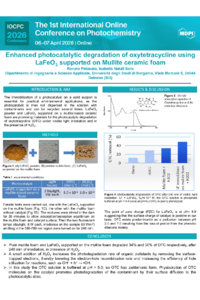
Photocatalysis is an accepted technique for persistent pollutant remediation. Compared to conventional photocatalytic systems based on a powdered catalyst, the immobilization of the catalyst on a solid support is essential for practical environmental applications. LaFeO3 is a stable p-type oxide semiconductor with a medium bandgap of 2.48 eV. Undoped-LaFeO3, like many ABO3 perovskite-type oxides, presents an extensive recombination rate for photogenerated electron–hole pairs, but it is stable in acidic solutions (pH>3) and non-toxic.
Thus, we applied a thin active layer of catalyst on the surface of sintered mullite-based ceramic foam. The photocatalyst powder covering the outer surfaces was placed layer by layer through adding the alcohol slurry of LaFeO3 powder dropwise and then thermal treatment in air at moderate temperature. With this procedure, the catalyst particles remain nanometric. Parallel tests for the photocatalytic degradation of oxytetracycline (OTC) c0 = 5.0∙10-6 M under visible-light irradiation in three different configurations were carried out: H2O2 c0 = 3.0∙10-3 M solution, H2O2 + LaFeO3 supported on the mullite foam, and H2O2 + mullite foam without catalyst. In this study, the OTC solution was buffered at pH = 5.0, so OTC had a zwitterionic form. The OTC solutions were stirred in the dark for 20 minutes, and then two fluorescent lamps (daylight, 8 W each) emitting in the 380-780 nm region were turned on for 240 min.
H2O2 + mullite foam and H2O2 + LaFeO3 supported on the mullite foam degraded 34% and 50% of OTC, respectively, after 240 min of irradiation. The small addition of H2O2 increases the photodegradation rate of organic pollutants by removing the surface-trapped electrons, thereby lowering the electron–hole recombination rate. The final results show that mullite foam with a thin layer of LaFeO3 has a promising and stable photocatalytic activity for oxytetracycline degradation under visible light.
Keywords
Lanthanum ferrite
LaFeO3 photocatalyst
mullite ceramic foam
Poster
Poster 166304.pdf
Low-Dimensional Structures and Composite Materials for Environmental Remediation
Photodegration of Methylene Blue by PLA/TiO2 Composite Membranes Prepared by the Phase Inversion Method