Event submissions
Published
This submission belongs to the session S1. Photocatalysis of the event The 1st International Online Conference on Photochemistry
Published date
03 Apr, 2026
Academic Editor
'%3e%3cpath%20d='M12.6657%2010.9104C12.4185%2010.325%2012.0599%209.79327%2011.6097%209.34482C11.1609%208.89508%2010.6293%208.5365%2010.0442%208.28888C10.0389%208.28626%2010.0337%208.28495%2010.0285%208.28233C10.8446%207.69279%2011.3752%206.73249%2011.3752%205.64904C11.3752%203.8542%209.92103%202.39999%208.1262%202.39999C6.33136%202.39999%204.87715%203.8542%204.87715%205.64904C4.87715%206.73249%205.40774%207.69279%206.22393%208.28364C6.21869%208.28626%206.21345%208.28757%206.20821%208.29019C5.62129%208.5378%205.09463%208.89284%204.64265%209.34613C4.1929%209.79493%203.83432%2010.3266%203.58671%2010.9117C3.34345%2011.4845%203.21226%2012.0987%203.20023%2012.7209C3.19988%2012.7349%203.20233%2012.7488%203.20744%2012.7619C3.21255%2012.7749%203.22022%2012.7867%203.22998%2012.7968C3.23975%2012.8068%203.25142%2012.8147%203.26431%2012.8202C3.2772%2012.8256%203.29105%2012.8284%203.30504%2012.8284H4.09109C4.14874%2012.8284%204.19459%2012.7825%204.1959%2012.7262C4.2221%2011.7148%204.62823%2010.7676%205.34617%2010.0497C6.08899%209.30683%207.0755%208.89808%208.1262%208.89808C9.17689%208.89808%2010.1634%209.30683%2010.9062%2010.0497C11.6242%2010.7676%2012.0303%2011.7148%2012.0565%2012.7262C12.0578%2012.7838%2012.1037%2012.8284%2012.1613%2012.8284H12.9474C12.9613%2012.8284%2012.9752%2012.8256%2012.9881%2012.8202C13.001%2012.8147%2013.0126%2012.8068%2013.0224%2012.7968C13.0322%2012.7867%2013.0398%2012.7749%2013.0449%2012.7619C13.0501%2012.7488%2013.0525%2012.7349%2013.0522%2012.7209C13.0391%2012.0947%2012.9094%2011.4855%2012.6657%2010.9104ZM8.1262%207.9024C7.52486%207.9024%206.9589%207.6679%206.53312%207.24211C6.10733%206.81633%205.87283%206.25037%205.87283%205.64904C5.87283%205.0477%206.10733%204.48174%206.53312%204.05596C6.9589%203.63018%207.52486%203.39567%208.1262%203.39567C8.72753%203.39567%209.29349%203.63018%209.71927%204.05596C10.1451%204.48174%2010.3796%205.0477%2010.3796%205.64904C10.3796%206.25037%2010.1451%206.81633%209.71927%207.24211C9.29349%207.6679%208.72753%207.9024%208.1262%207.9024Z'%20fill='%235D1EE1'/%3e%3c/g%3e%3c/svg%3e) Vincenzo Vaiano
Vincenzo VaianoCitation
Alina D. Oparina, Daria A. Polivanovskaia, Kirill P. Birin, Aslan Yu. Tsivadze, Outstanding photocatalytic activity of new metalloporphyrins, in Proceedings of The 1st International Online Conference on Photochemistry, 8 April–9 April 2026, MDPI: Basel, Switzerland
Share
Email
Facebook
Twitter
LinkedIn
Outstanding photocatalytic activity of new metalloporphyrins
'%3e%3cpath%20d='M12.6647%2010.9104C12.4176%2010.325%2012.0589%209.7933%2011.6088%209.34485C11.16%208.89511%2010.6283%208.53653%2010.0432%208.28891C10.038%208.28629%2010.0327%208.28498%2010.0275%208.28236C10.8437%207.69282%2011.3743%206.73252%2011.3743%205.64907C11.3743%203.85423%209.92005%202.40002%208.12522%202.40002C6.33038%202.40002%204.87618%203.85423%204.87618%205.64907C4.87618%206.73252%205.40677%207.69282%206.22296%208.28367C6.21772%208.28629%206.21248%208.2876%206.20724%208.29022C5.62031%208.53783%205.09365%208.89287%204.64167%209.34616C4.19192%209.79496%203.83334%2010.3266%203.58573%2010.9117C3.34247%2011.4846%203.21128%2012.0987%203.19925%2012.721C3.1989%2012.735%203.20135%2012.7489%203.20646%2012.7619C3.21157%2012.7749%203.21924%2012.7868%203.22901%2012.7968C3.23877%2012.8068%203.25045%2012.8148%203.26334%2012.8202C3.27623%2012.8256%203.29007%2012.8284%203.30406%2012.8284H4.09012C4.14776%2012.8284%204.19362%2012.7825%204.19493%2012.7262C4.22113%2011.7148%204.62726%2010.7676%205.34519%2010.0497C6.08802%209.30686%207.07452%208.89811%208.12522%208.89811C9.17592%208.89811%2010.1624%209.30686%2010.9052%2010.0497C11.6232%2010.7676%2012.0293%2011.7148%2012.0555%2012.7262C12.0568%2012.7839%2012.1027%2012.8284%2012.1603%2012.8284H12.9464C12.9604%2012.8284%2012.9742%2012.8256%2012.9871%2012.8202C13%2012.8148%2013.0117%2012.8068%2013.0214%2012.7968C13.0312%2012.7868%2013.0389%2012.7749%2013.044%2012.7619C13.0491%2012.7489%2013.0515%2012.735%2013.0512%2012.721C13.0381%2012.0947%2012.9084%2011.4856%2012.6647%2010.9104ZM8.12522%207.90243C7.52388%207.90243%206.95792%207.66793%206.53214%207.24215C6.10636%206.81636%205.87185%206.2504%205.87185%205.64907C5.87185%205.04773%206.10636%204.48177%206.53214%204.05599C6.95792%203.63021%207.52388%203.3957%208.12522%203.3957C8.72655%203.3957%209.29252%203.63021%209.7183%204.05599C10.1441%204.48177%2010.3786%205.04773%2010.3786%205.64907C10.3786%206.2504%2010.1441%206.81636%209.7183%207.24215C9.29252%207.66793%208.72655%207.90243%208.12522%207.90243Z'%20fill='%235D1EE1'/%3e%3c/g%3e%3c/svg%3e)
Alina D. Oparina 1,2
Daria A. Polivanovskaia 2
Kirill P. Birin 2
Aslan Yu. Tsivadze 2,3
1. Faculty of Chemistry, Lomonosov Moscow State University, Moscow, 119991, Russia
2. Frumkin Institute of Physical Chemistry and Electrochemistry Russian Academy of Sciences, Moscow, 119071, Russia
3. Kurnakov Institute of General and Inorganic Chemistry Russian Academy of Sciences, Moscow, 119071, Russia
Abstract
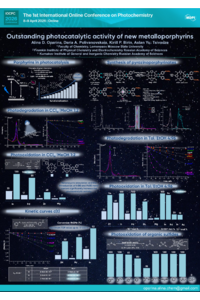
Porphyrins are able to act as effective photosensitizers for oxidation due to the ability to generate reactive oxygen species under photoexitation. Various strategies for macrocycle functionalization allow us to significantly impact the photocatalytic activity of porphyrins. For instance, heterocyclic annelation with additional aromatic fragments, expanding the π-system, or the introduction of certain metal ions into the porphyrin cave can contribute to an increase in the quantum yield of singlet oxygen. It is reasonable to expect that the use of both types of modification will make it possible to obtain fundamentally new and highly efficient photocatalysts based on pyrazine-annelated metalloporphyrin. In this work, a series of novel pyrazinoporphyrinato In(III), Pd(II), Zn(II) and Mg(II) were obtained. The study of the photostability of the compounds demonstrated that In(III) and Pd(II) complexes are the most resistant to photoirradiation. Furthermore, the Pd(II) and In(III) porphyrinates demonstrated superior photocatalytic activity in the oxidation of thioanisole. Under blue-light irradiation with photocatalyst loading of 1×10⁻3 mol%, Pd(II) and In(III) complexes achieved complete conversion of the substrate to sulfoxide and the turnover number (TON) up to 100000. Remarkably, the high activity of the In(III) complex reduced the loading to 5×10⁻⁴ mol% while still achieving 100% conversion. A study of the kinetics of photooxidation of thionalizole was carried out under photocatalytic conditions. The highest oxidation rate was demonstrated by the In(III) complex, which reached 52% conversion for 3 hours, with the maximum TOF value of 17333 h-1. The applicability of the In(III) complex as a photocatalyst for the oxidation of a series of structurally diverse organic sulfides was further studied, and 80-100% conversion was achieved for most of the substrates, which makes it a promising material for photocatalytic applications.
The work was supported by the Russian Science Foundation grant (project No. 24-73-00168).
Keywords
photocatalysis
oxidation of organic sulfides
pyrazine-annelated metalloporphyrins
Poster
Oparina_IOCPC.pdf
Photocatalysis of Ag Nanoparticles in Wastewater Teatment
Preparation and Characterization of PLAL-Derived Cobalt Nanoparticles for Methylene Blue Photodegradation