Event submissions
Published
This submission belongs to the session S2. Photochemistry for Environmental Remediation of the event The 1st International Online Conference on Photochemistry
Published date
03 Apr, 2026
Academic Editor
'%3e%3cpath%20d='M12.6657%2010.9104C12.4185%2010.325%2012.0599%209.79327%2011.6097%209.34482C11.1609%208.89508%2010.6293%208.5365%2010.0442%208.28888C10.0389%208.28626%2010.0337%208.28495%2010.0285%208.28233C10.8446%207.69279%2011.3752%206.73249%2011.3752%205.64904C11.3752%203.8542%209.92103%202.39999%208.1262%202.39999C6.33136%202.39999%204.87715%203.8542%204.87715%205.64904C4.87715%206.73249%205.40774%207.69279%206.22393%208.28364C6.21869%208.28626%206.21345%208.28757%206.20821%208.29019C5.62129%208.5378%205.09463%208.89284%204.64265%209.34613C4.1929%209.79493%203.83432%2010.3266%203.58671%2010.9117C3.34345%2011.4845%203.21226%2012.0987%203.20023%2012.7209C3.19988%2012.7349%203.20233%2012.7488%203.20744%2012.7619C3.21255%2012.7749%203.22022%2012.7867%203.22998%2012.7968C3.23975%2012.8068%203.25142%2012.8147%203.26431%2012.8202C3.2772%2012.8256%203.29105%2012.8284%203.30504%2012.8284H4.09109C4.14874%2012.8284%204.19459%2012.7825%204.1959%2012.7262C4.2221%2011.7148%204.62823%2010.7676%205.34617%2010.0497C6.08899%209.30683%207.0755%208.89808%208.1262%208.89808C9.17689%208.89808%2010.1634%209.30683%2010.9062%2010.0497C11.6242%2010.7676%2012.0303%2011.7148%2012.0565%2012.7262C12.0578%2012.7838%2012.1037%2012.8284%2012.1613%2012.8284H12.9474C12.9613%2012.8284%2012.9752%2012.8256%2012.9881%2012.8202C13.001%2012.8147%2013.0126%2012.8068%2013.0224%2012.7968C13.0322%2012.7867%2013.0398%2012.7749%2013.0449%2012.7619C13.0501%2012.7488%2013.0525%2012.7349%2013.0522%2012.7209C13.0391%2012.0947%2012.9094%2011.4855%2012.6657%2010.9104ZM8.1262%207.9024C7.52486%207.9024%206.9589%207.6679%206.53312%207.24211C6.10733%206.81633%205.87283%206.25037%205.87283%205.64904C5.87283%205.0477%206.10733%204.48174%206.53312%204.05596C6.9589%203.63018%207.52486%203.39567%208.1262%203.39567C8.72753%203.39567%209.29349%203.63018%209.71927%204.05596C10.1451%204.48174%2010.3796%205.0477%2010.3796%205.64904C10.3796%206.25037%2010.1451%206.81633%209.71927%207.24211C9.29349%207.6679%208.72753%207.9024%208.1262%207.9024Z'%20fill='%235D1EE1'/%3e%3c/g%3e%3c/svg%3e) Olga Sacco
Olga SaccoCitation
Nelda Xanath Martínez-Galero, Miguel Angel García-Muñoz, Raúl Mendoza-Ruiz, Gabriela Rivadeneyra-Romero, Adolfo Amador-Mendoza, Rocio Guadalupe Franco-Fabian, Treatment of effluents contaminated by synthetic dyes using heterogeneous photocatalysis, in Proceedings of The 1st International Online Conference on Photochemistry, 8 April–9 April 2026, MDPI: Basel, Switzerland
Share
Email
Facebook
Twitter
LinkedIn
Treatment of effluents contaminated by synthetic dyes using heterogeneous photocatalysis

Nelda Xanath Martínez-Galero 1
'%3e%3cpath%20d='M12.6647%2010.9104C12.4176%2010.325%2012.0589%209.7933%2011.6088%209.34485C11.16%208.89511%2010.6283%208.53653%2010.0432%208.28891C10.038%208.28629%2010.0327%208.28498%2010.0275%208.28236C10.8437%207.69282%2011.3743%206.73252%2011.3743%205.64907C11.3743%203.85423%209.92005%202.40002%208.12522%202.40002C6.33038%202.40002%204.87618%203.85423%204.87618%205.64907C4.87618%206.73252%205.40677%207.69282%206.22296%208.28367C6.21772%208.28629%206.21248%208.2876%206.20724%208.29022C5.62031%208.53783%205.09365%208.89287%204.64167%209.34616C4.19192%209.79496%203.83334%2010.3266%203.58573%2010.9117C3.34247%2011.4846%203.21128%2012.0987%203.19925%2012.721C3.1989%2012.735%203.20135%2012.7489%203.20646%2012.7619C3.21157%2012.7749%203.21924%2012.7868%203.22901%2012.7968C3.23877%2012.8068%203.25045%2012.8148%203.26334%2012.8202C3.27623%2012.8256%203.29007%2012.8284%203.30406%2012.8284H4.09012C4.14776%2012.8284%204.19362%2012.7825%204.19493%2012.7262C4.22113%2011.7148%204.62726%2010.7676%205.34519%2010.0497C6.08802%209.30686%207.07452%208.89811%208.12522%208.89811C9.17592%208.89811%2010.1624%209.30686%2010.9052%2010.0497C11.6232%2010.7676%2012.0293%2011.7148%2012.0555%2012.7262C12.0568%2012.7839%2012.1027%2012.8284%2012.1603%2012.8284H12.9464C12.9604%2012.8284%2012.9742%2012.8256%2012.9871%2012.8202C13%2012.8148%2013.0117%2012.8068%2013.0214%2012.7968C13.0312%2012.7868%2013.0389%2012.7749%2013.044%2012.7619C13.0491%2012.7489%2013.0515%2012.735%2013.0512%2012.721C13.0381%2012.0947%2012.9084%2011.4856%2012.6647%2010.9104ZM8.12522%207.90243C7.52388%207.90243%206.95792%207.66793%206.53214%207.24215C6.10636%206.81636%205.87185%206.2504%205.87185%205.64907C5.87185%205.04773%206.10636%204.48177%206.53214%204.05599C6.95792%203.63021%207.52388%203.3957%208.12522%203.3957C8.72655%203.3957%209.29252%203.63021%209.7183%204.05599C10.1441%204.48177%2010.3786%205.04773%2010.3786%205.64907C10.3786%206.2504%2010.1441%206.81636%209.7183%207.24215C9.29252%207.66793%208.72655%207.90243%208.12522%207.90243Z'%20fill='%235D1EE1'/%3e%3c/g%3e%3c/svg%3e)
Miguel Angel García-Muñoz 1
Raúl Mendoza-Ruiz 1
Gabriela Rivadeneyra-Romero 2
Adolfo Amador-Mendoza 3
Rocio Guadalupe Franco-Fabian 4
1. Organic Synthesis Laboratory, Scientific Research Center, Applied Chemistry Institute, Universidad del Papaloapan, Tuxtepec, 68301, México.
2. Studies of Energy Institute, Universidad del Istmo, Tehuantepec, 70760, México.
3. Agro-Engineering Institute, Universidad del Papaloapan, Loma Bonita, 68400, México.
4. Preventive Health, School of Medicine, Universidad del Papaloapan, Tuxtepec, 68301, México.
Abstract
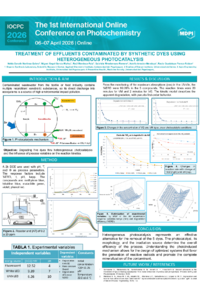
The treatment of industrial effluents represents one of the most significant challenges in contemporary environmental engineering due to the presence of persistent organic compounds, synthetic dyes, pharmaceuticals, and endocrine disruptors that are not removed by conventional methods. Therefore, advanced oxidation processes (AOPs) are effective alternatives for the complete mineralization of recalcitrant pollutants through the generation of highly reactive species capable of degrading complex molecules into carbon dioxide, water, and inorganic salts. The objective of this work is to degrade five dyes using heterogeneous photocatalysis. The AOP study was carried out using DOE 2k and UV-Vis spectroscopic monitoring (Perkin-Elmer, Spectrum 100). The five model pollutants (AM, AT, RB, RM, and VM) (Sigma-Aldrich) were degraded under controlled conditions of pH, H₂O₂, and TiO₂. The response variables included the percentage of pollutant removal (%ERD), the apparent rate constant (kapp), and the final pH.
The optimized AOP achieved degradation efficiencies exceeding 99% for various aromatic organic compounds, demonstrating the high oxidative capacity of the generated radicals. AOPs constitute a versatile and highly efficient environmental technology capable of transforming persistent organic compounds into less toxic byproducts or completely mineralizing them. Their implementation contributes to reducing the pollutant load in effluents, promoting compliance with environmental regulations, and the reuse of treated water.
Keywords
Advanced Oxidation Processes
industrial effluent treatment
Synthetic Dyes
Photocatalysis
Poster
sciforum-162650 Treatment of effluents contaminated by synthetic dyes using heterogeneous photocatalysis.pdf
PHOTOCATALYTIC DEGRADATION OF RHODAMINE USING Bi2WO6/ g-C3N4 COMPOSITE
Removal of ethidium bromide from aqueous waste using advanced oxidation processes via heterogeneous photocatalysis