Event submissions
Published
This submission belongs to the session S2. Photochemistry for Environmental Remediation of the event The 1st International Online Conference on Photochemistry
Published date
03 Apr, 2026
Academic Editor
'%3e%3cpath%20d='M12.6657%2010.9104C12.4185%2010.325%2012.0599%209.79327%2011.6097%209.34482C11.1609%208.89508%2010.6293%208.5365%2010.0442%208.28888C10.0389%208.28626%2010.0337%208.28495%2010.0285%208.28233C10.8446%207.69279%2011.3752%206.73249%2011.3752%205.64904C11.3752%203.8542%209.92103%202.39999%208.1262%202.39999C6.33136%202.39999%204.87715%203.8542%204.87715%205.64904C4.87715%206.73249%205.40774%207.69279%206.22393%208.28364C6.21869%208.28626%206.21345%208.28757%206.20821%208.29019C5.62129%208.5378%205.09463%208.89284%204.64265%209.34613C4.1929%209.79493%203.83432%2010.3266%203.58671%2010.9117C3.34345%2011.4845%203.21226%2012.0987%203.20023%2012.7209C3.19988%2012.7349%203.20233%2012.7488%203.20744%2012.7619C3.21255%2012.7749%203.22022%2012.7867%203.22998%2012.7968C3.23975%2012.8068%203.25142%2012.8147%203.26431%2012.8202C3.2772%2012.8256%203.29105%2012.8284%203.30504%2012.8284H4.09109C4.14874%2012.8284%204.19459%2012.7825%204.1959%2012.7262C4.2221%2011.7148%204.62823%2010.7676%205.34617%2010.0497C6.08899%209.30683%207.0755%208.89808%208.1262%208.89808C9.17689%208.89808%2010.1634%209.30683%2010.9062%2010.0497C11.6242%2010.7676%2012.0303%2011.7148%2012.0565%2012.7262C12.0578%2012.7838%2012.1037%2012.8284%2012.1613%2012.8284H12.9474C12.9613%2012.8284%2012.9752%2012.8256%2012.9881%2012.8202C13.001%2012.8147%2013.0126%2012.8068%2013.0224%2012.7968C13.0322%2012.7867%2013.0398%2012.7749%2013.0449%2012.7619C13.0501%2012.7488%2013.0525%2012.7349%2013.0522%2012.7209C13.0391%2012.0947%2012.9094%2011.4855%2012.6657%2010.9104ZM8.1262%207.9024C7.52486%207.9024%206.9589%207.6679%206.53312%207.24211C6.10733%206.81633%205.87283%206.25037%205.87283%205.64904C5.87283%205.0477%206.10733%204.48174%206.53312%204.05596C6.9589%203.63018%207.52486%203.39567%208.1262%203.39567C8.72753%203.39567%209.29349%203.63018%209.71927%204.05596C10.1451%204.48174%2010.3796%205.0477%2010.3796%205.64904C10.3796%206.25037%2010.1451%206.81633%209.71927%207.24211C9.29349%207.6679%208.72753%207.9024%208.1262%207.9024Z'%20fill='%235D1EE1'/%3e%3c/g%3e%3c/svg%3e) Olga Sacco
Olga SaccoCitation
Raúl Mendoza-Ruiz, Gabriela Rivadeneyra-Romero, Rocio Guadalupe Franco-Fabian, Adolfo Amador-Mendoza, Nelda Xanath Martínez-Galero, Removal of ethidium bromide from aqueous waste using advanced oxidation processes via heterogeneous photocatalysis, in Proceedings of The 1st International Online Conference on Photochemistry, 8 April–9 April 2026, MDPI: Basel, Switzerland
Share
Email
Facebook
Twitter
LinkedIn
Removal of ethidium bromide from aqueous waste using advanced oxidation processes via heterogeneous photocatalysis
'%3e%3cpath%20d='M12.6647%2010.9104C12.4176%2010.325%2012.0589%209.7933%2011.6088%209.34485C11.16%208.89511%2010.6283%208.53653%2010.0432%208.28891C10.038%208.28629%2010.0327%208.28498%2010.0275%208.28236C10.8437%207.69282%2011.3743%206.73252%2011.3743%205.64907C11.3743%203.85423%209.92005%202.40002%208.12522%202.40002C6.33038%202.40002%204.87618%203.85423%204.87618%205.64907C4.87618%206.73252%205.40677%207.69282%206.22296%208.28367C6.21772%208.28629%206.21248%208.2876%206.20724%208.29022C5.62031%208.53783%205.09365%208.89287%204.64167%209.34616C4.19192%209.79496%203.83334%2010.3266%203.58573%2010.9117C3.34247%2011.4846%203.21128%2012.0987%203.19925%2012.721C3.1989%2012.735%203.20135%2012.7489%203.20646%2012.7619C3.21157%2012.7749%203.21924%2012.7868%203.22901%2012.7968C3.23877%2012.8068%203.25045%2012.8148%203.26334%2012.8202C3.27623%2012.8256%203.29007%2012.8284%203.30406%2012.8284H4.09012C4.14776%2012.8284%204.19362%2012.7825%204.19493%2012.7262C4.22113%2011.7148%204.62726%2010.7676%205.34519%2010.0497C6.08802%209.30686%207.07452%208.89811%208.12522%208.89811C9.17592%208.89811%2010.1624%209.30686%2010.9052%2010.0497C11.6232%2010.7676%2012.0293%2011.7148%2012.0555%2012.7262C12.0568%2012.7839%2012.1027%2012.8284%2012.1603%2012.8284H12.9464C12.9604%2012.8284%2012.9742%2012.8256%2012.9871%2012.8202C13%2012.8148%2013.0117%2012.8068%2013.0214%2012.7968C13.0312%2012.7868%2013.0389%2012.7749%2013.044%2012.7619C13.0491%2012.7489%2013.0515%2012.735%2013.0512%2012.721C13.0381%2012.0947%2012.9084%2011.4856%2012.6647%2010.9104ZM8.12522%207.90243C7.52388%207.90243%206.95792%207.66793%206.53214%207.24215C6.10636%206.81636%205.87185%206.2504%205.87185%205.64907C5.87185%205.04773%206.10636%204.48177%206.53214%204.05599C6.95792%203.63021%207.52388%203.3957%208.12522%203.3957C8.72655%203.3957%209.29252%203.63021%209.7183%204.05599C10.1441%204.48177%2010.3786%205.04773%2010.3786%205.64907C10.3786%206.2504%2010.1441%206.81636%209.7183%207.24215C9.29252%207.66793%208.72655%207.90243%208.12522%207.90243Z'%20fill='%235D1EE1'/%3e%3c/g%3e%3c/svg%3e)
Raúl Mendoza-Ruiz 1
Gabriela Rivadeneyra-Romero 2
Rocio Guadalupe Franco-Fabian 3
Adolfo Amador-Mendoza 4

Nelda Xanath Martínez-Galero 1
1. Organic Synthesis Laboratory, Scientific Research Center, Applied Chemistry Institute, Universidad del Papaloapan, Tuxtepec, 68301, México.
2. Studies of Energy Institute, Universidad del Istmo, Tehuantepec, 70760, México.
3. Preventive Health, School of Medicine, Universidad del Papaloapan, Tuxtepec, 68301, México.
4. Agroengineering Institute, Universidad del Papaloapan, Loma Bonita, 68400, México.
Abstract
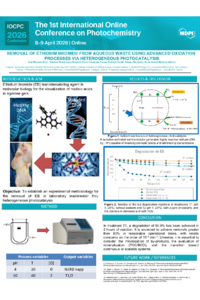
Ethidium bromide (EB) is a compound used as an intercalating agent in molecular biology for the visualization of nucleic acids in agarose gels. Its high mutagenic and carcinogenic properties, along with its potential for bioaccumulation, raise concerns regarding its release into aqueous effluents from research, diagnostic, and teaching laboratories. In this context, advanced oxidation processes (AOPs), particularly heterogeneous photocatalysis, are presented as an alternative for the complete degradation or mineralization of recalcitrant organic contaminants. In these processes, a radiation-activated semiconductor generates highly reactive radicals (•OH, •O₂⁻, h⁺) capable of breaking aromatic bonds and removing contaminants that escape conventional treatments. The objective of this protocol is to propose an experimental methodology for the removal of EB from laboratory wastewater using heterogeneous photocatalysis and to optimize operating parameters.
Based on the preliminary results obtained, the use of advanced oxidation processes, specifically heterogeneous photocatalysis with TiO₂, is a viable method for removing ethidium bromide (EB) from laboratory wastewater. It is expected that, under optimized conditions (pH, catalyst dosage, irradiation, aeration), removal rates greater than 80% can be achieved within reasonable operating times, with kinetic constants on the scale of 10⁻³ min⁻¹. Furthermore, it is essential to consider minimizing byproducts, evaluating mineralization (TOC/COD), and transitioning to continuous or scalable systems. In this regard, the findings support the integration of this technology into biotechnological effluent treatment flows, promoting environmentally responsible management and reducing the risk associated with EB release into aquatic environments.
Keywords: Advanced oxidation processes; ethidium bromide; heterogeneous photocatalysis; contaminant degradation
Keywords
Advanced Oxidation Processes
Ethidium Bromide
Heterogeneous Photocatalysis
Contaminant Degradation
Poster
sciforum-162659 Ethidium Bromide-2.pdf-1.pdf
Treatment of effluents contaminated by synthetic dyes using heterogeneous photocatalysis
Spectral Response of a Styryl Dye Confined in 1:2 Cucurbit[7]uril Inclusion Complexes