Event submissions
Published
This submission belongs to the session S5. Photoluminescent Materials of the event The 1st International Online Conference on Photochemistry
Published date
03 Apr, 2026
Academic Editor
'%3e%3cpath%20d='M12.6657%2010.9104C12.4185%2010.325%2012.0599%209.79327%2011.6097%209.34482C11.1609%208.89508%2010.6293%208.5365%2010.0442%208.28888C10.0389%208.28626%2010.0337%208.28495%2010.0285%208.28233C10.8446%207.69279%2011.3752%206.73249%2011.3752%205.64904C11.3752%203.8542%209.92103%202.39999%208.1262%202.39999C6.33136%202.39999%204.87715%203.8542%204.87715%205.64904C4.87715%206.73249%205.40774%207.69279%206.22393%208.28364C6.21869%208.28626%206.21345%208.28757%206.20821%208.29019C5.62129%208.5378%205.09463%208.89284%204.64265%209.34613C4.1929%209.79493%203.83432%2010.3266%203.58671%2010.9117C3.34345%2011.4845%203.21226%2012.0987%203.20023%2012.7209C3.19988%2012.7349%203.20233%2012.7488%203.20744%2012.7619C3.21255%2012.7749%203.22022%2012.7867%203.22998%2012.7968C3.23975%2012.8068%203.25142%2012.8147%203.26431%2012.8202C3.2772%2012.8256%203.29105%2012.8284%203.30504%2012.8284H4.09109C4.14874%2012.8284%204.19459%2012.7825%204.1959%2012.7262C4.2221%2011.7148%204.62823%2010.7676%205.34617%2010.0497C6.08899%209.30683%207.0755%208.89808%208.1262%208.89808C9.17689%208.89808%2010.1634%209.30683%2010.9062%2010.0497C11.6242%2010.7676%2012.0303%2011.7148%2012.0565%2012.7262C12.0578%2012.7838%2012.1037%2012.8284%2012.1613%2012.8284H12.9474C12.9613%2012.8284%2012.9752%2012.8256%2012.9881%2012.8202C13.001%2012.8147%2013.0126%2012.8068%2013.0224%2012.7968C13.0322%2012.7867%2013.0398%2012.7749%2013.0449%2012.7619C13.0501%2012.7488%2013.0525%2012.7349%2013.0522%2012.7209C13.0391%2012.0947%2012.9094%2011.4855%2012.6657%2010.9104ZM8.1262%207.9024C7.52486%207.9024%206.9589%207.6679%206.53312%207.24211C6.10733%206.81633%205.87283%206.25037%205.87283%205.64904C5.87283%205.0477%206.10733%204.48174%206.53312%204.05596C6.9589%203.63018%207.52486%203.39567%208.1262%203.39567C8.72753%203.39567%209.29349%203.63018%209.71927%204.05596C10.1451%204.48174%2010.3796%205.0477%2010.3796%205.64904C10.3796%206.25037%2010.1451%206.81633%209.71927%207.24211C9.29349%207.6679%208.72753%207.9024%208.1262%207.9024Z'%20fill='%235D1EE1'/%3e%3c/g%3e%3c/svg%3e) Dirk Poelman
Dirk PoelmanCitation
Olga P. Kolesnikova, Denis A. Ivanov, Igor V. Kryukov, Nikolai Kh. Petrov, Spectral Response of a Styryl Dye Confined in 1:2 Cucurbit[7]uril Inclusion Complexes, in Proceedings of The 1st International Online Conference on Photochemistry, 8 April–9 April 2026, MDPI: Basel, Switzerland
Share
Email
Facebook
Twitter
LinkedIn
Spectral Response of a Styryl Dye Confined in 1:2 Cucurbit[7]uril Inclusion Complexes

Olga P. Kolesnikova 1,2
'%3e%3cpath%20d='M12.6647%2010.9104C12.4176%2010.325%2012.0589%209.7933%2011.6088%209.34485C11.16%208.89511%2010.6283%208.53653%2010.0432%208.28891C10.038%208.28629%2010.0327%208.28498%2010.0275%208.28236C10.8437%207.69282%2011.3743%206.73252%2011.3743%205.64907C11.3743%203.85423%209.92005%202.40002%208.12522%202.40002C6.33038%202.40002%204.87618%203.85423%204.87618%205.64907C4.87618%206.73252%205.40677%207.69282%206.22296%208.28367C6.21772%208.28629%206.21248%208.2876%206.20724%208.29022C5.62031%208.53783%205.09365%208.89287%204.64167%209.34616C4.19192%209.79496%203.83334%2010.3266%203.58573%2010.9117C3.34247%2011.4846%203.21128%2012.0987%203.19925%2012.721C3.1989%2012.735%203.20135%2012.7489%203.20646%2012.7619C3.21157%2012.7749%203.21924%2012.7868%203.22901%2012.7968C3.23877%2012.8068%203.25045%2012.8148%203.26334%2012.8202C3.27623%2012.8256%203.29007%2012.8284%203.30406%2012.8284H4.09012C4.14776%2012.8284%204.19362%2012.7825%204.19493%2012.7262C4.22113%2011.7148%204.62726%2010.7676%205.34519%2010.0497C6.08802%209.30686%207.07452%208.89811%208.12522%208.89811C9.17592%208.89811%2010.1624%209.30686%2010.9052%2010.0497C11.6232%2010.7676%2012.0293%2011.7148%2012.0555%2012.7262C12.0568%2012.7839%2012.1027%2012.8284%2012.1603%2012.8284H12.9464C12.9604%2012.8284%2012.9742%2012.8256%2012.9871%2012.8202C13%2012.8148%2013.0117%2012.8068%2013.0214%2012.7968C13.0312%2012.7868%2013.0389%2012.7749%2013.044%2012.7619C13.0491%2012.7489%2013.0515%2012.735%2013.0512%2012.721C13.0381%2012.0947%2012.9084%2011.4856%2012.6647%2010.9104ZM8.12522%207.90243C7.52388%207.90243%206.95792%207.66793%206.53214%207.24215C6.10636%206.81636%205.87185%206.2504%205.87185%205.64907C5.87185%205.04773%206.10636%204.48177%206.53214%204.05599C6.95792%203.63021%207.52388%203.3957%208.12522%203.3957C8.72655%203.3957%209.29252%203.63021%209.7183%204.05599C10.1441%204.48177%2010.3786%205.04773%2010.3786%205.64907C10.3786%206.2504%2010.1441%206.81636%209.7183%207.24215C9.29252%207.66793%208.72655%207.90243%208.12522%207.90243Z'%20fill='%235D1EE1'/%3e%3c/g%3e%3c/svg%3e)
Denis A. Ivanov 2
Igor V. Kryukov 2
Nikolai Kh. Petrov 1,2
1. Moscow Center for Advanced Studies, Moscow, Kulakova Str, 20, 123592, Russia
2. National Research Center Kurchatov Institute, Moscow, Akademika Kurchatov Square, 1, 123182, Russia
Abstract
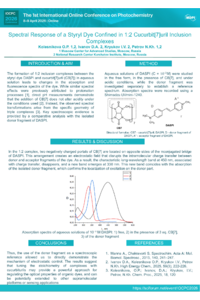
The formation of 1:2 inclusion complexes between the styryl dye DASPI and cucurbit[7]uril (CB[7]) in aqueous solution leads to changes in the absorption and fluorescence spectra of the dye. While similar spectral effects were previously attributed to protonation processes [1], direct pH measurements demonstrate that the addition of CB[7] does not alter acidity under the conditions used [2]. Instead, the observed spectral transformations arise from the specific geometry of triple complexes [3]. Key spectroscopic evidence is provided by a comparative analysis with the isolated donor fragment of DASPI.
Aqueous solutions of DASPI (C = 10-5 M) were studied in the free form, in the presence of CB[7], and under acidic conditions, while the donor fragment was investigated separately to establish a reference spectrum. Absorption spectra were recorded using a Shimadzu UVmini-1240, and fluorescence spectra were recorded on a Fluorolog-3 Tau.
In the 1:2 complex, two negatively charged portals of CB[7] are located on opposite sides of the π-conjugated bridge of DASPI. This arrangement creates an electrostatic field that disrupts the intramolecular charge transfer between donor and acceptor fragments of the dye. As a result, the characteristic long-wavelength band at 450 nm, associated with charge transfer, disappears, and a new band emerges at 330 nm. This new band coincides with the absorption of the isolated donor fragment, which confirms the localization of excitation on the donor part.
Thus, the use of the donor fragment as a spectroscopic reference allowed us to directly demonstrate the mechanism of electrostatic control. The results suggest that tuning the stoichiometry of complexes with cucurbiturils may provide a powerful approach for regulating the optical properties of organic dyes, and can be potentially extended to other supramolecular platforms or sensing applications.
- Manna A., Chakravorti S. Spectrochim. Acta A: Mol. Biomol. Spectrosc., 2015, 140, 241–247.
- Ivanov D.A., Kolesnikova O.P., Kryukov I.V., Petrov N.Kh. High Energy Chem., 2025, 59(3), 222-226.
- Kolesnikova, O.P.; Ivanov, D.A.; Kryukov, I.V.; Petrov, N.K. The Influence of Cucurbit[7]uril on the Photophysical Properties of Encapsulated Styryl Dye. Chem. Proc.2025, 18, 120
Keywords
styryl dyes
cucurbit[7]uril
inclusion complexes
fluorescence
influence of electrostatic field
Poster
Kolesnikova_updated.pdf
Removal of ethidium bromide from aqueous waste using advanced oxidation processes via heterogeneous photocatalysis
Photooxidation of organic sulfides in the presence of new metal(IV)porphyrinate-monocapped Fe(II)-, Ni(II) and Co(III)-centered pseudoclathrochelates