Event submissions
Published
This submission belongs to the session S1. Photocatalysis of the event The 1st International Online Conference on Photochemistry
Published date
03 Apr, 2026
Academic Editor
'%3e%3cpath%20d='M12.6657%2010.9104C12.4185%2010.325%2012.0599%209.79327%2011.6097%209.34482C11.1609%208.89508%2010.6293%208.5365%2010.0442%208.28888C10.0389%208.28626%2010.0337%208.28495%2010.0285%208.28233C10.8446%207.69279%2011.3752%206.73249%2011.3752%205.64904C11.3752%203.8542%209.92103%202.39999%208.1262%202.39999C6.33136%202.39999%204.87715%203.8542%204.87715%205.64904C4.87715%206.73249%205.40774%207.69279%206.22393%208.28364C6.21869%208.28626%206.21345%208.28757%206.20821%208.29019C5.62129%208.5378%205.09463%208.89284%204.64265%209.34613C4.1929%209.79493%203.83432%2010.3266%203.58671%2010.9117C3.34345%2011.4845%203.21226%2012.0987%203.20023%2012.7209C3.19988%2012.7349%203.20233%2012.7488%203.20744%2012.7619C3.21255%2012.7749%203.22022%2012.7867%203.22998%2012.7968C3.23975%2012.8068%203.25142%2012.8147%203.26431%2012.8202C3.2772%2012.8256%203.29105%2012.8284%203.30504%2012.8284H4.09109C4.14874%2012.8284%204.19459%2012.7825%204.1959%2012.7262C4.2221%2011.7148%204.62823%2010.7676%205.34617%2010.0497C6.08899%209.30683%207.0755%208.89808%208.1262%208.89808C9.17689%208.89808%2010.1634%209.30683%2010.9062%2010.0497C11.6242%2010.7676%2012.0303%2011.7148%2012.0565%2012.7262C12.0578%2012.7838%2012.1037%2012.8284%2012.1613%2012.8284H12.9474C12.9613%2012.8284%2012.9752%2012.8256%2012.9881%2012.8202C13.001%2012.8147%2013.0126%2012.8068%2013.0224%2012.7968C13.0322%2012.7867%2013.0398%2012.7749%2013.0449%2012.7619C13.0501%2012.7488%2013.0525%2012.7349%2013.0522%2012.7209C13.0391%2012.0947%2012.9094%2011.4855%2012.6657%2010.9104ZM8.1262%207.9024C7.52486%207.9024%206.9589%207.6679%206.53312%207.24211C6.10733%206.81633%205.87283%206.25037%205.87283%205.64904C5.87283%205.0477%206.10733%204.48174%206.53312%204.05596C6.9589%203.63018%207.52486%203.39567%208.1262%203.39567C8.72753%203.39567%209.29349%203.63018%209.71927%204.05596C10.1451%204.48174%2010.3796%205.0477%2010.3796%205.64904C10.3796%206.25037%2010.1451%206.81633%209.71927%207.24211C9.29349%207.6679%208.72753%207.9024%208.1262%207.9024Z'%20fill='%235D1EE1'/%3e%3c/g%3e%3c/svg%3e) Vincenzo Vaiano
Vincenzo VaianoCitation
Daria A. Polivanovskaia, Semyon V. Dudkin, Kirill P. Birin, Aslan Yu. Tsivadze, Photooxidation of organic sulfides in the presence of new metal(IV)porphyrinate-monocapped Fe(II)-, Ni(II) and Co(III)-centered pseudoclathrochelates, in Proceedings of The 1st International Online Conference on Photochemistry, 8 April–9 April 2026, MDPI: Basel, Switzerland
Share
Email
Facebook
Twitter
LinkedIn
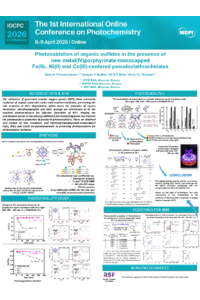
Photooxidation of organic sulfides in the presence of new metal(IV)porphyrinate-monocapped Fe(II)-, Ni(II) and Co(III)-centered pseudoclathrochelates
'%3e%3cpath%20d='M12.6647%2010.9104C12.4176%2010.325%2012.0589%209.7933%2011.6088%209.34485C11.16%208.89511%2010.6283%208.53653%2010.0432%208.28891C10.038%208.28629%2010.0327%208.28498%2010.0275%208.28236C10.8437%207.69282%2011.3743%206.73252%2011.3743%205.64907C11.3743%203.85423%209.92005%202.40002%208.12522%202.40002C6.33038%202.40002%204.87618%203.85423%204.87618%205.64907C4.87618%206.73252%205.40677%207.69282%206.22296%208.28367C6.21772%208.28629%206.21248%208.2876%206.20724%208.29022C5.62031%208.53783%205.09365%208.89287%204.64167%209.34616C4.19192%209.79496%203.83334%2010.3266%203.58573%2010.9117C3.34247%2011.4846%203.21128%2012.0987%203.19925%2012.721C3.1989%2012.735%203.20135%2012.7489%203.20646%2012.7619C3.21157%2012.7749%203.21924%2012.7868%203.22901%2012.7968C3.23877%2012.8068%203.25045%2012.8148%203.26334%2012.8202C3.27623%2012.8256%203.29007%2012.8284%203.30406%2012.8284H4.09012C4.14776%2012.8284%204.19362%2012.7825%204.19493%2012.7262C4.22113%2011.7148%204.62726%2010.7676%205.34519%2010.0497C6.08802%209.30686%207.07452%208.89811%208.12522%208.89811C9.17592%208.89811%2010.1624%209.30686%2010.9052%2010.0497C11.6232%2010.7676%2012.0293%2011.7148%2012.0555%2012.7262C12.0568%2012.7839%2012.1027%2012.8284%2012.1603%2012.8284H12.9464C12.9604%2012.8284%2012.9742%2012.8256%2012.9871%2012.8202C13%2012.8148%2013.0117%2012.8068%2013.0214%2012.7968C13.0312%2012.7868%2013.0389%2012.7749%2013.044%2012.7619C13.0491%2012.7489%2013.0515%2012.735%2013.0512%2012.721C13.0381%2012.0947%2012.9084%2011.4856%2012.6647%2010.9104ZM8.12522%207.90243C7.52388%207.90243%206.95792%207.66793%206.53214%207.24215C6.10636%206.81636%205.87185%206.2504%205.87185%205.64907C5.87185%205.04773%206.10636%204.48177%206.53214%204.05599C6.95792%203.63021%207.52388%203.3957%208.12522%203.3957C8.72655%203.3957%209.29252%203.63021%209.7183%204.05599C10.1441%204.48177%2010.3786%205.04773%2010.3786%205.64907C10.3786%206.2504%2010.1441%206.81636%209.7183%207.24215C9.29252%207.66793%208.72655%207.90243%208.12522%207.90243Z'%20fill='%235D1EE1'/%3e%3c/g%3e%3c/svg%3e)
Daria A. Polivanovskaia 1,2
Semyon V. Dudkin 2
Kirill P. Birin 1
Aslan Yu. Tsivadze 1,3
1. Frumkin Institute of Physical Chemistry and Electrochemistry Russian Academy of Sciences, 119071 Moscow, Russia.
2. Nesmeyanov Institute of Organoelement Compounds Russian Academy of Sciences, 119334 Moscow, Russia.
3. Kurnakov Institute of General and Inorganic Chemistry Russian Academy Of Sciences, 119071, Moscow, Russia.
Abstract
One of the priority areas of scientific development today is the search for new approaches to efficient and selective transformations of organic substrates. This challenge can be successfully overcome using catalytic approaches to various reactions, including oxidation reactions. Due to their broadly conjugated polyaromatic system, porphyrins possess unique optical and electronic properties upon photoexcitation, namely the ability to transfer energy and electrons to molecular oxygen, forming its reactive oxygen species (ROS). In turn, the ROS allows selective oxidation reactions to be performed under mild conditions and prevents the formation byproducts and degradation products of chemical oxidants. This is fully consistent with the principles of atom economy and green chemistry. Thus, porphyrins could be considered as promising photocatalysts for effective oxidation processes. Nevertheless, the known porphyrin-based photocatalysts require significant efforts for the optimization of their photocatalytic characteristics, including activity, photostability, and conditions of photocatalytic reactions.
In this study, we developed an approach to control the physicochemical properties of the tetrapyrroles by introducing into the axial positions of Zr and Hf(IV) porphyrinates additional coordination structures—tris-pyridinoximate complexes of Fe, Ni(II) and Co(III). Thus, new metal(IV)porphyrinate-monocapped Fe, Ni(II) and Co(III)-centered pseudoclathrochelates were prepared.
It was shown that this functionalization of porphyrinates was shown to significantly increase photostability and the photocatalytic activity of the macrocycles in oxidation compared to their precursors. Irradiation with low-power light (LED lamp, 3W, 410-510 nm) in most cases resulted in complete conversion of thioanisole as model organic sulfide while maintaining >99% selectivity of the formation of the target sulfoxide. This type of photocatalyst has demonstrated high applicability for the oxidation of a series of aryl alkyl and alkyl alkyl sulfides with various substituents at extremely low catalyst loading (0.02 mol%).
This work was supported by the Russian Science Foundation grant (project No. 24-23-00323).
Keywords
macroheterocyclic compounds
polynuclear complexes
3d-metal complexes
cage metal complexes
metal porphyrinates
photocatalytic oxidation
organic sulfoxides
Poster
Poster_POLIVANOVSKAYA_iocpc2026.pdf
Spectral Response of a Styryl Dye Confined in 1:2 Cucurbit[7]uril Inclusion Complexes
Light-Induced Optical and Interfacial Charge Modulation in SiC/PS Nanocomposites for Photocatalytic Applications