Event submissions
Published
This submission belongs to the session S1. Photocatalysis of the event The 1st International Online Conference on Photochemistry
Published date
03 Apr, 2026
Academic Editor
'%3e%3cpath%20d='M12.6657%2010.9104C12.4185%2010.325%2012.0599%209.79327%2011.6097%209.34482C11.1609%208.89508%2010.6293%208.5365%2010.0442%208.28888C10.0389%208.28626%2010.0337%208.28495%2010.0285%208.28233C10.8446%207.69279%2011.3752%206.73249%2011.3752%205.64904C11.3752%203.8542%209.92103%202.39999%208.1262%202.39999C6.33136%202.39999%204.87715%203.8542%204.87715%205.64904C4.87715%206.73249%205.40774%207.69279%206.22393%208.28364C6.21869%208.28626%206.21345%208.28757%206.20821%208.29019C5.62129%208.5378%205.09463%208.89284%204.64265%209.34613C4.1929%209.79493%203.83432%2010.3266%203.58671%2010.9117C3.34345%2011.4845%203.21226%2012.0987%203.20023%2012.7209C3.19988%2012.7349%203.20233%2012.7488%203.20744%2012.7619C3.21255%2012.7749%203.22022%2012.7867%203.22998%2012.7968C3.23975%2012.8068%203.25142%2012.8147%203.26431%2012.8202C3.2772%2012.8256%203.29105%2012.8284%203.30504%2012.8284H4.09109C4.14874%2012.8284%204.19459%2012.7825%204.1959%2012.7262C4.2221%2011.7148%204.62823%2010.7676%205.34617%2010.0497C6.08899%209.30683%207.0755%208.89808%208.1262%208.89808C9.17689%208.89808%2010.1634%209.30683%2010.9062%2010.0497C11.6242%2010.7676%2012.0303%2011.7148%2012.0565%2012.7262C12.0578%2012.7838%2012.1037%2012.8284%2012.1613%2012.8284H12.9474C12.9613%2012.8284%2012.9752%2012.8256%2012.9881%2012.8202C13.001%2012.8147%2013.0126%2012.8068%2013.0224%2012.7968C13.0322%2012.7867%2013.0398%2012.7749%2013.0449%2012.7619C13.0501%2012.7488%2013.0525%2012.7349%2013.0522%2012.7209C13.0391%2012.0947%2012.9094%2011.4855%2012.6657%2010.9104ZM8.1262%207.9024C7.52486%207.9024%206.9589%207.6679%206.53312%207.24211C6.10733%206.81633%205.87283%206.25037%205.87283%205.64904C5.87283%205.0477%206.10733%204.48174%206.53312%204.05596C6.9589%203.63018%207.52486%203.39567%208.1262%203.39567C8.72753%203.39567%209.29349%203.63018%209.71927%204.05596C10.1451%204.48174%2010.3796%205.0477%2010.3796%205.64904C10.3796%206.25037%2010.1451%206.81633%209.71927%207.24211C9.29349%207.6679%208.72753%207.9024%208.1262%207.9024Z'%20fill='%235D1EE1'/%3e%3c/g%3e%3c/svg%3e) Vincenzo Vaiano
Vincenzo VaianoCitation
Ekaterina Sergeevna Shremzer, Daria A. Polivanovskaia, Kirill P. Birin, Aslan Yu. Tsivadze, Pyrazinoporphyrins for the photooxidation of organic sulfides: the role of the metal center and functional groups, in Proceedings of The 1st International Online Conference on Photochemistry, 8 April–9 April 2026, MDPI: Basel, Switzerland
Share
Email
Facebook
Twitter
LinkedIn
Pyrazinoporphyrins for the photooxidation of organic sulfides: the role of the metal center and functional groups
'%3e%3cpath%20d='M12.6647%2010.9104C12.4176%2010.325%2012.0589%209.7933%2011.6088%209.34485C11.16%208.89511%2010.6283%208.53653%2010.0432%208.28891C10.038%208.28629%2010.0327%208.28498%2010.0275%208.28236C10.8437%207.69282%2011.3743%206.73252%2011.3743%205.64907C11.3743%203.85423%209.92005%202.40002%208.12522%202.40002C6.33038%202.40002%204.87618%203.85423%204.87618%205.64907C4.87618%206.73252%205.40677%207.69282%206.22296%208.28367C6.21772%208.28629%206.21248%208.2876%206.20724%208.29022C5.62031%208.53783%205.09365%208.89287%204.64167%209.34616C4.19192%209.79496%203.83334%2010.3266%203.58573%2010.9117C3.34247%2011.4846%203.21128%2012.0987%203.19925%2012.721C3.1989%2012.735%203.20135%2012.7489%203.20646%2012.7619C3.21157%2012.7749%203.21924%2012.7868%203.22901%2012.7968C3.23877%2012.8068%203.25045%2012.8148%203.26334%2012.8202C3.27623%2012.8256%203.29007%2012.8284%203.30406%2012.8284H4.09012C4.14776%2012.8284%204.19362%2012.7825%204.19493%2012.7262C4.22113%2011.7148%204.62726%2010.7676%205.34519%2010.0497C6.08802%209.30686%207.07452%208.89811%208.12522%208.89811C9.17592%208.89811%2010.1624%209.30686%2010.9052%2010.0497C11.6232%2010.7676%2012.0293%2011.7148%2012.0555%2012.7262C12.0568%2012.7839%2012.1027%2012.8284%2012.1603%2012.8284H12.9464C12.9604%2012.8284%2012.9742%2012.8256%2012.9871%2012.8202C13%2012.8148%2013.0117%2012.8068%2013.0214%2012.7968C13.0312%2012.7868%2013.0389%2012.7749%2013.044%2012.7619C13.0491%2012.7489%2013.0515%2012.735%2013.0512%2012.721C13.0381%2012.0947%2012.9084%2011.4856%2012.6647%2010.9104ZM8.12522%207.90243C7.52388%207.90243%206.95792%207.66793%206.53214%207.24215C6.10636%206.81636%205.87185%206.2504%205.87185%205.64907C5.87185%205.04773%206.10636%204.48177%206.53214%204.05599C6.95792%203.63021%207.52388%203.3957%208.12522%203.3957C8.72655%203.3957%209.29252%203.63021%209.7183%204.05599C10.1441%204.48177%2010.3786%205.04773%2010.3786%205.64907C10.3786%206.2504%2010.1441%206.81636%209.7183%207.24215C9.29252%207.66793%208.72655%207.90243%208.12522%207.90243Z'%20fill='%235D1EE1'/%3e%3c/g%3e%3c/svg%3e)
Ekaterina Sergeevna Shremzer 1
Daria A. Polivanovskaia 1
Kirill P. Birin 1
Aslan Yu. Tsivadze 1,2
1. Frumkin Institute of Physical Chemistry and Electrochemistry Russian Academy of Sciences, 119071 Moscow, Russia.
2. Kurnakov Institute of General and Inorganic Chemistry Russian Academy of Sciences, 119071, Moscow, Russia.
Abstract
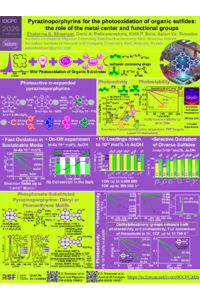
Porphyrins constitute a versatile platform for designing photocatalysts, and the growing interest in photocatalysis for organic synthesis and sustainable technologies underscores the need for strategies that improve their efficiency. The synthesis of the target pyrazinoporphyrins was carried out following previously developed methodologies, which involve the reduction of 2-nitro-3-aminoporphyrin to the corresponding 2,3-diamino derivative followed by condensation with aromatic carbonyl compounds. A synthetic approach enabling the introduction of phosphoryl groups on the periphery of diaryl-substituted and phenanthrene-appended pyrazinoporphyrins was established via phosphorylation of brominated precursors. This strategy afforded a series of photoactive compounds, including the free bases and the Zn(II) and In(III) complexes bearing various meso-substituents.
To assess the effect of these structural modifications on the stability of pyrazinoporphyrins, the kinetics of photodegradation were analyzed. The introduction of diethylphosphoryl groups was found to markedly enhance photostability. Indium(III) complexation further decreased the photodegradation rate by nearly 20-fold, whereas zinc(II) coordination had the opposite effect.
The introduction of phosphoryl substituents and indium(III) ions into the macrocycle also resulted in a systematic enhancement in photocatalytic activity in the photooxidation of thioanisole. At 0.0005 mol% loading, functionalized free bases and In(III) complexes achieved 78–100% conversion, whereas non-functionalized pyrazinoporphyrins produced only 66–72% even at higher loadings (0.001 mol%).
Kinetics studies of thioanisole photooxidation in acetic acid revealed that in both series of pyrazinoporphyrins, the In(III) complexes outperform the corresponding free bases. At the lowest tested loading (0.00001 mol%), an exceptional TON of 9900000 and a TOF of 309000 h-1 were obtained, highlighting the outstanding catalytic performance of these systems. The high efficiency of the catalysts was further demonstrated in the selective oxidation of a wide range of sulfides. Overall, the new photosensitizers outperformed previously reported porphyrin systems.
This work was supported by the Russian Science Foundation (grant № 24-73-00168).
Keywords
Pyrazine-fused porphyrin
Indium(III) porphyrinates
π-Expansion Photostability
Photocatalysis
Oxidation of organic sulfides
Poster
shremzerES_IOCPC.pdf
Light-Induced Optical and Interfacial Charge Modulation in SiC/PS Nanocomposites for Photocatalytic Applications
Photocatalytic C-H Oxygenation of Hydrocarbons with Chlorine Dioxide