Event submissions
Published
This submission belongs to the session S1. Photocatalysis of the event The 1st International Online Conference on Photochemistry
Published date
03 Apr, 2026
Academic Editor
'%3e%3cpath%20d='M12.6657%2010.9104C12.4185%2010.325%2012.0599%209.79327%2011.6097%209.34482C11.1609%208.89508%2010.6293%208.5365%2010.0442%208.28888C10.0389%208.28626%2010.0337%208.28495%2010.0285%208.28233C10.8446%207.69279%2011.3752%206.73249%2011.3752%205.64904C11.3752%203.8542%209.92103%202.39999%208.1262%202.39999C6.33136%202.39999%204.87715%203.8542%204.87715%205.64904C4.87715%206.73249%205.40774%207.69279%206.22393%208.28364C6.21869%208.28626%206.21345%208.28757%206.20821%208.29019C5.62129%208.5378%205.09463%208.89284%204.64265%209.34613C4.1929%209.79493%203.83432%2010.3266%203.58671%2010.9117C3.34345%2011.4845%203.21226%2012.0987%203.20023%2012.7209C3.19988%2012.7349%203.20233%2012.7488%203.20744%2012.7619C3.21255%2012.7749%203.22022%2012.7867%203.22998%2012.7968C3.23975%2012.8068%203.25142%2012.8147%203.26431%2012.8202C3.2772%2012.8256%203.29105%2012.8284%203.30504%2012.8284H4.09109C4.14874%2012.8284%204.19459%2012.7825%204.1959%2012.7262C4.2221%2011.7148%204.62823%2010.7676%205.34617%2010.0497C6.08899%209.30683%207.0755%208.89808%208.1262%208.89808C9.17689%208.89808%2010.1634%209.30683%2010.9062%2010.0497C11.6242%2010.7676%2012.0303%2011.7148%2012.0565%2012.7262C12.0578%2012.7838%2012.1037%2012.8284%2012.1613%2012.8284H12.9474C12.9613%2012.8284%2012.9752%2012.8256%2012.9881%2012.8202C13.001%2012.8147%2013.0126%2012.8068%2013.0224%2012.7968C13.0322%2012.7867%2013.0398%2012.7749%2013.0449%2012.7619C13.0501%2012.7488%2013.0525%2012.7349%2013.0522%2012.7209C13.0391%2012.0947%2012.9094%2011.4855%2012.6657%2010.9104ZM8.1262%207.9024C7.52486%207.9024%206.9589%207.6679%206.53312%207.24211C6.10733%206.81633%205.87283%206.25037%205.87283%205.64904C5.87283%205.0477%206.10733%204.48174%206.53312%204.05596C6.9589%203.63018%207.52486%203.39567%208.1262%203.39567C8.72753%203.39567%209.29349%203.63018%209.71927%204.05596C10.1451%204.48174%2010.3796%205.0477%2010.3796%205.64904C10.3796%206.25037%2010.1451%206.81633%209.71927%207.24211C9.29349%207.6679%208.72753%207.9024%208.1262%207.9024Z'%20fill='%235D1EE1'/%3e%3c/g%3e%3c/svg%3e) Vincenzo Vaiano
Vincenzo VaianoCitation
Muhammad Ayyaz, Maria Vittoria Diamanti, MariaPia Pedeferri, Maria Jose Mateos, Silvia Suarez, Viscoelastic and Thermoreversible study of Water-Based TiO₂ Sol–Gels for High-Efficiency Photocatalytic Air Purification, in Proceedings of The 1st International Online Conference on Photochemistry, 8 April–9 April 2026, MDPI: Basel, Switzerland
Share
Email
Facebook
Twitter
LinkedIn
Viscoelastic and Thermoreversible study of Water-Based TiO2 Sol–Gels for High-Efficiency Photocatalytic Air Purification
'%3e%3cpath%20d='M12.6647%2010.9104C12.4176%2010.325%2012.0589%209.7933%2011.6088%209.34485C11.16%208.89511%2010.6283%208.53653%2010.0432%208.28891C10.038%208.28629%2010.0327%208.28498%2010.0275%208.28236C10.8437%207.69282%2011.3743%206.73252%2011.3743%205.64907C11.3743%203.85423%209.92005%202.40002%208.12522%202.40002C6.33038%202.40002%204.87618%203.85423%204.87618%205.64907C4.87618%206.73252%205.40677%207.69282%206.22296%208.28367C6.21772%208.28629%206.21248%208.2876%206.20724%208.29022C5.62031%208.53783%205.09365%208.89287%204.64167%209.34616C4.19192%209.79496%203.83334%2010.3266%203.58573%2010.9117C3.34247%2011.4846%203.21128%2012.0987%203.19925%2012.721C3.1989%2012.735%203.20135%2012.7489%203.20646%2012.7619C3.21157%2012.7749%203.21924%2012.7868%203.22901%2012.7968C3.23877%2012.8068%203.25045%2012.8148%203.26334%2012.8202C3.27623%2012.8256%203.29007%2012.8284%203.30406%2012.8284H4.09012C4.14776%2012.8284%204.19362%2012.7825%204.19493%2012.7262C4.22113%2011.7148%204.62726%2010.7676%205.34519%2010.0497C6.08802%209.30686%207.07452%208.89811%208.12522%208.89811C9.17592%208.89811%2010.1624%209.30686%2010.9052%2010.0497C11.6232%2010.7676%2012.0293%2011.7148%2012.0555%2012.7262C12.0568%2012.7839%2012.1027%2012.8284%2012.1603%2012.8284H12.9464C12.9604%2012.8284%2012.9742%2012.8256%2012.9871%2012.8202C13%2012.8148%2013.0117%2012.8068%2013.0214%2012.7968C13.0312%2012.7868%2013.0389%2012.7749%2013.044%2012.7619C13.0491%2012.7489%2013.0515%2012.735%2013.0512%2012.721C13.0381%2012.0947%2012.9084%2011.4856%2012.6647%2010.9104ZM8.12522%207.90243C7.52388%207.90243%206.95792%207.66793%206.53214%207.24215C6.10636%206.81636%205.87185%206.2504%205.87185%205.64907C5.87185%205.04773%206.10636%204.48177%206.53214%204.05599C6.95792%203.63021%207.52388%203.3957%208.12522%203.3957C8.72655%203.3957%209.29252%203.63021%209.7183%204.05599C10.1441%204.48177%2010.3786%205.04773%2010.3786%205.64907C10.3786%206.2504%2010.1441%206.81636%209.7183%207.24215C9.29252%207.66793%208.72655%207.90243%208.12522%207.90243Z'%20fill='%235D1EE1'/%3e%3c/g%3e%3c/svg%3e)
Muhammad Ayyaz 1

Maria Vittoria Diamanti 1
MariaPia Pedeferri 1
Maria Jose Mateos 2

Silvia Suarez 2
1. Department of Chemistry, Materials and Chemical Engineering “Giulio Natta”, Politecnico di Milano, Via Mancinelli 7, 20131 Milan, Italy.
2. FOTOAIR-CIEMAT, Energy and Environmental Devices Unit, Energy Department, Avda. Complutense 40, Madrid, Spain.
Abstract
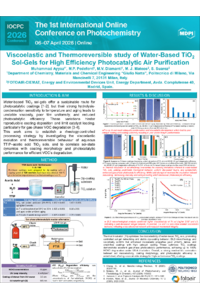
Water-based sol–gel synthesis of TiO₂ is increasingly relevant for sustainable photocatalytic materials, but its strong temperature-sensitive hydrolysis–condensation behaviour often leads to poor viscosity control, unpredictable gelation, and non-uniform coatings. These rheological instabilities limit catalyst loading and reduce photocatalytic efficiency, particularly in gas-phase VOC degradation. This work investigates the viscoelastic evolution, thermoreversibility, and structural transitions of fully aqueous TTIP–acetic acid TiO2 sols to establish processing conditions that yield uniform, high-performance coatings.
TiO2 sols were aged at ambient temperature (Ta), thermally incubated at 50 °C (Ti), and subsequently cold stored at 4 °C (Tc). Viscosity was monitored using vibro-viscometry, while microstructural viscoelasticity was evaluated through DLS microrheology with 40 nm and 100 nm Au probes. Coatings prepared by dip-coating were examined via FE-SEM, profilometry, XRD, and UV-Vis spectroscopy. Gas-phase formaldehyde (10 ppm) degradation under UV-A irradiation (300–700 mL/min) was used to assess photocatalytic performance.
Ta sols remained weakly condensed (48–60 nm particles; ~1.8 mPa·s viscosity), producing thin, non-uniform coatings with low catalyst loading (0.016 mg/cm2) and poor HCHO degradation (<30%). Thermal incubation induced controlled condensation, optimized viscosity (~8 mPa·s), and generated subdiffusive microrheological behaviour, enabling uniform coatings with 0.106 mg/cm2 loading and crystallite size ~7 nm. These coatings achieved 100%, 97%, and 78% HCHO degradation under UV-A irradiation at 300, 500, and 700 mL/min, respectively. Cold storage partially reversed the incubation effects, reducing viscosity, thickness, and photocatalytic activity.
Thermally modulated aqueous sol–gel processing enables precise control of TiO2 sol viscoelasticity and thermoreversibility, allowing the formation of stable, uniform, nanocrystalline coatings with high gas-phase photocatalytic efficiency. This study establishes a rheology-guided pathway for designing sustainable, high-performance water-based TiO2 photocatalytic materials.
Keywords
Titanium dioxide
sol-gel
rheology
thermoreversibility
photocatalytic coatings
formaldehyde
Poster
Poster Ayyaz.pdf
First highly efficient degradation and dechlorination of herbicides by photocatalytic hydrogenation: Advanced reduction processes (ARP) approach
Investigation of the Photocatalytic Activity of Nickel Ferrite-Iron Oxide Materials