Event submissions
Published
This submission belongs to the session S1. Photocatalysis of the event The 1st International Online Conference on Photochemistry
Published date
03 Apr, 2026
Academic Editor
'%3e%3cpath%20d='M12.6657%2010.9104C12.4185%2010.325%2012.0599%209.79327%2011.6097%209.34482C11.1609%208.89508%2010.6293%208.5365%2010.0442%208.28888C10.0389%208.28626%2010.0337%208.28495%2010.0285%208.28233C10.8446%207.69279%2011.3752%206.73249%2011.3752%205.64904C11.3752%203.8542%209.92103%202.39999%208.1262%202.39999C6.33136%202.39999%204.87715%203.8542%204.87715%205.64904C4.87715%206.73249%205.40774%207.69279%206.22393%208.28364C6.21869%208.28626%206.21345%208.28757%206.20821%208.29019C5.62129%208.5378%205.09463%208.89284%204.64265%209.34613C4.1929%209.79493%203.83432%2010.3266%203.58671%2010.9117C3.34345%2011.4845%203.21226%2012.0987%203.20023%2012.7209C3.19988%2012.7349%203.20233%2012.7488%203.20744%2012.7619C3.21255%2012.7749%203.22022%2012.7867%203.22998%2012.7968C3.23975%2012.8068%203.25142%2012.8147%203.26431%2012.8202C3.2772%2012.8256%203.29105%2012.8284%203.30504%2012.8284H4.09109C4.14874%2012.8284%204.19459%2012.7825%204.1959%2012.7262C4.2221%2011.7148%204.62823%2010.7676%205.34617%2010.0497C6.08899%209.30683%207.0755%208.89808%208.1262%208.89808C9.17689%208.89808%2010.1634%209.30683%2010.9062%2010.0497C11.6242%2010.7676%2012.0303%2011.7148%2012.0565%2012.7262C12.0578%2012.7838%2012.1037%2012.8284%2012.1613%2012.8284H12.9474C12.9613%2012.8284%2012.9752%2012.8256%2012.9881%2012.8202C13.001%2012.8147%2013.0126%2012.8068%2013.0224%2012.7968C13.0322%2012.7867%2013.0398%2012.7749%2013.0449%2012.7619C13.0501%2012.7488%2013.0525%2012.7349%2013.0522%2012.7209C13.0391%2012.0947%2012.9094%2011.4855%2012.6657%2010.9104ZM8.1262%207.9024C7.52486%207.9024%206.9589%207.6679%206.53312%207.24211C6.10733%206.81633%205.87283%206.25037%205.87283%205.64904C5.87283%205.0477%206.10733%204.48174%206.53312%204.05596C6.9589%203.63018%207.52486%203.39567%208.1262%203.39567C8.72753%203.39567%209.29349%203.63018%209.71927%204.05596C10.1451%204.48174%2010.3796%205.0477%2010.3796%205.64904C10.3796%206.25037%2010.1451%206.81633%209.71927%207.24211C9.29349%207.6679%208.72753%207.9024%208.1262%207.9024Z'%20fill='%235D1EE1'/%3e%3c/g%3e%3c/svg%3e) Vincenzo Vaiano
Vincenzo VaianoCitation
Michail Evgenievich Fedosenko, Svetlana Vasilievna Saikova, Diana Igorevna Nemkova, Investigation of the Photocatalytic Activity of Nickel Ferrite-Iron Oxide Materials, in Proceedings of The 1st International Online Conference on Photochemistry, 8 April–9 April 2026, MDPI: Basel, Switzerland
Share
Email
Facebook
Twitter
LinkedIn
Investigation of the Photocatalytic Activity of Nickel Ferrite-Iron Oxide Materials
'%3e%3cpath%20d='M12.6647%2010.9104C12.4176%2010.325%2012.0589%209.7933%2011.6088%209.34485C11.16%208.89511%2010.6283%208.53653%2010.0432%208.28891C10.038%208.28629%2010.0327%208.28498%2010.0275%208.28236C10.8437%207.69282%2011.3743%206.73252%2011.3743%205.64907C11.3743%203.85423%209.92005%202.40002%208.12522%202.40002C6.33038%202.40002%204.87618%203.85423%204.87618%205.64907C4.87618%206.73252%205.40677%207.69282%206.22296%208.28367C6.21772%208.28629%206.21248%208.2876%206.20724%208.29022C5.62031%208.53783%205.09365%208.89287%204.64167%209.34616C4.19192%209.79496%203.83334%2010.3266%203.58573%2010.9117C3.34247%2011.4846%203.21128%2012.0987%203.19925%2012.721C3.1989%2012.735%203.20135%2012.7489%203.20646%2012.7619C3.21157%2012.7749%203.21924%2012.7868%203.22901%2012.7968C3.23877%2012.8068%203.25045%2012.8148%203.26334%2012.8202C3.27623%2012.8256%203.29007%2012.8284%203.30406%2012.8284H4.09012C4.14776%2012.8284%204.19362%2012.7825%204.19493%2012.7262C4.22113%2011.7148%204.62726%2010.7676%205.34519%2010.0497C6.08802%209.30686%207.07452%208.89811%208.12522%208.89811C9.17592%208.89811%2010.1624%209.30686%2010.9052%2010.0497C11.6232%2010.7676%2012.0293%2011.7148%2012.0555%2012.7262C12.0568%2012.7839%2012.1027%2012.8284%2012.1603%2012.8284H12.9464C12.9604%2012.8284%2012.9742%2012.8256%2012.9871%2012.8202C13%2012.8148%2013.0117%2012.8068%2013.0214%2012.7968C13.0312%2012.7868%2013.0389%2012.7749%2013.044%2012.7619C13.0491%2012.7489%2013.0515%2012.735%2013.0512%2012.721C13.0381%2012.0947%2012.9084%2011.4856%2012.6647%2010.9104ZM8.12522%207.90243C7.52388%207.90243%206.95792%207.66793%206.53214%207.24215C6.10636%206.81636%205.87185%206.2504%205.87185%205.64907C5.87185%205.04773%206.10636%204.48177%206.53214%204.05599C6.95792%203.63021%207.52388%203.3957%208.12522%203.3957C8.72655%203.3957%209.29252%203.63021%209.7183%204.05599C10.1441%204.48177%2010.3786%205.04773%2010.3786%205.64907C10.3786%206.2504%2010.1441%206.81636%209.7183%207.24215C9.29252%207.66793%208.72655%207.90243%208.12522%207.90243Z'%20fill='%235D1EE1'/%3e%3c/g%3e%3c/svg%3e)
Michail Evgenievich Fedosenko 1

Svetlana Vasilievna Saikova 2

Diana Igorevna Nemkova 2
1. School of Non-Ferrous Metals, Faculty of Physical and Inorganic Chemistry, Siberian Federal University, Krasnoyarsk, 660012, Russian Federation
2. School of Non-Ferrous Metals, Siberian Federal University, Institute of chemistry and chemical technologies SB RAS, Krasnoyarsk, 660078, Russian Federation
Abstract
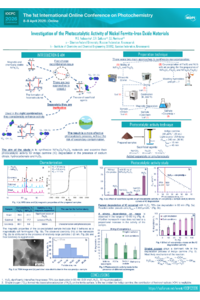
Photocatalysis is a highly promising approach to environmental pollution. However, the practical application of many photocatalysts is limited by the difficulties of efficently separating them from the reaction medium. Using magnetic materials is a viable solution to this problem. Nickel ferrite is a material that has proven to have high chemical stability and magnetic properties. Unfortunately, its application in photocatalysis is limited by the rapid process of charge recombination. The two primary mechanisms for separating charges are as follows: The first involves creating a contact between two semiconductors to form a solid-state heterojunction. The second is the addition of sacrificial agents in the liquid phase, which react irreversibly with charges from the semiconductor, thereby inhibiting rapid recombination. Therefore, the aim of this work is to synthesize and characterize nickel–ferrite-based materials and investigate their photocatalytic activity in the presence of sacrificial agents. NiFe2O4/Fe2O3 photocatalysts were prepared via co-precipitation of Fe(NO₃)₃ and Ni(NO₃)₂ using NaOH, followed by calcination at 650 °C for 3 hours. The synthesized materials were characterized by XRD, TEM, UV-Vis, and photoluminescence spectroscopy. Photocatalytic activity was evaluated via the degradation of an indigocarmine dye (20 mL, 4.0×10⁻⁵ mol·L⁻¹) under a13 W lamp with λmax =340 nm. Experiments to identify the most effective sacrificial agent (NaHCO₃, Na₂CO₃, sodium citrate, or H₂O₂) were conducted under the same conditions. The most promising photocatalyst was also tested for recyclability. The highest photocatalytic activity (73% degradation of indigocarmine under 340 nm irradiation for 45 minutes) was achieved using hydrogen peroxide (0,011 mol*L-1 in the reaction medium) as a sacrificial agent. An indigocarmine degradation reaction mechanism is proposed.
Keywords
Photocatalysis
sacrificial agents
iron oxide
nickel ferrite
Poster
poster.pdf
Viscoelastic and Thermoreversible study of Water-Based TiO2 Sol–Gels for High-Efficiency Photocatalytic Air Purification
Reduced imide derivatives of natural chlorins