Event submissions
Published
This submission belongs to the session S2. Photochemistry for Environmental Remediation of the event The 1st International Online Conference on Photochemistry
Published date
03 Apr, 2026
Academic Editor
'%3e%3cpath%20d='M12.6657%2010.9104C12.4185%2010.325%2012.0599%209.79327%2011.6097%209.34482C11.1609%208.89508%2010.6293%208.5365%2010.0442%208.28888C10.0389%208.28626%2010.0337%208.28495%2010.0285%208.28233C10.8446%207.69279%2011.3752%206.73249%2011.3752%205.64904C11.3752%203.8542%209.92103%202.39999%208.1262%202.39999C6.33136%202.39999%204.87715%203.8542%204.87715%205.64904C4.87715%206.73249%205.40774%207.69279%206.22393%208.28364C6.21869%208.28626%206.21345%208.28757%206.20821%208.29019C5.62129%208.5378%205.09463%208.89284%204.64265%209.34613C4.1929%209.79493%203.83432%2010.3266%203.58671%2010.9117C3.34345%2011.4845%203.21226%2012.0987%203.20023%2012.7209C3.19988%2012.7349%203.20233%2012.7488%203.20744%2012.7619C3.21255%2012.7749%203.22022%2012.7867%203.22998%2012.7968C3.23975%2012.8068%203.25142%2012.8147%203.26431%2012.8202C3.2772%2012.8256%203.29105%2012.8284%203.30504%2012.8284H4.09109C4.14874%2012.8284%204.19459%2012.7825%204.1959%2012.7262C4.2221%2011.7148%204.62823%2010.7676%205.34617%2010.0497C6.08899%209.30683%207.0755%208.89808%208.1262%208.89808C9.17689%208.89808%2010.1634%209.30683%2010.9062%2010.0497C11.6242%2010.7676%2012.0303%2011.7148%2012.0565%2012.7262C12.0578%2012.7838%2012.1037%2012.8284%2012.1613%2012.8284H12.9474C12.9613%2012.8284%2012.9752%2012.8256%2012.9881%2012.8202C13.001%2012.8147%2013.0126%2012.8068%2013.0224%2012.7968C13.0322%2012.7867%2013.0398%2012.7749%2013.0449%2012.7619C13.0501%2012.7488%2013.0525%2012.7349%2013.0522%2012.7209C13.0391%2012.0947%2012.9094%2011.4855%2012.6657%2010.9104ZM8.1262%207.9024C7.52486%207.9024%206.9589%207.6679%206.53312%207.24211C6.10733%206.81633%205.87283%206.25037%205.87283%205.64904C5.87283%205.0477%206.10733%204.48174%206.53312%204.05596C6.9589%203.63018%207.52486%203.39567%208.1262%203.39567C8.72753%203.39567%209.29349%203.63018%209.71927%204.05596C10.1451%204.48174%2010.3796%205.0477%2010.3796%205.64904C10.3796%206.25037%2010.1451%206.81633%209.71927%207.24211C9.29349%207.6679%208.72753%207.9024%208.1262%207.9024Z'%20fill='%235D1EE1'/%3e%3c/g%3e%3c/svg%3e) Olga Sacco
Olga SaccoCitation
Michelle Tatiana Custodio Castro, Rosana Mariel Romano, Investigating the Photooxidation of CHBr₃: Matrix-Isolation, Gas-Phase, and DFT Study, in Proceedings of The 1st International Online Conference on Photochemistry, 8 April–9 April 2026, MDPI: Basel, Switzerland
Share
Email
Facebook
Twitter
LinkedIn
Investigating the Photooxidation of CHBr₃: Matrix-Isolation, Gas-Phase, and DFT Study

Michelle Tatiana Custodio Castro 1
'%3e%3cpath%20d='M12.6647%2010.9104C12.4176%2010.325%2012.0589%209.7933%2011.6088%209.34485C11.16%208.89511%2010.6283%208.53653%2010.0432%208.28891C10.038%208.28629%2010.0327%208.28498%2010.0275%208.28236C10.8437%207.69282%2011.3743%206.73252%2011.3743%205.64907C11.3743%203.85423%209.92005%202.40002%208.12522%202.40002C6.33038%202.40002%204.87618%203.85423%204.87618%205.64907C4.87618%206.73252%205.40677%207.69282%206.22296%208.28367C6.21772%208.28629%206.21248%208.2876%206.20724%208.29022C5.62031%208.53783%205.09365%208.89287%204.64167%209.34616C4.19192%209.79496%203.83334%2010.3266%203.58573%2010.9117C3.34247%2011.4846%203.21128%2012.0987%203.19925%2012.721C3.1989%2012.735%203.20135%2012.7489%203.20646%2012.7619C3.21157%2012.7749%203.21924%2012.7868%203.22901%2012.7968C3.23877%2012.8068%203.25045%2012.8148%203.26334%2012.8202C3.27623%2012.8256%203.29007%2012.8284%203.30406%2012.8284H4.09012C4.14776%2012.8284%204.19362%2012.7825%204.19493%2012.7262C4.22113%2011.7148%204.62726%2010.7676%205.34519%2010.0497C6.08802%209.30686%207.07452%208.89811%208.12522%208.89811C9.17592%208.89811%2010.1624%209.30686%2010.9052%2010.0497C11.6232%2010.7676%2012.0293%2011.7148%2012.0555%2012.7262C12.0568%2012.7839%2012.1027%2012.8284%2012.1603%2012.8284H12.9464C12.9604%2012.8284%2012.9742%2012.8256%2012.9871%2012.8202C13%2012.8148%2013.0117%2012.8068%2013.0214%2012.7968C13.0312%2012.7868%2013.0389%2012.7749%2013.044%2012.7619C13.0491%2012.7489%2013.0515%2012.735%2013.0512%2012.721C13.0381%2012.0947%2012.9084%2011.4856%2012.6647%2010.9104ZM8.12522%207.90243C7.52388%207.90243%206.95792%207.66793%206.53214%207.24215C6.10636%206.81636%205.87185%206.2504%205.87185%205.64907C5.87185%205.04773%206.10636%204.48177%206.53214%204.05599C6.95792%203.63021%207.52388%203.3957%208.12522%203.3957C8.72655%203.3957%209.29252%203.63021%209.7183%204.05599C10.1441%204.48177%2010.3786%205.04773%2010.3786%205.64907C10.3786%206.2504%2010.1441%206.81636%209.7183%207.24215C9.29252%207.66793%208.72655%207.90243%208.12522%207.90243Z'%20fill='%235D1EE1'/%3e%3c/g%3e%3c/svg%3e)
Rosana Mariel Romano 1
1. Department of Chemistry, Faculty of Exact Sciences, Center for Inorganic Chemistry “Dr. Pedro J. Aymonino” (CEQUINOR), National University of La Plata (UNLP), CCT-CONICET La Plata, associated with CIC-PBA, La Plata, B1900, Argentina.
Abstract
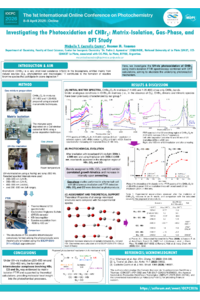
Bromoform (CHBr3) is a very short-lived substance (VSLS) present in the troposphere, originating mainly from natural sources (e.g., phytoplankton and macroalgae)1. It contributes to the formation of reactive bromine species that participate in ozone depleting and other atmospheric reactions2. The aim of this work is to investigate the evolution of CHBr3 in the presence of O2 under UV-vis irradiation and to elucidate the mechanism involved in the photoreaction.
Different CHBr3:O2:Ar mixtures (1:1:400 and 1:20:400) were prepared on a vacuum line using standard manometric techniques. The mixtures were deposited on a CsI window cooled at 10 K using a pulse-deposition technique. A Xe(Hg) arc lamp was operated at 800 W. To reproduce atmospheric conditions, selected spectral intervals were used: 400≤λ≤ 800 nm for visible radiation; 350≤λ≤450 nm and 280≤λ≤320 nm, corresponding to portions of the UV-A and UV-B regions, respectively; and 200≤λ≤800 nm to include UV-C, UV-B, UV-A, and visible radiation. Complementarily, we investigated the reaction mechanism between CHBr3 and O2 in the gas phase using a home-built cell that allows simultaneous irradiation and FTIR acquisition.
The initial spectra of the matrix-isolated samples showed only the bands of CHBr3. After irradiation with broadband UV-vis light and using the 350≤ λ ≤ 450 nm filter, new bands appeared in the absorption region of CO, HBr, and CO2. These bands exhibited the same growth kinetics and increased their intensity after annealing. CO, HBr, and CO2 were detected as photoproducts in gas phase experiments.
The structures of the possible intermolecular complexes formed among the photoproducts were theoretically simulated using the B3LYP-D3/6-311++G(d,p) approximation. At the molecular level, we detected, via FTIR-matrix isolation techniques, new complexes involving CO, HBr, and Br2, in agreement with theoretical calculations.
(1) Villamayor et al. Nat. Clim. Chang. 13 (2023) 554–560.
(2) Tinel et al. Elem. Sci. Anthr. 11:1 (2023) 00032.
Keywords
Matrix-isolation
FTIR
complexes
bromoform
photooxidation
Poster
IOCPC_2026_Custodio_vf_2.pdf
Comparative photocatalytic performance of asphaltene-tuned photocatalyst and Pd/g-C3N4 for degradation of 2,5-dichlorophenol
Assessment of Photocatalytic Performance of Silica-Bound Photocatalysts For Sulfide Oxidation