Event submissions
Published
This submission belongs to the session S4. Photodynamic and Photothermal Therapy of the event The 1st International Online Conference on Photochemistry
Published date
03 Apr, 2026
Academic Editor
'%3e%3cpath%20d='M12.6657%2010.9104C12.4185%2010.325%2012.0599%209.79327%2011.6097%209.34482C11.1609%208.89508%2010.6293%208.5365%2010.0442%208.28888C10.0389%208.28626%2010.0337%208.28495%2010.0285%208.28233C10.8446%207.69279%2011.3752%206.73249%2011.3752%205.64904C11.3752%203.8542%209.92103%202.39999%208.1262%202.39999C6.33136%202.39999%204.87715%203.8542%204.87715%205.64904C4.87715%206.73249%205.40774%207.69279%206.22393%208.28364C6.21869%208.28626%206.21345%208.28757%206.20821%208.29019C5.62129%208.5378%205.09463%208.89284%204.64265%209.34613C4.1929%209.79493%203.83432%2010.3266%203.58671%2010.9117C3.34345%2011.4845%203.21226%2012.0987%203.20023%2012.7209C3.19988%2012.7349%203.20233%2012.7488%203.20744%2012.7619C3.21255%2012.7749%203.22022%2012.7867%203.22998%2012.7968C3.23975%2012.8068%203.25142%2012.8147%203.26431%2012.8202C3.2772%2012.8256%203.29105%2012.8284%203.30504%2012.8284H4.09109C4.14874%2012.8284%204.19459%2012.7825%204.1959%2012.7262C4.2221%2011.7148%204.62823%2010.7676%205.34617%2010.0497C6.08899%209.30683%207.0755%208.89808%208.1262%208.89808C9.17689%208.89808%2010.1634%209.30683%2010.9062%2010.0497C11.6242%2010.7676%2012.0303%2011.7148%2012.0565%2012.7262C12.0578%2012.7838%2012.1037%2012.8284%2012.1613%2012.8284H12.9474C12.9613%2012.8284%2012.9752%2012.8256%2012.9881%2012.8202C13.001%2012.8147%2013.0126%2012.8068%2013.0224%2012.7968C13.0322%2012.7867%2013.0398%2012.7749%2013.0449%2012.7619C13.0501%2012.7488%2013.0525%2012.7349%2013.0522%2012.7209C13.0391%2012.0947%2012.9094%2011.4855%2012.6657%2010.9104ZM8.1262%207.9024C7.52486%207.9024%206.9589%207.6679%206.53312%207.24211C6.10733%206.81633%205.87283%206.25037%205.87283%205.64904C5.87283%205.0477%206.10733%204.48174%206.53312%204.05596C6.9589%203.63018%207.52486%203.39567%208.1262%203.39567C8.72753%203.39567%209.29349%203.63018%209.71927%204.05596C10.1451%204.48174%2010.3796%205.0477%2010.3796%205.64904C10.3796%206.25037%2010.1451%206.81633%209.71927%207.24211C9.29349%207.6679%208.72753%207.9024%208.1262%207.9024Z'%20fill='%235D1EE1'/%3e%3c/g%3e%3c/svg%3e) Rui Fausto
Rui FaustoCitation
Andreea Neacsu, Stela Minkovska, Valentin Alexiev, Viorel Chihaia, Visual readout-enabled systems: Merocyanine–β-Cyclodextrin complexes as photo-controlled material actuators, in Proceedings of The 1st International Online Conference on Photochemistry, 8 April–9 April 2026, MDPI: Basel, Switzerland
Share
Email
Facebook
Twitter
LinkedIn
Visual readout-enabled systems: Merocyanine–β-Cyclodextrin complexes as photo-controlled material actuators

Andreea Neacsu 1

Stela Minkovska 2
'%3e%3cpath%20d='M12.6647%2010.9104C12.4176%2010.325%2012.0589%209.7933%2011.6088%209.34485C11.16%208.89511%2010.6283%208.53653%2010.0432%208.28891C10.038%208.28629%2010.0327%208.28498%2010.0275%208.28236C10.8437%207.69282%2011.3743%206.73252%2011.3743%205.64907C11.3743%203.85423%209.92005%202.40002%208.12522%202.40002C6.33038%202.40002%204.87618%203.85423%204.87618%205.64907C4.87618%206.73252%205.40677%207.69282%206.22296%208.28367C6.21772%208.28629%206.21248%208.2876%206.20724%208.29022C5.62031%208.53783%205.09365%208.89287%204.64167%209.34616C4.19192%209.79496%203.83334%2010.3266%203.58573%2010.9117C3.34247%2011.4846%203.21128%2012.0987%203.19925%2012.721C3.1989%2012.735%203.20135%2012.7489%203.20646%2012.7619C3.21157%2012.7749%203.21924%2012.7868%203.22901%2012.7968C3.23877%2012.8068%203.25045%2012.8148%203.26334%2012.8202C3.27623%2012.8256%203.29007%2012.8284%203.30406%2012.8284H4.09012C4.14776%2012.8284%204.19362%2012.7825%204.19493%2012.7262C4.22113%2011.7148%204.62726%2010.7676%205.34519%2010.0497C6.08802%209.30686%207.07452%208.89811%208.12522%208.89811C9.17592%208.89811%2010.1624%209.30686%2010.9052%2010.0497C11.6232%2010.7676%2012.0293%2011.7148%2012.0555%2012.7262C12.0568%2012.7839%2012.1027%2012.8284%2012.1603%2012.8284H12.9464C12.9604%2012.8284%2012.9742%2012.8256%2012.9871%2012.8202C13%2012.8148%2013.0117%2012.8068%2013.0214%2012.7968C13.0312%2012.7868%2013.0389%2012.7749%2013.044%2012.7619C13.0491%2012.7489%2013.0515%2012.735%2013.0512%2012.721C13.0381%2012.0947%2012.9084%2011.4856%2012.6647%2010.9104ZM8.12522%207.90243C7.52388%207.90243%206.95792%207.66793%206.53214%207.24215C6.10636%206.81636%205.87185%206.2504%205.87185%205.64907C5.87185%205.04773%206.10636%204.48177%206.53214%204.05599C6.95792%203.63021%207.52388%203.3957%208.12522%203.3957C8.72655%203.3957%209.29252%203.63021%209.7183%204.05599C10.1441%204.48177%2010.3786%205.04773%2010.3786%205.64907C10.3786%206.2504%2010.1441%206.81636%209.7183%207.24215C9.29252%207.66793%208.72655%207.90243%208.12522%207.90243Z'%20fill='%235D1EE1'/%3e%3c/g%3e%3c/svg%3e)
Valentin Alexiev 2

Viorel Chihaia 1
1. Institute of Physical Chemistry “Ilie Murgulescu” of the Romanian Academy, 202 Splaiul Independentei, 060021, Bucharest, Romania
2. Institute of Catalysis, Bulgarian Academy of Sciences, Acad. G. Bonchev St., Bldg.11, Sofia 1113, Bulgaria
Abstract
The interaction between beta-cyclodextrin (β-CD) and the merocyanine form of 4-[(2E)-1,1-dimethyl-2-({[(1Z)-2-oxo-1,2-dihydronaphthalen-1-ylidene]amino}methylidene)-1H,2H,3H-benzo[e]indol-3-yl]butane-1-sulfonic acid (MC) was investigated to elucidate host–guest complexation dynamics and stability, in order to develop applications such as photoswitches for imaging and therapy. These applications are possible due to MC’s absorption changes upon isomerization; therefore, the β-CD environment can provide a consistent, water-compatible platform and potentially targetable coatings. β-CD is a cyclic oligosaccharide that is well known for its ability to form "inclusion complexes" with other molecules, changing the properties of the guest molecule upon binding. Spironaphthoxazines belong to the class of organic photochromic compounds. In this work, MC’s Open Photomerocyanine form was used in the investigations and complex formation. Aqueous solutions of MC in the presence and absence of β-CD were irradiated at the corresponding wavelength, and their spectroscopic behavior was analyzed. Binding constants were calculated, and the continuous variation method (Job’s plot) demonstrated that stoichiometries other than 1:1 were present. Not only were 2:1 and 3:1 complexes observed, but many other possible intermediate stoichiometries (e.g., between 1:1 and 3:1) may also be present in the solution. Dynamic light scattering measurements were used to characterize the β-CD/MC nanoparticles. The thermal behavior of the complexes was investigated using solution calorimetry. Docking studies combined with DFT calculations were done to evaluate the stability of β-CD/MC complexes with different stoichiometries. Interestingly, the 2:1 complex shows a slightly higher stability compared to the 1:1 and 3:1 complexes, aligning well with experimental findings. The results have shown that the inclusion of MC within the β-CD cavity influences the rate and direction of isomerization between different MC forms, also affecting MC solubility and stability. The interaction between MC and β-CD can be used for further applications to create controlled optical switches that respond to external stimuli like light, temperature, or pH.
Keywords
photoswitch
merocyanine
cyclodextrin
DFT
spectroscopy
Poster
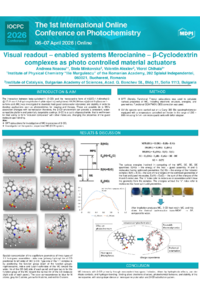
IOCPC2026_Poster_Neacsu_Andreea.pdf
Comparative Evaluation of Human serum Albumin Conjugation and Micellization for the Delivery of Chlorin-based Photosensitizers
A photocontrollable conjugate of a natural chlorin and a chemotherapeutic agent for combined photodynamic therapy.