Event submissions
Published
This submission belongs to the session S2. Photochemistry for Environmental Remediation of the event The 1st International Online Conference on Photochemistry
Published date
03 Apr, 2026
Academic Editor
'%3e%3cpath%20d='M12.6657%2010.9104C12.4185%2010.325%2012.0599%209.79327%2011.6097%209.34482C11.1609%208.89508%2010.6293%208.5365%2010.0442%208.28888C10.0389%208.28626%2010.0337%208.28495%2010.0285%208.28233C10.8446%207.69279%2011.3752%206.73249%2011.3752%205.64904C11.3752%203.8542%209.92103%202.39999%208.1262%202.39999C6.33136%202.39999%204.87715%203.8542%204.87715%205.64904C4.87715%206.73249%205.40774%207.69279%206.22393%208.28364C6.21869%208.28626%206.21345%208.28757%206.20821%208.29019C5.62129%208.5378%205.09463%208.89284%204.64265%209.34613C4.1929%209.79493%203.83432%2010.3266%203.58671%2010.9117C3.34345%2011.4845%203.21226%2012.0987%203.20023%2012.7209C3.19988%2012.7349%203.20233%2012.7488%203.20744%2012.7619C3.21255%2012.7749%203.22022%2012.7867%203.22998%2012.7968C3.23975%2012.8068%203.25142%2012.8147%203.26431%2012.8202C3.2772%2012.8256%203.29105%2012.8284%203.30504%2012.8284H4.09109C4.14874%2012.8284%204.19459%2012.7825%204.1959%2012.7262C4.2221%2011.7148%204.62823%2010.7676%205.34617%2010.0497C6.08899%209.30683%207.0755%208.89808%208.1262%208.89808C9.17689%208.89808%2010.1634%209.30683%2010.9062%2010.0497C11.6242%2010.7676%2012.0303%2011.7148%2012.0565%2012.7262C12.0578%2012.7838%2012.1037%2012.8284%2012.1613%2012.8284H12.9474C12.9613%2012.8284%2012.9752%2012.8256%2012.9881%2012.8202C13.001%2012.8147%2013.0126%2012.8068%2013.0224%2012.7968C13.0322%2012.7867%2013.0398%2012.7749%2013.0449%2012.7619C13.0501%2012.7488%2013.0525%2012.7349%2013.0522%2012.7209C13.0391%2012.0947%2012.9094%2011.4855%2012.6657%2010.9104ZM8.1262%207.9024C7.52486%207.9024%206.9589%207.6679%206.53312%207.24211C6.10733%206.81633%205.87283%206.25037%205.87283%205.64904C5.87283%205.0477%206.10733%204.48174%206.53312%204.05596C6.9589%203.63018%207.52486%203.39567%208.1262%203.39567C8.72753%203.39567%209.29349%203.63018%209.71927%204.05596C10.1451%204.48174%2010.3796%205.0477%2010.3796%205.64904C10.3796%206.25037%2010.1451%206.81633%209.71927%207.24211C9.29349%207.6679%208.72753%207.9024%208.1262%207.9024Z'%20fill='%235D1EE1'/%3e%3c/g%3e%3c/svg%3e) Olga Sacco
Olga SaccoCitation
Anca Vasile, Florica Papa, Veronica Bratan, Crina Anastasescu, Irina Atkinson, Ioan Balint, Investigation of bimetallic Pt-Co and Pt-Ni catalysts in the photoreduction of nitrate, in Proceedings of The 1st International Online Conference on Photochemistry, 8 April–9 April 2026, MDPI: Basel, Switzerland
Share
Email
Facebook
Twitter
LinkedIn
Investigation of bimetallic Pt-Co and Pt-Ni catalysts in the photoreduction of nitrate

Anca Vasile 1

Florica Papa 1
'%3e%3cpath%20d='M12.6647%2010.9104C12.4176%2010.325%2012.0589%209.7933%2011.6088%209.34485C11.16%208.89511%2010.6283%208.53653%2010.0432%208.28891C10.038%208.28629%2010.0327%208.28498%2010.0275%208.28236C10.8437%207.69282%2011.3743%206.73252%2011.3743%205.64907C11.3743%203.85423%209.92005%202.40002%208.12522%202.40002C6.33038%202.40002%204.87618%203.85423%204.87618%205.64907C4.87618%206.73252%205.40677%207.69282%206.22296%208.28367C6.21772%208.28629%206.21248%208.2876%206.20724%208.29022C5.62031%208.53783%205.09365%208.89287%204.64167%209.34616C4.19192%209.79496%203.83334%2010.3266%203.58573%2010.9117C3.34247%2011.4846%203.21128%2012.0987%203.19925%2012.721C3.1989%2012.735%203.20135%2012.7489%203.20646%2012.7619C3.21157%2012.7749%203.21924%2012.7868%203.22901%2012.7968C3.23877%2012.8068%203.25045%2012.8148%203.26334%2012.8202C3.27623%2012.8256%203.29007%2012.8284%203.30406%2012.8284H4.09012C4.14776%2012.8284%204.19362%2012.7825%204.19493%2012.7262C4.22113%2011.7148%204.62726%2010.7676%205.34519%2010.0497C6.08802%209.30686%207.07452%208.89811%208.12522%208.89811C9.17592%208.89811%2010.1624%209.30686%2010.9052%2010.0497C11.6232%2010.7676%2012.0293%2011.7148%2012.0555%2012.7262C12.0568%2012.7839%2012.1027%2012.8284%2012.1603%2012.8284H12.9464C12.9604%2012.8284%2012.9742%2012.8256%2012.9871%2012.8202C13%2012.8148%2013.0117%2012.8068%2013.0214%2012.7968C13.0312%2012.7868%2013.0389%2012.7749%2013.044%2012.7619C13.0491%2012.7489%2013.0515%2012.735%2013.0512%2012.721C13.0381%2012.0947%2012.9084%2011.4856%2012.6647%2010.9104ZM8.12522%207.90243C7.52388%207.90243%206.95792%207.66793%206.53214%207.24215C6.10636%206.81636%205.87185%206.2504%205.87185%205.64907C5.87185%205.04773%206.10636%204.48177%206.53214%204.05599C6.95792%203.63021%207.52388%203.3957%208.12522%203.3957C8.72655%203.3957%209.29252%203.63021%209.7183%204.05599C10.1441%204.48177%2010.3786%205.04773%2010.3786%205.64907C10.3786%206.2504%2010.1441%206.81636%209.7183%207.24215C9.29252%207.66793%208.72655%207.90243%208.12522%207.90243Z'%20fill='%235D1EE1'/%3e%3c/g%3e%3c/svg%3e)
Veronica Bratan 1
Crina Anastasescu 1
Irina Atkinson 1

Ioan Balint 1
1. “Ilie Murgulescu” Institute of Physical Chemistry, Romanian Academy, 202 Spl. Independentei, 060021 Bucharest, Romania
Abstract
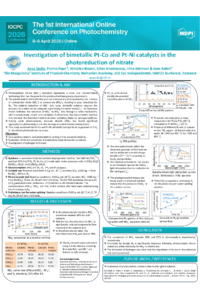
Photocatalytic nitrate (NO3¯) reduction represents a novel and transformative technology that has the potential to produce harmless gaseous byproducts. The photocatalytic denitrification process is frequently accompanied by the creation of undesirable nitrite (NO2¯) or ammonium (NH4+), resulting in poor selectivity for dinitrogen (N2). The catalytic reduction of NO3¯ ions utilizing bimetallic catalysts necessitates the presence of a noble metal, alongside a promoting transition metal. The transition metal facilitates the reduction of NO3¯ to NO2¯ ions through a redox mechanism, which subsequently results in its oxidation. Furthermore, the noble metal's function is to maintain the transition metal in its lower oxidation states via hydrogen spillover. Among oxide photocatalysts, titanium dioxide (TiO2) has found significant application in photocatalysis and the cleanup of environmental contaminants.
In this report, we present the deposition of platinum (Pt), cobalt (Co), and nickel (Ni) onto the surface of TiO2 powder through a successive impregnation method. The influence of non-noble metal incorporation over Pt-TiO2 catalyst was studied by means of powder X-ray diffraction (XRD), diffuse reflectance UV-Vis, and temperature programmed reduction in hydrogen (H2-TPR) analyses and photoluminescence spectroscopy (PL). The initial activity evaluation focused on the catalytic reduction of NO3¯ with H2. The following stage involved the evaluation of the photocatalytic activity of the catalysts by monitoring the reduction of NO3¯ under the illumination of a UV lamp. A primary goal is to assess these materials for their optimal selectivity in generating benign end products (such as N2). In the tests conducted under UV light irradiation, the selectivity toward N2 was around 68%, which is approximately 1.5 times greater than the values obtained during denitrification without light exposure. A preliminary test for water splitting using the Pt-Ni/TiO2 sample yielded hydrogen. It is hypothesized that hydrogen is generated, yet it is utilized in the process of nitrate photoreduction.
Keywords
Photocatalytic nitrate reduction
Bimetallic catalysts
Pt-Ni/TiO2
Pt-Co/TiO2
Poster
Poster_IOCPC 2026_Anca VASILE.pdf
Synthesis and Photocatalytic Activity of the Oxysulfide Perovskite KTaO3-xSx
The impact of intial pH value and H2O2 on the efficiency of glyphosate photocatalytic degradation in aqueous suspension using simulated solar irradiation