Event submissions
Published

This submission belongs to the session f. Posters of the event 1st Electronic Conference on Molecular Science
Published date
15 Oct, 2015
Citation
Ge Liu, Kazuo Asanoma, Tomoka Takao, Kiyomi Tsukimori, Hiroshi Uchi, Masutaka Furue, Kiyoko Kato, Norio Wake, AhR/IL-24 signaling is associated with susceptibility to dioxins, in Proceedings of 1st Electronic Conference on Molecular Science, 15 October–22 October 2015, MDPI: Basel, Switzerland, doi: 10.3390/ecms-1-f001
Share
Email
Facebook
Twitter
LinkedIn
AhR/IL-24 signaling is associated with susceptibility to dioxins
'%3e%3cpath%20d='M12.6647%2010.9104C12.4176%2010.325%2012.0589%209.7933%2011.6088%209.34485C11.16%208.89511%2010.6283%208.53653%2010.0432%208.28891C10.038%208.28629%2010.0327%208.28498%2010.0275%208.28236C10.8437%207.69282%2011.3743%206.73252%2011.3743%205.64907C11.3743%203.85423%209.92005%202.40002%208.12522%202.40002C6.33038%202.40002%204.87618%203.85423%204.87618%205.64907C4.87618%206.73252%205.40677%207.69282%206.22296%208.28367C6.21772%208.28629%206.21248%208.2876%206.20724%208.29022C5.62031%208.53783%205.09365%208.89287%204.64167%209.34616C4.19192%209.79496%203.83334%2010.3266%203.58573%2010.9117C3.34247%2011.4846%203.21128%2012.0987%203.19925%2012.721C3.1989%2012.735%203.20135%2012.7489%203.20646%2012.7619C3.21157%2012.7749%203.21924%2012.7868%203.22901%2012.7968C3.23877%2012.8068%203.25045%2012.8148%203.26334%2012.8202C3.27623%2012.8256%203.29007%2012.8284%203.30406%2012.8284H4.09012C4.14776%2012.8284%204.19362%2012.7825%204.19493%2012.7262C4.22113%2011.7148%204.62726%2010.7676%205.34519%2010.0497C6.08802%209.30686%207.07452%208.89811%208.12522%208.89811C9.17592%208.89811%2010.1624%209.30686%2010.9052%2010.0497C11.6232%2010.7676%2012.0293%2011.7148%2012.0555%2012.7262C12.0568%2012.7839%2012.1027%2012.8284%2012.1603%2012.8284H12.9464C12.9604%2012.8284%2012.9742%2012.8256%2012.9871%2012.8202C13%2012.8148%2013.0117%2012.8068%2013.0214%2012.7968C13.0312%2012.7868%2013.0389%2012.7749%2013.044%2012.7619C13.0491%2012.7489%2013.0515%2012.735%2013.0512%2012.721C13.0381%2012.0947%2012.9084%2011.4856%2012.6647%2010.9104ZM8.12522%207.90243C7.52388%207.90243%206.95792%207.66793%206.53214%207.24215C6.10636%206.81636%205.87185%206.2504%205.87185%205.64907C5.87185%205.04773%206.10636%204.48177%206.53214%204.05599C6.95792%203.63021%207.52388%203.3957%208.12522%203.3957C8.72655%203.3957%209.29252%203.63021%209.7183%204.05599C10.1441%204.48177%2010.3786%205.04773%2010.3786%205.64907C10.3786%206.2504%2010.1441%206.81636%209.7183%207.24215C9.29252%207.66793%208.72655%207.90243%208.12522%207.90243Z'%20fill='%235D1EE1'/%3e%3c/g%3e%3c/svg%3e)
Ge Liu 1
Kazuo Asanoma 2
Tomoka Takao 1
Kiyomi Tsukimori 3
Hiroshi Uchi 4,5
Masutaka Furue 4,5
Kiyoko Kato 2
Norio Wake 1
1. Department of Genomic Epidemiology, Research Center for Environment and Developmental Medical Sciences, Kyushu University, Japan
2. Department of Obstetrics and Gynecology, Graduate School of Medical Science, Kyushu University, Japan
3. Department of Obstetrics, Fukuoka Children’s Hospital, Japan
4. Research and Clinical Center for Yusho and Dioxins, Kyushu University Hospital, Japan;
5. Department of Dermatology, Graduate School of Medical Science, Kyushu University, Japan
Abstract
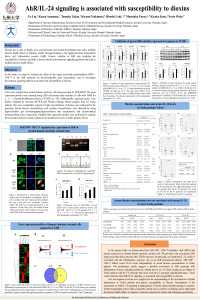
Dioxins are a class of highly toxic and persistent environmental pollutants that cause multiple adverse health effects in humans, mainly through binding to the ligand-activated transcription factor, aryl hydrocarbon receptor (AhR). Genetic variation in AhR may modulate the susceptibility to dioxins, and little is known about the downstream signaling pathways that lead to multiple adverse health effects. In the present study, we evaluated the effect of a single nucleotide polymorphism (SNP) –130C/T in the AhR promoter on dioxin-inducible gene transcription and downstream signaling pathways using primary human fibroblast. We found that AhR SNP –130C/T modulates AhR mRNA and protein expression in normal human chorionic stromal cells. The gene expression profiles in the cells exposed to a representative dioxin compound TCDD were further determined by using microarray technology. Several genes associated with human disorders including interleukin 24 (IL-24) were highly up-regulated in cells with the TT genotype. Higher up-regulation of IL-24 protein in cells with the TT genotype was also observed. We further evaluated the genotype, dioxins concentrations and serum IL-24 levels in the blood sample from 64 Yusho patients who were accidentally exposed to high concentrations of dioxins via the ingestion of contaminated rice oil in a famous incident of contamination happened in 1968 in Japan.We found that AhR SNP –130C/T affects serum IL-24 levels, independently of serum dioxins concentrations in Yusho patients. Our observations demonstrated the association of AhR SNP –130C/T with dioxin susceptibility in individuals. In particular, we found that IL-24, which is associated with the inflammatory response, acts as an AhR downstream effector. Our investigation provides new insights into the understanding of the mechanisms of health impairments in Yusho patients and genetic susceptibility to dioxins.
Keywords
Aryl hydrocarbon receptor(AhR)
Single nucleotide polymorphism(SNP)
Interleukin 24 (IL-24)
Dioxins
Manuscript
sciforum-006306.pdf
Poster
sciforum-006306-poster.pdf
Interferon alpha induces the apoptosis of cervical cancer HeLa cells by activating both the Intrinsic Mitochondrial pathway and ER Stress-induced pathway
Expression of human H ferritin prompts the identification of a hitherto elusive yeast orthologue and enables parsing of distinct iron-induced cell death pathways in Saccharomyces cerevisiae