Event submissions
Published
This submission belongs to the session S1. Photocatalysis of the event The 1st International Online Conference on Photochemistry
Published date
03 Apr, 2026
Academic Editor
'%3e%3cpath%20d='M12.6657%2010.9104C12.4185%2010.325%2012.0599%209.79327%2011.6097%209.34482C11.1609%208.89508%2010.6293%208.5365%2010.0442%208.28888C10.0389%208.28626%2010.0337%208.28495%2010.0285%208.28233C10.8446%207.69279%2011.3752%206.73249%2011.3752%205.64904C11.3752%203.8542%209.92103%202.39999%208.1262%202.39999C6.33136%202.39999%204.87715%203.8542%204.87715%205.64904C4.87715%206.73249%205.40774%207.69279%206.22393%208.28364C6.21869%208.28626%206.21345%208.28757%206.20821%208.29019C5.62129%208.5378%205.09463%208.89284%204.64265%209.34613C4.1929%209.79493%203.83432%2010.3266%203.58671%2010.9117C3.34345%2011.4845%203.21226%2012.0987%203.20023%2012.7209C3.19988%2012.7349%203.20233%2012.7488%203.20744%2012.7619C3.21255%2012.7749%203.22022%2012.7867%203.22998%2012.7968C3.23975%2012.8068%203.25142%2012.8147%203.26431%2012.8202C3.2772%2012.8256%203.29105%2012.8284%203.30504%2012.8284H4.09109C4.14874%2012.8284%204.19459%2012.7825%204.1959%2012.7262C4.2221%2011.7148%204.62823%2010.7676%205.34617%2010.0497C6.08899%209.30683%207.0755%208.89808%208.1262%208.89808C9.17689%208.89808%2010.1634%209.30683%2010.9062%2010.0497C11.6242%2010.7676%2012.0303%2011.7148%2012.0565%2012.7262C12.0578%2012.7838%2012.1037%2012.8284%2012.1613%2012.8284H12.9474C12.9613%2012.8284%2012.9752%2012.8256%2012.9881%2012.8202C13.001%2012.8147%2013.0126%2012.8068%2013.0224%2012.7968C13.0322%2012.7867%2013.0398%2012.7749%2013.0449%2012.7619C13.0501%2012.7488%2013.0525%2012.7349%2013.0522%2012.7209C13.0391%2012.0947%2012.9094%2011.4855%2012.6657%2010.9104ZM8.1262%207.9024C7.52486%207.9024%206.9589%207.6679%206.53312%207.24211C6.10733%206.81633%205.87283%206.25037%205.87283%205.64904C5.87283%205.0477%206.10733%204.48174%206.53312%204.05596C6.9589%203.63018%207.52486%203.39567%208.1262%203.39567C8.72753%203.39567%209.29349%203.63018%209.71927%204.05596C10.1451%204.48174%2010.3796%205.0477%2010.3796%205.64904C10.3796%206.25037%2010.1451%206.81633%209.71927%207.24211C9.29349%207.6679%208.72753%207.9024%208.1262%207.9024Z'%20fill='%235D1EE1'/%3e%3c/g%3e%3c/svg%3e) Vincenzo Vaiano
Vincenzo VaianoCitation
Daniil Varabyou, Aliaksei Vaitusionak, Sergei Kostjuk, Polystyrene with Controlled Molecular Weight via Photoinduced Reversible-Deactivation Radical Polymerizations, in Proceedings of The 1st International Online Conference on Photochemistry, 8 April–9 April 2026, MDPI: Basel, Switzerland
Share
Email
Facebook
Twitter
LinkedIn
Polystyrene with Controlled Molecular Weight via Photoinduced Reversible-Deactivation Radical Polymerizations
'%3e%3cpath%20d='M12.6647%2010.9104C12.4176%2010.325%2012.0589%209.7933%2011.6088%209.34485C11.16%208.89511%2010.6283%208.53653%2010.0432%208.28891C10.038%208.28629%2010.0327%208.28498%2010.0275%208.28236C10.8437%207.69282%2011.3743%206.73252%2011.3743%205.64907C11.3743%203.85423%209.92005%202.40002%208.12522%202.40002C6.33038%202.40002%204.87618%203.85423%204.87618%205.64907C4.87618%206.73252%205.40677%207.69282%206.22296%208.28367C6.21772%208.28629%206.21248%208.2876%206.20724%208.29022C5.62031%208.53783%205.09365%208.89287%204.64167%209.34616C4.19192%209.79496%203.83334%2010.3266%203.58573%2010.9117C3.34247%2011.4846%203.21128%2012.0987%203.19925%2012.721C3.1989%2012.735%203.20135%2012.7489%203.20646%2012.7619C3.21157%2012.7749%203.21924%2012.7868%203.22901%2012.7968C3.23877%2012.8068%203.25045%2012.8148%203.26334%2012.8202C3.27623%2012.8256%203.29007%2012.8284%203.30406%2012.8284H4.09012C4.14776%2012.8284%204.19362%2012.7825%204.19493%2012.7262C4.22113%2011.7148%204.62726%2010.7676%205.34519%2010.0497C6.08802%209.30686%207.07452%208.89811%208.12522%208.89811C9.17592%208.89811%2010.1624%209.30686%2010.9052%2010.0497C11.6232%2010.7676%2012.0293%2011.7148%2012.0555%2012.7262C12.0568%2012.7839%2012.1027%2012.8284%2012.1603%2012.8284H12.9464C12.9604%2012.8284%2012.9742%2012.8256%2012.9871%2012.8202C13%2012.8148%2013.0117%2012.8068%2013.0214%2012.7968C13.0312%2012.7868%2013.0389%2012.7749%2013.044%2012.7619C13.0491%2012.7489%2013.0515%2012.735%2013.0512%2012.721C13.0381%2012.0947%2012.9084%2011.4856%2012.6647%2010.9104ZM8.12522%207.90243C7.52388%207.90243%206.95792%207.66793%206.53214%207.24215C6.10636%206.81636%205.87185%206.2504%205.87185%205.64907C5.87185%205.04773%206.10636%204.48177%206.53214%204.05599C6.95792%203.63021%207.52388%203.3957%208.12522%203.3957C8.72655%203.3957%209.29252%203.63021%209.7183%204.05599C10.1441%204.48177%2010.3786%205.04773%2010.3786%205.64907C10.3786%206.2504%2010.1441%206.81636%209.7183%207.24215C9.29252%207.66793%208.72655%207.90243%208.12522%207.90243Z'%20fill='%235D1EE1'/%3e%3c/g%3e%3c/svg%3e)
Daniil Varabyou 1,2
Aliaksei Vaitusionak 3,4

Sergei Kostjuk 5
1. Research Institute for Physical Chemical Problems of the Belarusian State University, 14 Leningradskaya St., 220006, Minsk, Belarus
2. Department of Chemistry, Belarusian State University, 14 Leningradskaya St., 220006, Minsk, Belarus
3. Research Institute for Physical Chemical Problems of the Belarusian State University, 14 Leningradskaya St., 220006 Minsk, Belarus
4. Institute for Regenerative Medicine, Sechenov First Moscow State Medical University, 8-2 Trubetskaya St., Moscow 119991, Russia
5. Parisian Institute of Molecular Chemistry, Sorbonne University, Paris, 75252, France
Abstract
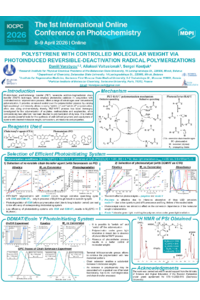
The application of light as an external stimulus to induce polymerization processes can have significant implications in a range of scientific, medical and technological domains. Photoinduced electron/energy transfer (PET) RAFT polymerization, which employs photoredox catalysis in conjunction with the RAFT process, offers a range of advantages over conventional RAFT polymerization. In addition to the inherent benefits of the RAFT technique, this method also provides enhanced control over the polymerization process by varying light wavelength and intensity, while also being environmentally friendly. The PET-RAFT process has been thoroughly investigated with regard to the polymerization of acrylates, methacrylates and acrylamides, while comparatively less attention has been devoted to the polymerization of styrene.
In this study, in order to conduct effective PET-RAFT polymerization of styrene, we have examined a number of organic dyes and sulfur-containing compounds as potential photocatalysts and RAFT agents, respectively. It has been demonstrated that 2-(dodecylthiocarbonothioylthio)-2-methylpropionic acid is the most effective RAFT agent, while eosin Y and perylene are the most effective photocatalysts. PET-RAFT polymerization with 2-(dodecylthiocarbonothioylthio)-2-methylpropionic acid and eosin Y yielded polystyrene with a molecular weight of up to 9000 g/mol and low polydispersity (Ð ≤ 1.4). Trithiocarbonate functionality was observed on 1H NMR spectra, which is important from the perspective of further modification and synthesis of block copolymers. Moreover, this photoinitiating system allowed us to polymerize styrene under both blue and green light irradiation; to achieve temporal control of the polymerization process (by switching off/on the light); and to conduct polymerization in air without negative influence from oxygen on the rate and molecular weight characteristics of the obtained polymers.
Keywords
polystyrene
controlled radical polymerization
photocatalysis
reversible addition-fragmentation chain transfer
photoinduced electron transfer
Poster
Polystyrene with Controlled Molecular Weight via Photoinduced Reversible-Deactivation Radical Polymerizations (IOCPC 2026)(2).pdf
The impact of intial pH value and H2O2 on the efficiency of glyphosate photocatalytic degradation in aqueous suspension using simulated solar irradiation
Sustainable photolytic and photocatalytic removal of antibiotic and antipsychotic from the aquatic medium in the presence of H2O2, KBrO3, and (NH4)2S2O8