Event submissions
Published
This submission belongs to the session S1. Photocatalysis of the event The 1st International Online Conference on Photochemistry
Published date
03 Apr, 2026
Academic Editor
'%3e%3cpath%20d='M12.6657%2010.9104C12.4185%2010.325%2012.0599%209.79327%2011.6097%209.34482C11.1609%208.89508%2010.6293%208.5365%2010.0442%208.28888C10.0389%208.28626%2010.0337%208.28495%2010.0285%208.28233C10.8446%207.69279%2011.3752%206.73249%2011.3752%205.64904C11.3752%203.8542%209.92103%202.39999%208.1262%202.39999C6.33136%202.39999%204.87715%203.8542%204.87715%205.64904C4.87715%206.73249%205.40774%207.69279%206.22393%208.28364C6.21869%208.28626%206.21345%208.28757%206.20821%208.29019C5.62129%208.5378%205.09463%208.89284%204.64265%209.34613C4.1929%209.79493%203.83432%2010.3266%203.58671%2010.9117C3.34345%2011.4845%203.21226%2012.0987%203.20023%2012.7209C3.19988%2012.7349%203.20233%2012.7488%203.20744%2012.7619C3.21255%2012.7749%203.22022%2012.7867%203.22998%2012.7968C3.23975%2012.8068%203.25142%2012.8147%203.26431%2012.8202C3.2772%2012.8256%203.29105%2012.8284%203.30504%2012.8284H4.09109C4.14874%2012.8284%204.19459%2012.7825%204.1959%2012.7262C4.2221%2011.7148%204.62823%2010.7676%205.34617%2010.0497C6.08899%209.30683%207.0755%208.89808%208.1262%208.89808C9.17689%208.89808%2010.1634%209.30683%2010.9062%2010.0497C11.6242%2010.7676%2012.0303%2011.7148%2012.0565%2012.7262C12.0578%2012.7838%2012.1037%2012.8284%2012.1613%2012.8284H12.9474C12.9613%2012.8284%2012.9752%2012.8256%2012.9881%2012.8202C13.001%2012.8147%2013.0126%2012.8068%2013.0224%2012.7968C13.0322%2012.7867%2013.0398%2012.7749%2013.0449%2012.7619C13.0501%2012.7488%2013.0525%2012.7349%2013.0522%2012.7209C13.0391%2012.0947%2012.9094%2011.4855%2012.6657%2010.9104ZM8.1262%207.9024C7.52486%207.9024%206.9589%207.6679%206.53312%207.24211C6.10733%206.81633%205.87283%206.25037%205.87283%205.64904C5.87283%205.0477%206.10733%204.48174%206.53312%204.05596C6.9589%203.63018%207.52486%203.39567%208.1262%203.39567C8.72753%203.39567%209.29349%203.63018%209.71927%204.05596C10.1451%204.48174%2010.3796%205.0477%2010.3796%205.64904C10.3796%206.25037%2010.1451%206.81633%209.71927%207.24211C9.29349%207.6679%208.72753%207.9024%208.1262%207.9024Z'%20fill='%235D1EE1'/%3e%3c/g%3e%3c/svg%3e) Vincenzo Vaiano
Vincenzo VaianoCitation
Eva Prokopová, Zuzana Burešová, Filip Bureš, From DPZ to DTQ: Organic Catalysts for Homo- and Heterogeneous Photoredox Processes, in Proceedings of The 1st International Online Conference on Photochemistry, 8 April–9 April 2026, MDPI: Basel, Switzerland
Share
Email
Facebook
Twitter
LinkedIn
From DPZ to DTQ: Organic Catalysts for Homo- and Heterogeneous Photoredox Processes
'%3e%3cpath%20d='M12.6647%2010.9104C12.4176%2010.325%2012.0589%209.7933%2011.6088%209.34485C11.16%208.89511%2010.6283%208.53653%2010.0432%208.28891C10.038%208.28629%2010.0327%208.28498%2010.0275%208.28236C10.8437%207.69282%2011.3743%206.73252%2011.3743%205.64907C11.3743%203.85423%209.92005%202.40002%208.12522%202.40002C6.33038%202.40002%204.87618%203.85423%204.87618%205.64907C4.87618%206.73252%205.40677%207.69282%206.22296%208.28367C6.21772%208.28629%206.21248%208.2876%206.20724%208.29022C5.62031%208.53783%205.09365%208.89287%204.64167%209.34616C4.19192%209.79496%203.83334%2010.3266%203.58573%2010.9117C3.34247%2011.4846%203.21128%2012.0987%203.19925%2012.721C3.1989%2012.735%203.20135%2012.7489%203.20646%2012.7619C3.21157%2012.7749%203.21924%2012.7868%203.22901%2012.7968C3.23877%2012.8068%203.25045%2012.8148%203.26334%2012.8202C3.27623%2012.8256%203.29007%2012.8284%203.30406%2012.8284H4.09012C4.14776%2012.8284%204.19362%2012.7825%204.19493%2012.7262C4.22113%2011.7148%204.62726%2010.7676%205.34519%2010.0497C6.08802%209.30686%207.07452%208.89811%208.12522%208.89811C9.17592%208.89811%2010.1624%209.30686%2010.9052%2010.0497C11.6232%2010.7676%2012.0293%2011.7148%2012.0555%2012.7262C12.0568%2012.7839%2012.1027%2012.8284%2012.1603%2012.8284H12.9464C12.9604%2012.8284%2012.9742%2012.8256%2012.9871%2012.8202C13%2012.8148%2013.0117%2012.8068%2013.0214%2012.7968C13.0312%2012.7868%2013.0389%2012.7749%2013.044%2012.7619C13.0491%2012.7489%2013.0515%2012.735%2013.0512%2012.721C13.0381%2012.0947%2012.9084%2011.4856%2012.6647%2010.9104ZM8.12522%207.90243C7.52388%207.90243%206.95792%207.66793%206.53214%207.24215C6.10636%206.81636%205.87185%206.2504%205.87185%205.64907C5.87185%205.04773%206.10636%204.48177%206.53214%204.05599C6.95792%203.63021%207.52388%203.3957%208.12522%203.3957C8.72655%203.3957%209.29252%203.63021%209.7183%204.05599C10.1441%204.48177%2010.3786%205.04773%2010.3786%205.64907C10.3786%206.2504%2010.1441%206.81636%209.7183%207.24215C9.29252%207.66793%208.72655%207.90243%208.12522%207.90243Z'%20fill='%235D1EE1'/%3e%3c/g%3e%3c/svg%3e)
Eva Prokopová 1
Zuzana Burešová 1

Filip Bureš 1
1. Institute of Organic Chemistry and Technology, Faculty of Chemical Technology, University of Pardubice, Studentská 573, 532 10 Pardubice 2, Czech Republic
Abstract
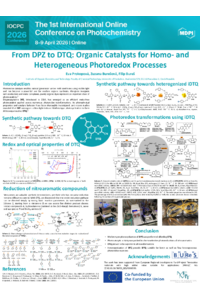
Photoredox catalysis has emerged as a powerful strategy for driving redox reactions under exceptionally mild conditions by using light as a clean and controllable energy source. A suitable photocatalyst capable of harvesting light energy and promoting electron-transfer processes is essential for this methodology.1 Common classes of purely organic photocatalysts include xanthene, acridinium dyes, perylenediimides, and cyanoarenes.2
In 2014, dicyanopyrazine DPZ was introduced as organic photocatalyst, which has been employed in numerous photoredox transformations so far.3 Its mechanism of action and catalytic activity were investigated,4 while a recent study revealed that, under blue-light irradiation, DPZ undergoes a Mallory-type photocyclization to dithienoquinoxaline (DTQ).5 Its double excited DTQ⁻· proved to be an exceptionally strong organic reductant capable of chemodivergently reducing nitroaromatics. Hence, utilizing ³DTQ or *DTQ⁻· and a single blue light source, diethienoquinoxaline can be employed either as a one-electron oxidant or reductant via PET and conPET processes.
DTQ was further immobilized through copolymerization with styrene, generating a polymer-bound photocatalyst (iDTQ). Both powdered material and a flexible monolithic column based on iDTQ were prepared, each retaining the key photophysical and catalytic features of the homogeneous DTQ. iDTQ was successfully applied in both batch and continuous-flow heterogeneous photocatalytic processes.6
1 N. A. Romero, D. A. Nicewicz, Chem. Rev. 2016, 116, 10075.
2 H. Wang, C. Zhao, Z. Burešová, F. Bureš, J. Liu, J. Mater. Chem. A 2023, 11, 3753.
3 Z. Burešová, F. Bureš, Chem. Rec. 2025, 25, e202500134.
4 Z. Burešová, H. B. Gobeze, M. Grygarová, O. Pytela, M. Klikar, R. Obertík, R. Cibulka, T. Islam, K. S. Schanze, F. Bureš, J. Catal. 2024, 430, 115348.
5 Z. Burešová, M. Grygarová, E. Prokopová, M. Klikar, O. Pytela, J. Váňa, A. M. M. Fahim, K. Jana, E. Zubova, J. Bartáček, J. Tydlitát, Z. Růžičková, R. Cibulka, K. S. Schanze, F. Bureš, J. Catal. 2025, 445, 116033.
6 M. Klikar, Z. Burešová, J. Bartáček, E. Prokopová, M. Grygarová, J. Svoboda, R. Bulánek, F. Bureš, J. Catal. 2025, 450, 116323.
Keywords
photoredox catalysis
dicyanopyrazine (DPZ)
diethienoquinoxaline (DTQ)
Mallory-type photocyclization
immobilization
continuous-flow processes
Poster
IOCP2026_EvaProkopova.pdf
Conjugates of Photosensitizers and Doxorubicin with Cleavable Linkers for Controlled Release
Unexpected Photoluminescence Enhancement upon Epoxidation of Coronene: A DFT/MRCI Study