Event submissions
Published
This submission belongs to the session S3. Photocatalytic Energy Conversion of the event The 1st International Online Conference on Photochemistry
Published date
03 Apr, 2026
Academic Editor
'%3e%3cpath%20d='M12.6657%2010.9104C12.4185%2010.325%2012.0599%209.79327%2011.6097%209.34482C11.1609%208.89508%2010.6293%208.5365%2010.0442%208.28888C10.0389%208.28626%2010.0337%208.28495%2010.0285%208.28233C10.8446%207.69279%2011.3752%206.73249%2011.3752%205.64904C11.3752%203.8542%209.92103%202.39999%208.1262%202.39999C6.33136%202.39999%204.87715%203.8542%204.87715%205.64904C4.87715%206.73249%205.40774%207.69279%206.22393%208.28364C6.21869%208.28626%206.21345%208.28757%206.20821%208.29019C5.62129%208.5378%205.09463%208.89284%204.64265%209.34613C4.1929%209.79493%203.83432%2010.3266%203.58671%2010.9117C3.34345%2011.4845%203.21226%2012.0987%203.20023%2012.7209C3.19988%2012.7349%203.20233%2012.7488%203.20744%2012.7619C3.21255%2012.7749%203.22022%2012.7867%203.22998%2012.7968C3.23975%2012.8068%203.25142%2012.8147%203.26431%2012.8202C3.2772%2012.8256%203.29105%2012.8284%203.30504%2012.8284H4.09109C4.14874%2012.8284%204.19459%2012.7825%204.1959%2012.7262C4.2221%2011.7148%204.62823%2010.7676%205.34617%2010.0497C6.08899%209.30683%207.0755%208.89808%208.1262%208.89808C9.17689%208.89808%2010.1634%209.30683%2010.9062%2010.0497C11.6242%2010.7676%2012.0303%2011.7148%2012.0565%2012.7262C12.0578%2012.7838%2012.1037%2012.8284%2012.1613%2012.8284H12.9474C12.9613%2012.8284%2012.9752%2012.8256%2012.9881%2012.8202C13.001%2012.8147%2013.0126%2012.8068%2013.0224%2012.7968C13.0322%2012.7867%2013.0398%2012.7749%2013.0449%2012.7619C13.0501%2012.7488%2013.0525%2012.7349%2013.0522%2012.7209C13.0391%2012.0947%2012.9094%2011.4855%2012.6657%2010.9104ZM8.1262%207.9024C7.52486%207.9024%206.9589%207.6679%206.53312%207.24211C6.10733%206.81633%205.87283%206.25037%205.87283%205.64904C5.87283%205.0477%206.10733%204.48174%206.53312%204.05596C6.9589%203.63018%207.52486%203.39567%208.1262%203.39567C8.72753%203.39567%209.29349%203.63018%209.71927%204.05596C10.1451%204.48174%2010.3796%205.0477%2010.3796%205.64904C10.3796%206.25037%2010.1451%206.81633%209.71927%207.24211C9.29349%207.6679%208.72753%207.9024%208.1262%207.9024Z'%20fill='%235D1EE1'/%3e%3c/g%3e%3c/svg%3e) Detlef Bahnemann
Detlef BahnemannCitation
RAHHOU Abd elaziz, HASNAOUI Ali, ROCHDI Nabil, AIT ALI Mustapha, Di-Nuclear Water-Soluble Oxovanadium (V) Schiff Base Complexes: Electrochemical Properties, Catalytic Oxidation, and Photovoltaic Applications., in Proceedings of The 1st International Online Conference on Photochemistry, 8 April–9 April 2026, MDPI: Basel, Switzerland
Share
Email
Facebook
Twitter
LinkedIn
Di-Nuclear Water-Soluble Oxovanadium (V) Schiff Base Complexes: Electrochemical Properties, Catalytic Oxidation, and Photovoltaic Applications.
'%3e%3cpath%20d='M12.6647%2010.9104C12.4176%2010.325%2012.0589%209.7933%2011.6088%209.34485C11.16%208.89511%2010.6283%208.53653%2010.0432%208.28891C10.038%208.28629%2010.0327%208.28498%2010.0275%208.28236C10.8437%207.69282%2011.3743%206.73252%2011.3743%205.64907C11.3743%203.85423%209.92005%202.40002%208.12522%202.40002C6.33038%202.40002%204.87618%203.85423%204.87618%205.64907C4.87618%206.73252%205.40677%207.69282%206.22296%208.28367C6.21772%208.28629%206.21248%208.2876%206.20724%208.29022C5.62031%208.53783%205.09365%208.89287%204.64167%209.34616C4.19192%209.79496%203.83334%2010.3266%203.58573%2010.9117C3.34247%2011.4846%203.21128%2012.0987%203.19925%2012.721C3.1989%2012.735%203.20135%2012.7489%203.20646%2012.7619C3.21157%2012.7749%203.21924%2012.7868%203.22901%2012.7968C3.23877%2012.8068%203.25045%2012.8148%203.26334%2012.8202C3.27623%2012.8256%203.29007%2012.8284%203.30406%2012.8284H4.09012C4.14776%2012.8284%204.19362%2012.7825%204.19493%2012.7262C4.22113%2011.7148%204.62726%2010.7676%205.34519%2010.0497C6.08802%209.30686%207.07452%208.89811%208.12522%208.89811C9.17592%208.89811%2010.1624%209.30686%2010.9052%2010.0497C11.6232%2010.7676%2012.0293%2011.7148%2012.0555%2012.7262C12.0568%2012.7839%2012.1027%2012.8284%2012.1603%2012.8284H12.9464C12.9604%2012.8284%2012.9742%2012.8256%2012.9871%2012.8202C13%2012.8148%2013.0117%2012.8068%2013.0214%2012.7968C13.0312%2012.7868%2013.0389%2012.7749%2013.044%2012.7619C13.0491%2012.7489%2013.0515%2012.735%2013.0512%2012.721C13.0381%2012.0947%2012.9084%2011.4856%2012.6647%2010.9104ZM8.12522%207.90243C7.52388%207.90243%206.95792%207.66793%206.53214%207.24215C6.10636%206.81636%205.87185%206.2504%205.87185%205.64907C5.87185%205.04773%206.10636%204.48177%206.53214%204.05599C6.95792%203.63021%207.52388%203.3957%208.12522%203.3957C8.72655%203.3957%209.29252%203.63021%209.7183%204.05599C10.1441%204.48177%2010.3786%205.04773%2010.3786%205.64907C10.3786%206.2504%2010.1441%206.81636%209.7183%207.24215C9.29252%207.66793%208.72655%207.90243%208.12522%207.90243Z'%20fill='%235D1EE1'/%3e%3c/g%3e%3c/svg%3e)
RAHHOU Abd elaziz 1
HASNAOUI Ali 2
ROCHDI Nabil 3
AIT ALI Mustapha 2
1. IMED-Lab, Faculty of Sciences and Techniques, Cadi Ayyad University, Bd Abdelkrim Al
Khattabi, BP 549, 40000, Marrakech, Morocco.
2. Molecular Chemistry Laboratory, Faculty of Sciences Semlalia, Cadi Ayyad University, BP 2390
Bd My Abdellah, 40000 Marrakech, Morocco.
3. MED-Lab, Faculty of Sciences and Techniques, Cadi Ayyad University, Bd Abdelkrim Al
Khattabi, BP 549, 40000, Marrakech, Morocco.
Abstract
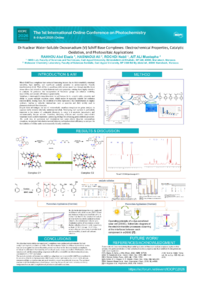
Two dinuclear oxovanadium(V) complexes with water solubility, [(L1H)VO(μ-O)]₂ (C1) and [(L2H)VO(μ-O)]₂ (C2), were successfully synthesized via the reaction of VOSO₄ with their respective tetradentate Schiff base ligands, namely [N-(2-hydroxyethylamino)ethyl]-5-methoxysalicylaldimine (L1H) and 2-[(2-(2-hydroxyethylamino)ethylimino)methyl]phenol (L2H), under reflux in methanol. The synthetic procedure afforded the complexes in good yields and with high purity, as confirmed by spectroscopic analyses and elemental composition. These dinuclear Schiff base oxovanadium complexes were systematically evaluated for their catalytic activity in the oxidation of olefins using water as a green and environmentally benign solvent in combination with various oxidizing agents. The experimental results demonstrated high catalytic efficiency, excellent product yields, and remarkable reusability, highlighting the potential of these complexes as sustainable catalysts in aqueous media. Beyond their catalytic applications, these oxovanadium(V) complexes possess significant photophysical and electrochemical properties, including strong absorption in the visible region and tunable redox potentials. These characteristics render them promising candidates for photovoltaic applications, particularly in dye-sensitized solar cells (DSSCs) and other solar energy conversion devices, where efficient light harvesting and electron transfer are essential. The combination of water solubility, catalytic performance, and photophysical features makes these complexes versatile functional materials for both chemical and energy-related applications.
Keywords
chiff base
X -ray structure
Catalyze in water
Vanadium complexes
Oxidation of olefins
Photovoltaic applications
Poster
IOCPC2026 POSTER.pdf
Machine Learning Guided Design of Metal–Ligand Complexes for Photocatalysis
Enhanced Visible-Light-Driven Photocatalytic Degradation of Organic Pollutants by a Novel MgO/g-C3N4/Bi2O3 Ternary Nanocomposite