Event submissions
Published
This submission belongs to the session S4. Fractional Calculus in Complex and Nonlinear Dynamical Systems of the event The 1st International Online Conference on Fractal and Fractional
Published date
08 Apr, 2026
Academic Editor
'%3e%3cpath%20d='M12.6657%2010.9104C12.4185%2010.325%2012.0599%209.79327%2011.6097%209.34482C11.1609%208.89508%2010.6293%208.5365%2010.0442%208.28888C10.0389%208.28626%2010.0337%208.28495%2010.0285%208.28233C10.8446%207.69279%2011.3752%206.73249%2011.3752%205.64904C11.3752%203.8542%209.92103%202.39999%208.1262%202.39999C6.33136%202.39999%204.87715%203.8542%204.87715%205.64904C4.87715%206.73249%205.40774%207.69279%206.22393%208.28364C6.21869%208.28626%206.21345%208.28757%206.20821%208.29019C5.62129%208.5378%205.09463%208.89284%204.64265%209.34613C4.1929%209.79493%203.83432%2010.3266%203.58671%2010.9117C3.34345%2011.4845%203.21226%2012.0987%203.20023%2012.7209C3.19988%2012.7349%203.20233%2012.7488%203.20744%2012.7619C3.21255%2012.7749%203.22022%2012.7867%203.22998%2012.7968C3.23975%2012.8068%203.25142%2012.8147%203.26431%2012.8202C3.2772%2012.8256%203.29105%2012.8284%203.30504%2012.8284H4.09109C4.14874%2012.8284%204.19459%2012.7825%204.1959%2012.7262C4.2221%2011.7148%204.62823%2010.7676%205.34617%2010.0497C6.08899%209.30683%207.0755%208.89808%208.1262%208.89808C9.17689%208.89808%2010.1634%209.30683%2010.9062%2010.0497C11.6242%2010.7676%2012.0303%2011.7148%2012.0565%2012.7262C12.0578%2012.7838%2012.1037%2012.8284%2012.1613%2012.8284H12.9474C12.9613%2012.8284%2012.9752%2012.8256%2012.9881%2012.8202C13.001%2012.8147%2013.0126%2012.8068%2013.0224%2012.7968C13.0322%2012.7867%2013.0398%2012.7749%2013.0449%2012.7619C13.0501%2012.7488%2013.0525%2012.7349%2013.0522%2012.7209C13.0391%2012.0947%2012.9094%2011.4855%2012.6657%2010.9104ZM8.1262%207.9024C7.52486%207.9024%206.9589%207.6679%206.53312%207.24211C6.10733%206.81633%205.87283%206.25037%205.87283%205.64904C5.87283%205.0477%206.10733%204.48174%206.53312%204.05596C6.9589%203.63018%207.52486%203.39567%208.1262%203.39567C8.72753%203.39567%209.29349%203.63018%209.71927%204.05596C10.1451%204.48174%2010.3796%205.0477%2010.3796%205.64904C10.3796%206.25037%2010.1451%206.81633%209.71927%207.24211C9.29349%207.6679%208.72753%207.9024%208.1262%207.9024Z'%20fill='%235D1EE1'/%3e%3c/g%3e%3c/svg%3e) Anwarud Din
Anwarud DinCitation
Yajie Li, Zhiqiang Wu, Yongtao Sun, Ying Hao, Shengli Chen, Xiangyun Zhang, Bifurcation control and parametric influence analysis in a fractional bi-rhythm Van der pol-Rayleigh system driven by Gaussian colored noises, in Proceedings of The 1st International Online Conference on Fractal and Fractional, 13 April–15 April 2026, MDPI: Basel, Switzerland
Share
Email
Facebook
Twitter
LinkedIn
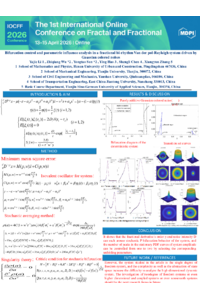
Bifurcation control and parametric influence analysis in a fractional bi-rhythm Van der pol-Rayleigh system driven by Gaussian colored noises
'%3e%3cpath%20d='M12.6647%2010.9104C12.4176%2010.325%2012.0589%209.7933%2011.6088%209.34485C11.16%208.89511%2010.6283%208.53653%2010.0432%208.28891C10.038%208.28629%2010.0327%208.28498%2010.0275%208.28236C10.8437%207.69282%2011.3743%206.73252%2011.3743%205.64907C11.3743%203.85423%209.92005%202.40002%208.12522%202.40002C6.33038%202.40002%204.87618%203.85423%204.87618%205.64907C4.87618%206.73252%205.40677%207.69282%206.22296%208.28367C6.21772%208.28629%206.21248%208.2876%206.20724%208.29022C5.62031%208.53783%205.09365%208.89287%204.64167%209.34616C4.19192%209.79496%203.83334%2010.3266%203.58573%2010.9117C3.34247%2011.4846%203.21128%2012.0987%203.19925%2012.721C3.1989%2012.735%203.20135%2012.7489%203.20646%2012.7619C3.21157%2012.7749%203.21924%2012.7868%203.22901%2012.7968C3.23877%2012.8068%203.25045%2012.8148%203.26334%2012.8202C3.27623%2012.8256%203.29007%2012.8284%203.30406%2012.8284H4.09012C4.14776%2012.8284%204.19362%2012.7825%204.19493%2012.7262C4.22113%2011.7148%204.62726%2010.7676%205.34519%2010.0497C6.08802%209.30686%207.07452%208.89811%208.12522%208.89811C9.17592%208.89811%2010.1624%209.30686%2010.9052%2010.0497C11.6232%2010.7676%2012.0293%2011.7148%2012.0555%2012.7262C12.0568%2012.7839%2012.1027%2012.8284%2012.1603%2012.8284H12.9464C12.9604%2012.8284%2012.9742%2012.8256%2012.9871%2012.8202C13%2012.8148%2013.0117%2012.8068%2013.0214%2012.7968C13.0312%2012.7868%2013.0389%2012.7749%2013.044%2012.7619C13.0491%2012.7489%2013.0515%2012.735%2013.0512%2012.721C13.0381%2012.0947%2012.9084%2011.4856%2012.6647%2010.9104ZM8.12522%207.90243C7.52388%207.90243%206.95792%207.66793%206.53214%207.24215C6.10636%206.81636%205.87185%206.2504%205.87185%205.64907C5.87185%205.04773%206.10636%204.48177%206.53214%204.05599C6.95792%203.63021%207.52388%203.3957%208.12522%203.3957C8.72655%203.3957%209.29252%203.63021%209.7183%204.05599C10.1441%204.48177%2010.3786%205.04773%2010.3786%205.64907C10.3786%206.2504%2010.1441%206.81636%209.7183%207.24215C9.29252%207.66793%208.72655%207.90243%208.12522%207.90243Z'%20fill='%235D1EE1'/%3e%3c/g%3e%3c/svg%3e)
Yajie Li 1
Zhiqiang Wu 2
Yongtao Sun 2
Ying Hao 3
Shengli Chen 4
Xiangyun Zhang 5
1. School of Mathematics and Physics, Henan University of Urban and Construction, Pingdingshan 467036, China
2. School of Mechanical Engineering, Tianjin University, Tianjin, 300072, China
3. School of Civil Engineering and Mechanics, Yanshan University, Qinhuangdao, 066104, China
4. School of Transportation Engineering, East China Jiaotong University, Nanchang 330013, China
5. Basic Course Department, Tianjin Sino-German University of Applied Sciences, Tianjin, 300354, China
Abstract
The stochastic P-bifurcation characteristics of a bistable Van der Pol-Rayleigh system incorporating fractional-order inertia and damping are examined under the joint effects of additive and multiplicative Gaussian colored noises. By invoking the minimum mean square error criterion, the fractional-order inertial and damping components are reformulated as the combinations of integer-order stiffness, damping, and inertial terms, allowing the original fractional system to be transformed into an isovalent integer-order dynamical system.
On this basis, the stationary probability density function of the system amplitude is obtained through the stochastic averaging technique. The parametric conditions governing the emergence of stochastic P-bifurcation are then identified using singularity theory. Furthermore, the qualitative topology evolution of the steady-state probability density is investigated by analyzing representative parameters located in distinct regions delineated by the transition curves.
To verify the analytical process, the numerical results obtained from Monte Carlo simulations and a Radial Basis Function Neural Network (RBFNN) are compared with the theoretical solutions. The high agreement among these results confirms the validity of the analytical framework and the accuracy of the transition set acquired. The findings provide theoretical insights into the control of bifurcation and vibration suppression in nonlinear fractional systems under random excitation, with potential applications in engineering design, aeroelastic stability, and vibration control of structures with memory-dependent properties.
Keywords
stochastic P bifurcation
stocastic averaging method
critical parameter conditions
singularity theory
transition set curves
Poster
Poster-Bifurcation control and parametric influence analysis in a fractional bi-rhythm Van der pol-Rayleigh system driven by Gaussian colored noises.pptx - Repaired.pdf
Control and synchronization of Julia sets of a discrete three-dimensional fractional HCV model
Modeling Air Pollution–Mortality Interactions Using Fractional Calculus and Stochastic Processes