Event submissions
Published
This submission belongs to the session S5. Fractional Calculus in Machine Learning: Applications and Challenges of the event The 1st International Online Conference on Fractal and Fractional
Published date
08 Apr, 2026
Academic Editor
'%3e%3cpath%20d='M12.6657%2010.9104C12.4185%2010.325%2012.0599%209.79327%2011.6097%209.34482C11.1609%208.89508%2010.6293%208.5365%2010.0442%208.28888C10.0389%208.28626%2010.0337%208.28495%2010.0285%208.28233C10.8446%207.69279%2011.3752%206.73249%2011.3752%205.64904C11.3752%203.8542%209.92103%202.39999%208.1262%202.39999C6.33136%202.39999%204.87715%203.8542%204.87715%205.64904C4.87715%206.73249%205.40774%207.69279%206.22393%208.28364C6.21869%208.28626%206.21345%208.28757%206.20821%208.29019C5.62129%208.5378%205.09463%208.89284%204.64265%209.34613C4.1929%209.79493%203.83432%2010.3266%203.58671%2010.9117C3.34345%2011.4845%203.21226%2012.0987%203.20023%2012.7209C3.19988%2012.7349%203.20233%2012.7488%203.20744%2012.7619C3.21255%2012.7749%203.22022%2012.7867%203.22998%2012.7968C3.23975%2012.8068%203.25142%2012.8147%203.26431%2012.8202C3.2772%2012.8256%203.29105%2012.8284%203.30504%2012.8284H4.09109C4.14874%2012.8284%204.19459%2012.7825%204.1959%2012.7262C4.2221%2011.7148%204.62823%2010.7676%205.34617%2010.0497C6.08899%209.30683%207.0755%208.89808%208.1262%208.89808C9.17689%208.89808%2010.1634%209.30683%2010.9062%2010.0497C11.6242%2010.7676%2012.0303%2011.7148%2012.0565%2012.7262C12.0578%2012.7838%2012.1037%2012.8284%2012.1613%2012.8284H12.9474C12.9613%2012.8284%2012.9752%2012.8256%2012.9881%2012.8202C13.001%2012.8147%2013.0126%2012.8068%2013.0224%2012.7968C13.0322%2012.7867%2013.0398%2012.7749%2013.0449%2012.7619C13.0501%2012.7488%2013.0525%2012.7349%2013.0522%2012.7209C13.0391%2012.0947%2012.9094%2011.4855%2012.6657%2010.9104ZM8.1262%207.9024C7.52486%207.9024%206.9589%207.6679%206.53312%207.24211C6.10733%206.81633%205.87283%206.25037%205.87283%205.64904C5.87283%205.0477%206.10733%204.48174%206.53312%204.05596C6.9589%203.63018%207.52486%203.39567%208.1262%203.39567C8.72753%203.39567%209.29349%203.63018%209.71927%204.05596C10.1451%204.48174%2010.3796%205.0477%2010.3796%205.64904C10.3796%206.25037%2010.1451%206.81633%209.71927%207.24211C9.29349%207.6679%208.72753%207.9024%208.1262%207.9024Z'%20fill='%235D1EE1'/%3e%3c/g%3e%3c/svg%3e) YangQuan Chen
YangQuan ChenCitation
Ipek Altan, Pınar Kırcı, Fractal and Machine Learning-Based Analysis of Shoreline Change in Storm-Affected Coastal Environments, in Proceedings of The 1st International Online Conference on Fractal and Fractional, 13 April–15 April 2026, MDPI: Basel, Switzerland
Share
Email
Facebook
Twitter
LinkedIn
Fractal and Machine Learning-Based Analysis of Shoreline Change in Storm-Affected Coastal Environments
'%3e%3cpath%20d='M12.6647%2010.9104C12.4176%2010.325%2012.0589%209.7933%2011.6088%209.34485C11.16%208.89511%2010.6283%208.53653%2010.0432%208.28891C10.038%208.28629%2010.0327%208.28498%2010.0275%208.28236C10.8437%207.69282%2011.3743%206.73252%2011.3743%205.64907C11.3743%203.85423%209.92005%202.40002%208.12522%202.40002C6.33038%202.40002%204.87618%203.85423%204.87618%205.64907C4.87618%206.73252%205.40677%207.69282%206.22296%208.28367C6.21772%208.28629%206.21248%208.2876%206.20724%208.29022C5.62031%208.53783%205.09365%208.89287%204.64167%209.34616C4.19192%209.79496%203.83334%2010.3266%203.58573%2010.9117C3.34247%2011.4846%203.21128%2012.0987%203.19925%2012.721C3.1989%2012.735%203.20135%2012.7489%203.20646%2012.7619C3.21157%2012.7749%203.21924%2012.7868%203.22901%2012.7968C3.23877%2012.8068%203.25045%2012.8148%203.26334%2012.8202C3.27623%2012.8256%203.29007%2012.8284%203.30406%2012.8284H4.09012C4.14776%2012.8284%204.19362%2012.7825%204.19493%2012.7262C4.22113%2011.7148%204.62726%2010.7676%205.34519%2010.0497C6.08802%209.30686%207.07452%208.89811%208.12522%208.89811C9.17592%208.89811%2010.1624%209.30686%2010.9052%2010.0497C11.6232%2010.7676%2012.0293%2011.7148%2012.0555%2012.7262C12.0568%2012.7839%2012.1027%2012.8284%2012.1603%2012.8284H12.9464C12.9604%2012.8284%2012.9742%2012.8256%2012.9871%2012.8202C13%2012.8148%2013.0117%2012.8068%2013.0214%2012.7968C13.0312%2012.7868%2013.0389%2012.7749%2013.044%2012.7619C13.0491%2012.7489%2013.0515%2012.735%2013.0512%2012.721C13.0381%2012.0947%2012.9084%2011.4856%2012.6647%2010.9104ZM8.12522%207.90243C7.52388%207.90243%206.95792%207.66793%206.53214%207.24215C6.10636%206.81636%205.87185%206.2504%205.87185%205.64907C5.87185%205.04773%206.10636%204.48177%206.53214%204.05599C6.95792%203.63021%207.52388%203.3957%208.12522%203.3957C8.72655%203.3957%209.29252%203.63021%209.7183%204.05599C10.1441%204.48177%2010.3786%205.04773%2010.3786%205.64907C10.3786%206.2504%2010.1441%206.81636%209.7183%207.24215C9.29252%207.66793%208.72655%207.90243%208.12522%207.90243Z'%20fill='%235D1EE1'/%3e%3c/g%3e%3c/svg%3e)
Ipek Altan 1
Pınar Kırcı 1
1. Computer Engineering, Engineering Faculty, Institute of Science, Bursa Uludag University, Bursa 16000, Turkey
Abstract
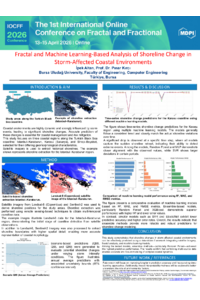
Understanding and forecasting coastline retreat under storm forcing is critical for coastal resilience planning. This study presents a multi-site, data-driven framework integrating fractal shoreline metrics, ERA5-derived storm parameters, and machine learning models to predict monthly shoreline retreat across three morphologically distinct Turkish coasts (Istanbul Karaburun, Karasu, and Sinop Boyabat). Satellite imagery (Sentinel-2, Landsat-8) was processed to extract historical shorelines, followed by computation of box-counting (D_box) and boundary-method (D_bm) fractal dimensions. Storm indicators—including storm index, high-wind hours, significant wave height exceedance durations, and wave energy metrics—were derived from ERA5 reanalysis. To address data sparsity, a block-bootstrap data augmentation strategy generated 300 synthetic years, yielding a final dataset of 10,815 monthly observations.
Five machine learning models were trained and evaluated: Random Forest, GRU, MLP, Ridge, and SVR. Results demonstrate that the Random Forest model achieved the highest performance (R² = 0.9866, MAE = 0.0113 m/month), followed by the GRU model (R² = 0.9552). Feature importance analysis revealed that shoreline-specific characteristics, fractal metrics, and storm intensity indicators are the dominant predictors. Cross-site generalization tests show that a single unified model can effectively predict retreat patterns across morphologically diverse coastlines.
The findings highlight: (1) the strong predictive capacity of storm indices and fractal shoreline complexity; (2) the suitability of tree-based and recurrent neural models for coastal change prediction; and (3) the viability of bootstrap-based synthetic augmentation for long-term coastal datasets. This framework provides a scalable and transferable methodology for early-warning systems and climate-adaptation strategies. Future work will explore scenario-based forecasting under extreme storm thresholds and SHAP-based interpretability to enhance model transparency.
Keywords
shoreline retreat
fractal analysis
machine learning
storm impact
coastal Dynamics
satellite imagery
shoreline complexity
wave energy
coastal morphodynamics
environmental change modeling
Poster
sciforum-145071.pdf
Fractional-Order Face Analytics for Age and Gender
RECENT DEVELOPMENTS IN FRACTIONAL ARTIFICIAL NEURAL NETWORK APPROXIMATION