Event submissions
Published
This submission belongs to the session S1. Recent Advances in Fractional-Order Differential and Integral Operators of the event The 1st International Online Conference on Fractal and Fractional
Published date
08 Apr, 2026
Academic Editor
'%3e%3cpath%20d='M12.6657%2010.9104C12.4185%2010.325%2012.0599%209.79327%2011.6097%209.34482C11.1609%208.89508%2010.6293%208.5365%2010.0442%208.28888C10.0389%208.28626%2010.0337%208.28495%2010.0285%208.28233C10.8446%207.69279%2011.3752%206.73249%2011.3752%205.64904C11.3752%203.8542%209.92103%202.39999%208.1262%202.39999C6.33136%202.39999%204.87715%203.8542%204.87715%205.64904C4.87715%206.73249%205.40774%207.69279%206.22393%208.28364C6.21869%208.28626%206.21345%208.28757%206.20821%208.29019C5.62129%208.5378%205.09463%208.89284%204.64265%209.34613C4.1929%209.79493%203.83432%2010.3266%203.58671%2010.9117C3.34345%2011.4845%203.21226%2012.0987%203.20023%2012.7209C3.19988%2012.7349%203.20233%2012.7488%203.20744%2012.7619C3.21255%2012.7749%203.22022%2012.7867%203.22998%2012.7968C3.23975%2012.8068%203.25142%2012.8147%203.26431%2012.8202C3.2772%2012.8256%203.29105%2012.8284%203.30504%2012.8284H4.09109C4.14874%2012.8284%204.19459%2012.7825%204.1959%2012.7262C4.2221%2011.7148%204.62823%2010.7676%205.34617%2010.0497C6.08899%209.30683%207.0755%208.89808%208.1262%208.89808C9.17689%208.89808%2010.1634%209.30683%2010.9062%2010.0497C11.6242%2010.7676%2012.0303%2011.7148%2012.0565%2012.7262C12.0578%2012.7838%2012.1037%2012.8284%2012.1613%2012.8284H12.9474C12.9613%2012.8284%2012.9752%2012.8256%2012.9881%2012.8202C13.001%2012.8147%2013.0126%2012.8068%2013.0224%2012.7968C13.0322%2012.7867%2013.0398%2012.7749%2013.0449%2012.7619C13.0501%2012.7488%2013.0525%2012.7349%2013.0522%2012.7209C13.0391%2012.0947%2012.9094%2011.4855%2012.6657%2010.9104ZM8.1262%207.9024C7.52486%207.9024%206.9589%207.6679%206.53312%207.24211C6.10733%206.81633%205.87283%206.25037%205.87283%205.64904C5.87283%205.0477%206.10733%204.48174%206.53312%204.05596C6.9589%203.63018%207.52486%203.39567%208.1262%203.39567C8.72753%203.39567%209.29349%203.63018%209.71927%204.05596C10.1451%204.48174%2010.3796%205.0477%2010.3796%205.64904C10.3796%206.25037%2010.1451%206.81633%209.71927%207.24211C9.29349%207.6679%208.72753%207.9024%208.1262%207.9024Z'%20fill='%235D1EE1'/%3e%3c/g%3e%3c/svg%3e) Rodica Luca
Rodica LucaCitation
Artur Sidorenko, Vasiliy Kolokoltsov, Anastasiya Kostrova, Uniform Weak Convergence Rates for CTRW Approximations of Time–Fractional Diffusions with Unbounded Coefficients, in Proceedings of The 1st International Online Conference on Fractal and Fractional, 13 April–15 April 2026, MDPI: Basel, Switzerland
Share
Email
Facebook
Twitter
LinkedIn
Uniform Weak Convergence Rates for CTRW Approximations of Time–Fractional Diffusions with Unbounded Coefficients
'%3e%3cpath%20d='M12.6647%2010.9104C12.4176%2010.325%2012.0589%209.7933%2011.6088%209.34485C11.16%208.89511%2010.6283%208.53653%2010.0432%208.28891C10.038%208.28629%2010.0327%208.28498%2010.0275%208.28236C10.8437%207.69282%2011.3743%206.73252%2011.3743%205.64907C11.3743%203.85423%209.92005%202.40002%208.12522%202.40002C6.33038%202.40002%204.87618%203.85423%204.87618%205.64907C4.87618%206.73252%205.40677%207.69282%206.22296%208.28367C6.21772%208.28629%206.21248%208.2876%206.20724%208.29022C5.62031%208.53783%205.09365%208.89287%204.64167%209.34616C4.19192%209.79496%203.83334%2010.3266%203.58573%2010.9117C3.34247%2011.4846%203.21128%2012.0987%203.19925%2012.721C3.1989%2012.735%203.20135%2012.7489%203.20646%2012.7619C3.21157%2012.7749%203.21924%2012.7868%203.22901%2012.7968C3.23877%2012.8068%203.25045%2012.8148%203.26334%2012.8202C3.27623%2012.8256%203.29007%2012.8284%203.30406%2012.8284H4.09012C4.14776%2012.8284%204.19362%2012.7825%204.19493%2012.7262C4.22113%2011.7148%204.62726%2010.7676%205.34519%2010.0497C6.08802%209.30686%207.07452%208.89811%208.12522%208.89811C9.17592%208.89811%2010.1624%209.30686%2010.9052%2010.0497C11.6232%2010.7676%2012.0293%2011.7148%2012.0555%2012.7262C12.0568%2012.7839%2012.1027%2012.8284%2012.1603%2012.8284H12.9464C12.9604%2012.8284%2012.9742%2012.8256%2012.9871%2012.8202C13%2012.8148%2013.0117%2012.8068%2013.0214%2012.7968C13.0312%2012.7868%2013.0389%2012.7749%2013.044%2012.7619C13.0491%2012.7489%2013.0515%2012.735%2013.0512%2012.721C13.0381%2012.0947%2012.9084%2011.4856%2012.6647%2010.9104ZM8.12522%207.90243C7.52388%207.90243%206.95792%207.66793%206.53214%207.24215C6.10636%206.81636%205.87185%206.2504%205.87185%205.64907C5.87185%205.04773%206.10636%204.48177%206.53214%204.05599C6.95792%203.63021%207.52388%203.3957%208.12522%203.3957C8.72655%203.3957%209.29252%203.63021%209.7183%204.05599C10.1441%204.48177%2010.3786%205.04773%2010.3786%205.64907C10.3786%206.2504%2010.1441%206.81636%209.7183%207.24215C9.29252%207.66793%208.72655%207.90243%208.12522%207.90243Z'%20fill='%235D1EE1'/%3e%3c/g%3e%3c/svg%3e)
Artur Sidorenko 1,2,3
Vasiliy Kolokoltsov 2,3,4
Anastasiya Kostrova 3,4
1. Faculty of Mechanics and Mathematics, Department of Probability Theory, Lomonosov Moscow State University, Moscow 119991, Russia
2. Faculty of Economics, Laboratory of Stochastic Analysis and its Applications, National Research University Higher School of Economics, Moscow 109028, Russia
3. Vega Institute Foundation, Moscow 119991, Russia
4. Faculty of Computational Mathematics and Cybernetics, Lomonosov Moscow State University, Moscow 119991, Russia
Abstract
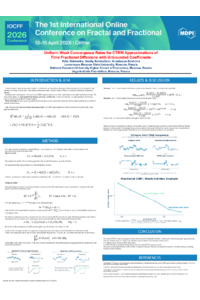
We study uniform weak convergence rates for probabilistic numerical schemes that approximate solutions of time-fractional diffusion equations with unbounded coefficients. The spatial part of the model is generated by a diffusion process with linearly growing drift and diffusion coefficients, which includes, in particular, geometric Brownian motion. The time-fractional structure is described by the classical Caputo–Dzherbashian derivative. In probabilistic terms, the solution can be represented as a subordinated Markov process obtained by time-changing a diffusion with the inverse of a stable subordinator.
We investigate a solution method based on continuous-time random walk (CTRW) approximations. The construction combines discrete-time Markov chain schemes for the diffusion component with heavy-tailed random walk approximations of the stable subordinator.
Our analysis develops a high-order sensitivity framework for the associated diffusion semigroup, relying on Kunita’s stochastic flow theory and the chain rule for tensor fields. This allows us to control derivatives of the flow with respect to the initial condition as random tensor fields, obtain uniform (in space) and exponentially growing (in time) bounds for all orders of sensitivities, and derive corresponding estimates for the derivatives of the Markov semigroup. We also establish a quasi-contraction property of the semigroup in suitable weighted function spaces.
Using these ingredients, we prove explicit uniform weak convergence rates for the CTRW approximation applied to smooth test functions of linear growth. Depending on the spatial part of the equation, the convergence rate is either logarithmic in the time step or follows a power law. Our results extend previous CTRW convergence theory from bounded to linearly growing coefficients, including applications to fractional Black–Scholes models.
Keywords
Time-Fractional Diffusion
Subordinated Markov processes
Continuous-Time Random Walks
Kunita Stochastic Flows
Poster
Poster Template copy.pdf
On non-autonomous fractional semilinear equations
Long-Term Behavior of Non-Oscillating Solutions in
High-Order Forced and Disturbed Fractional Difference
Systems
High-Order Forced and Disturbed Fractional Difference
Systems