Event submissions
Published
This submission belongs to the session S3. Numerical Methods for Fractional Calculus of the event The 1st International Online Conference on Fractal and Fractional
Published date
08 Apr, 2026
Academic Editor
'%3e%3cpath%20d='M12.6657%2010.9104C12.4185%2010.325%2012.0599%209.79327%2011.6097%209.34482C11.1609%208.89508%2010.6293%208.5365%2010.0442%208.28888C10.0389%208.28626%2010.0337%208.28495%2010.0285%208.28233C10.8446%207.69279%2011.3752%206.73249%2011.3752%205.64904C11.3752%203.8542%209.92103%202.39999%208.1262%202.39999C6.33136%202.39999%204.87715%203.8542%204.87715%205.64904C4.87715%206.73249%205.40774%207.69279%206.22393%208.28364C6.21869%208.28626%206.21345%208.28757%206.20821%208.29019C5.62129%208.5378%205.09463%208.89284%204.64265%209.34613C4.1929%209.79493%203.83432%2010.3266%203.58671%2010.9117C3.34345%2011.4845%203.21226%2012.0987%203.20023%2012.7209C3.19988%2012.7349%203.20233%2012.7488%203.20744%2012.7619C3.21255%2012.7749%203.22022%2012.7867%203.22998%2012.7968C3.23975%2012.8068%203.25142%2012.8147%203.26431%2012.8202C3.2772%2012.8256%203.29105%2012.8284%203.30504%2012.8284H4.09109C4.14874%2012.8284%204.19459%2012.7825%204.1959%2012.7262C4.2221%2011.7148%204.62823%2010.7676%205.34617%2010.0497C6.08899%209.30683%207.0755%208.89808%208.1262%208.89808C9.17689%208.89808%2010.1634%209.30683%2010.9062%2010.0497C11.6242%2010.7676%2012.0303%2011.7148%2012.0565%2012.7262C12.0578%2012.7838%2012.1037%2012.8284%2012.1613%2012.8284H12.9474C12.9613%2012.8284%2012.9752%2012.8256%2012.9881%2012.8202C13.001%2012.8147%2013.0126%2012.8068%2013.0224%2012.7968C13.0322%2012.7867%2013.0398%2012.7749%2013.0449%2012.7619C13.0501%2012.7488%2013.0525%2012.7349%2013.0522%2012.7209C13.0391%2012.0947%2012.9094%2011.4855%2012.6657%2010.9104ZM8.1262%207.9024C7.52486%207.9024%206.9589%207.6679%206.53312%207.24211C6.10733%206.81633%205.87283%206.25037%205.87283%205.64904C5.87283%205.0477%206.10733%204.48174%206.53312%204.05596C6.9589%203.63018%207.52486%203.39567%208.1262%203.39567C8.72753%203.39567%209.29349%203.63018%209.71927%204.05596C10.1451%204.48174%2010.3796%205.0477%2010.3796%205.64904C10.3796%206.25037%2010.1451%206.81633%209.71927%207.24211C9.29349%207.6679%208.72753%207.9024%208.1262%207.9024Z'%20fill='%235D1EE1'/%3e%3c/g%3e%3c/svg%3e) Dimplekumar Dimplekumar
Dimplekumar DimplekumarCitation
Teodor Vakarelsky, Anish Kumar, Dimiter Prodanov, Comparative Numerical Analysis of Bessel Integrals Arising in Space-Fractional Diffusion, in Proceedings of The 1st International Online Conference on Fractal and Fractional, 13 April–15 April 2026, MDPI: Basel, Switzerland
Share
Email
Facebook
Twitter
LinkedIn
Comparative Numerical Analysis of Bessel Integrals Arising in Space-Fractional Diffusion
'%3e%3cpath%20d='M12.6647%2010.9104C12.4176%2010.325%2012.0589%209.7933%2011.6088%209.34485C11.16%208.89511%2010.6283%208.53653%2010.0432%208.28891C10.038%208.28629%2010.0327%208.28498%2010.0275%208.28236C10.8437%207.69282%2011.3743%206.73252%2011.3743%205.64907C11.3743%203.85423%209.92005%202.40002%208.12522%202.40002C6.33038%202.40002%204.87618%203.85423%204.87618%205.64907C4.87618%206.73252%205.40677%207.69282%206.22296%208.28367C6.21772%208.28629%206.21248%208.2876%206.20724%208.29022C5.62031%208.53783%205.09365%208.89287%204.64167%209.34616C4.19192%209.79496%203.83334%2010.3266%203.58573%2010.9117C3.34247%2011.4846%203.21128%2012.0987%203.19925%2012.721C3.1989%2012.735%203.20135%2012.7489%203.20646%2012.7619C3.21157%2012.7749%203.21924%2012.7868%203.22901%2012.7968C3.23877%2012.8068%203.25045%2012.8148%203.26334%2012.8202C3.27623%2012.8256%203.29007%2012.8284%203.30406%2012.8284H4.09012C4.14776%2012.8284%204.19362%2012.7825%204.19493%2012.7262C4.22113%2011.7148%204.62726%2010.7676%205.34519%2010.0497C6.08802%209.30686%207.07452%208.89811%208.12522%208.89811C9.17592%208.89811%2010.1624%209.30686%2010.9052%2010.0497C11.6232%2010.7676%2012.0293%2011.7148%2012.0555%2012.7262C12.0568%2012.7839%2012.1027%2012.8284%2012.1603%2012.8284H12.9464C12.9604%2012.8284%2012.9742%2012.8256%2012.9871%2012.8202C13%2012.8148%2013.0117%2012.8068%2013.0214%2012.7968C13.0312%2012.7868%2013.0389%2012.7749%2013.044%2012.7619C13.0491%2012.7489%2013.0515%2012.735%2013.0512%2012.721C13.0381%2012.0947%2012.9084%2011.4856%2012.6647%2010.9104ZM8.12522%207.90243C7.52388%207.90243%206.95792%207.66793%206.53214%207.24215C6.10636%206.81636%205.87185%206.2504%205.87185%205.64907C5.87185%205.04773%206.10636%204.48177%206.53214%204.05599C6.95792%203.63021%207.52388%203.3957%208.12522%203.3957C8.72655%203.3957%209.29252%203.63021%209.7183%204.05599C10.1441%204.48177%2010.3786%205.04773%2010.3786%205.64907C10.3786%206.2504%2010.1441%206.81636%209.7183%207.24215C9.29252%207.66793%208.72655%207.90243%208.12522%207.90243Z'%20fill='%235D1EE1'/%3e%3c/g%3e%3c/svg%3e)
Teodor Vakarelsky 1
Anish Kumar 2

Dimiter Prodanov 1
1. Parallel Algorithms and Machine Learning with Neurotechnology Laboratory, Institute of Information and Communication Technologies, Bulgarian Academy of Sciences, Sofia 1612, Bulgaria
2. Department of Mathematics, Dr. Shyama Prasad Mukherjee University, Ranchi 834008, India
Abstract
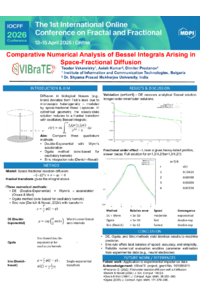
Diffusion within porous biological media, such as brain tissue, often exhibits anomalous behaviour that deviates from classical Fickian laws, motivating the use of space-fractional diffusion models. Analytically tractable space-fractional diffusion problems are typically solved using an integral transform. Bessel integrals arise in the scope of the radial Fourier transform on the plane, which is equivalent to the Hankel transform, and suffer from slow convergence.
This study focuses on the numerical evaluation of a space-fractional reaction-diffusion system with cylindrical symmetry that models the foreign body reaction around an implanted neural electrode. The system incorporates a space-fractional Riesz Laplacian to capture microscopic tissue heterogeneity, and its steady-state solution is derived via the Hankel transform, yielding expressions involving oscillatory Bessel integrals.
Numerical evaluation of these integrals is essential for practical application and parameter estimation. The foundational work implemented a Double-Exponential (DE) quadrature method, enhanced by a sine hyperbolic transformation for oscillatory kernels and accelerated through Wynn’s epsilon algorithm applied over intervals partitioned at Bessel function zeros. In this extended analysis, we compare the initial DE approach with two additional advanced quadrature methods: the Ogata quadrature and the sinc integration rule. Each method is systematically assessed for accuracy, convergence rate, and computational efficiency across a range of fractional orders and spatial ranges.
Our results demonstrate that fractional exponents produce heavy-tailed concentration profiles distinct from the exponential decay of integer-order solutions, and they provide clear performance benchmarks for these quadrature techniques. This comparative study not only validates the robustness of the numerical framework but also offers practical guidance for selecting efficient integration strategies when calibrating transport parameters from experimental data, thereby enhancing the reliability of anomalous diffusion models in biomedical applications.
Keywords
Space-fractional diffusion
Riesz fractional Laplacian
Bessel integrals
Hankel transform
Oscillatory integrals
Numerical quadrature
Double-Exponential method
Ogata quadrature
Sinc integration
Anomalous diffusion
Poster
Poster 3.pdf
Numerical Simulation of Caputo Fractional Oldroyd-B Fluid in a Top-Covered Square Cavity
Solution of fractional order Brusselator chemical model by homotopy analysis method