Event submissions
Published
This submission belongs to the session S2. Fractional Calculus and Its Applications in Engineering Systems of the event The 1st International Online Conference on Fractal and Fractional
Published date
08 Apr, 2026
Academic Editor
'%3e%3cpath%20d='M12.6657%2010.9104C12.4185%2010.325%2012.0599%209.79327%2011.6097%209.34482C11.1609%208.89508%2010.6293%208.5365%2010.0442%208.28888C10.0389%208.28626%2010.0337%208.28495%2010.0285%208.28233C10.8446%207.69279%2011.3752%206.73249%2011.3752%205.64904C11.3752%203.8542%209.92103%202.39999%208.1262%202.39999C6.33136%202.39999%204.87715%203.8542%204.87715%205.64904C4.87715%206.73249%205.40774%207.69279%206.22393%208.28364C6.21869%208.28626%206.21345%208.28757%206.20821%208.29019C5.62129%208.5378%205.09463%208.89284%204.64265%209.34613C4.1929%209.79493%203.83432%2010.3266%203.58671%2010.9117C3.34345%2011.4845%203.21226%2012.0987%203.20023%2012.7209C3.19988%2012.7349%203.20233%2012.7488%203.20744%2012.7619C3.21255%2012.7749%203.22022%2012.7867%203.22998%2012.7968C3.23975%2012.8068%203.25142%2012.8147%203.26431%2012.8202C3.2772%2012.8256%203.29105%2012.8284%203.30504%2012.8284H4.09109C4.14874%2012.8284%204.19459%2012.7825%204.1959%2012.7262C4.2221%2011.7148%204.62823%2010.7676%205.34617%2010.0497C6.08899%209.30683%207.0755%208.89808%208.1262%208.89808C9.17689%208.89808%2010.1634%209.30683%2010.9062%2010.0497C11.6242%2010.7676%2012.0303%2011.7148%2012.0565%2012.7262C12.0578%2012.7838%2012.1037%2012.8284%2012.1613%2012.8284H12.9474C12.9613%2012.8284%2012.9752%2012.8256%2012.9881%2012.8202C13.001%2012.8147%2013.0126%2012.8068%2013.0224%2012.7968C13.0322%2012.7867%2013.0398%2012.7749%2013.0449%2012.7619C13.0501%2012.7488%2013.0525%2012.7349%2013.0522%2012.7209C13.0391%2012.0947%2012.9094%2011.4855%2012.6657%2010.9104ZM8.1262%207.9024C7.52486%207.9024%206.9589%207.6679%206.53312%207.24211C6.10733%206.81633%205.87283%206.25037%205.87283%205.64904C5.87283%205.0477%206.10733%204.48174%206.53312%204.05596C6.9589%203.63018%207.52486%203.39567%208.1262%203.39567C8.72753%203.39567%209.29349%203.63018%209.71927%204.05596C10.1451%204.48174%2010.3796%205.0477%2010.3796%205.64904C10.3796%206.25037%2010.1451%206.81633%209.71927%207.24211C9.29349%207.6679%208.72753%207.9024%208.1262%207.9024Z'%20fill='%235D1EE1'/%3e%3c/g%3e%3c/svg%3e) Saptarshi Das
Saptarshi DasCitation
Dorukhan Astekin, Mümin Tolga Emirler, Erkin Dinçmen, Parameter Space-Based Fractional-Order PD Controller Design and Analysis for Cooperative Adaptive Cruise Control Systems, in Proceedings of The 1st International Online Conference on Fractal and Fractional, 13 April–15 April 2026, MDPI: Basel, Switzerland
Share
Email
Facebook
Twitter
LinkedIn
Parameter Space-Based Fractional-Order PD Controller Design and Analysis for Cooperative Adaptive Cruise Control Systems
'%3e%3cpath%20d='M12.6647%2010.9104C12.4176%2010.325%2012.0589%209.7933%2011.6088%209.34485C11.16%208.89511%2010.6283%208.53653%2010.0432%208.28891C10.038%208.28629%2010.0327%208.28498%2010.0275%208.28236C10.8437%207.69282%2011.3743%206.73252%2011.3743%205.64907C11.3743%203.85423%209.92005%202.40002%208.12522%202.40002C6.33038%202.40002%204.87618%203.85423%204.87618%205.64907C4.87618%206.73252%205.40677%207.69282%206.22296%208.28367C6.21772%208.28629%206.21248%208.2876%206.20724%208.29022C5.62031%208.53783%205.09365%208.89287%204.64167%209.34616C4.19192%209.79496%203.83334%2010.3266%203.58573%2010.9117C3.34247%2011.4846%203.21128%2012.0987%203.19925%2012.721C3.1989%2012.735%203.20135%2012.7489%203.20646%2012.7619C3.21157%2012.7749%203.21924%2012.7868%203.22901%2012.7968C3.23877%2012.8068%203.25045%2012.8148%203.26334%2012.8202C3.27623%2012.8256%203.29007%2012.8284%203.30406%2012.8284H4.09012C4.14776%2012.8284%204.19362%2012.7825%204.19493%2012.7262C4.22113%2011.7148%204.62726%2010.7676%205.34519%2010.0497C6.08802%209.30686%207.07452%208.89811%208.12522%208.89811C9.17592%208.89811%2010.1624%209.30686%2010.9052%2010.0497C11.6232%2010.7676%2012.0293%2011.7148%2012.0555%2012.7262C12.0568%2012.7839%2012.1027%2012.8284%2012.1603%2012.8284H12.9464C12.9604%2012.8284%2012.9742%2012.8256%2012.9871%2012.8202C13%2012.8148%2013.0117%2012.8068%2013.0214%2012.7968C13.0312%2012.7868%2013.0389%2012.7749%2013.044%2012.7619C13.0491%2012.7489%2013.0515%2012.735%2013.0512%2012.721C13.0381%2012.0947%2012.9084%2011.4856%2012.6647%2010.9104ZM8.12522%207.90243C7.52388%207.90243%206.95792%207.66793%206.53214%207.24215C6.10636%206.81636%205.87185%206.2504%205.87185%205.64907C5.87185%205.04773%206.10636%204.48177%206.53214%204.05599C6.95792%203.63021%207.52388%203.3957%208.12522%203.3957C8.72655%203.3957%209.29252%203.63021%209.7183%204.05599C10.1441%204.48177%2010.3786%205.04773%2010.3786%205.64907C10.3786%206.2504%2010.1441%206.81636%209.7183%207.24215C9.29252%207.66793%208.72655%207.90243%208.12522%207.90243Z'%20fill='%235D1EE1'/%3e%3c/g%3e%3c/svg%3e)
Dorukhan Astekin 1
Mümin Tolga Emirler 1
Erkin Dinçmen 1
1. Department of Control and Automation Engineering/Faculty of Electrical and Electronics Engineering, Yildiz Technical University, Istanbul, 34220, Turkey
Abstract
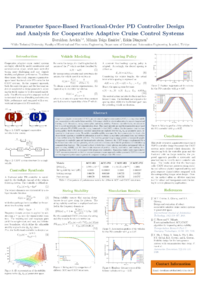
Cooperative adaptive cruise control (CACC), an extension of adaptive cruise control (ACC), is an important intelligent transportation solution for future mobility. It leverages vehicle-to-vehicle information to improve longitudinal tracking, traffic throughput, energy consumption, and string stability. However, controller tuning remains sensitive to model uncertainties and communication delay. This paper presents an analytical parameter-space-based fractional-order PD (FOPD) controller tuning framework for the CACC problem. For the constant-time headway spacing policy, the fractional-order controller parameters are explored over the (kp, kd, µ) parameter space, accounting for plant uncertainties. To enable a tractable stability assessment for the commensurate fractional-order characteristic equation, a variable transformation is used to obtain an equivalent polynomial form, and stability is then verified using the Hurwitz criterion. The resulting parameter-space maps provide a transparent graphical approach to controller gain and fractional-order selection. Moreover, the CACC design is implemented by a feedforward controller that uses preceding vehicle acceleration information within the predecessor-vehicle-following communication topology. The proposed method is tested in a vehicle platoon simulation environment with respect to string stability and the time-domain responses of position, velocity, acceleration, and headway time. The fractional-order CACC is compared with integer-order controllers. Simulation studies under representative CACC maneuvers demonstrate that the proposed parameter-space approach enables systematic FOPD tuning and achieves improved performance requirements compared to integer-order PD control.
Keywords
Cooperative adaptive cruise control
Fractional-order PD control
Hurwitz stability
Parameter space approach
Poster
IOCFF_Poster.pdf
Numerical Simulation of Fluid–Flexible Fin Fluid–Structure Interaction Based on a Fractional Model
Time-Dependent Electro-Osmotic Transport of a Fractional Second-Grade Tetra-Hybrid Nanofluid in a Compliant Multi-Stenosed Bifurcated Artery