Event submissions
Published
This submission belongs to the session S1. Next-Gen Aircraft Design & Optimization of the event The 1st International Online Conference on Aerospace
Published date
13 Apr, 2026
Academic Editor
'%3e%3cpath%20d='M12.6657%2010.9104C12.4185%2010.325%2012.0599%209.79327%2011.6097%209.34482C11.1609%208.89508%2010.6293%208.5365%2010.0442%208.28888C10.0389%208.28626%2010.0337%208.28495%2010.0285%208.28233C10.8446%207.69279%2011.3752%206.73249%2011.3752%205.64904C11.3752%203.8542%209.92103%202.39999%208.1262%202.39999C6.33136%202.39999%204.87715%203.8542%204.87715%205.64904C4.87715%206.73249%205.40774%207.69279%206.22393%208.28364C6.21869%208.28626%206.21345%208.28757%206.20821%208.29019C5.62129%208.5378%205.09463%208.89284%204.64265%209.34613C4.1929%209.79493%203.83432%2010.3266%203.58671%2010.9117C3.34345%2011.4845%203.21226%2012.0987%203.20023%2012.7209C3.19988%2012.7349%203.20233%2012.7488%203.20744%2012.7619C3.21255%2012.7749%203.22022%2012.7867%203.22998%2012.7968C3.23975%2012.8068%203.25142%2012.8147%203.26431%2012.8202C3.2772%2012.8256%203.29105%2012.8284%203.30504%2012.8284H4.09109C4.14874%2012.8284%204.19459%2012.7825%204.1959%2012.7262C4.2221%2011.7148%204.62823%2010.7676%205.34617%2010.0497C6.08899%209.30683%207.0755%208.89808%208.1262%208.89808C9.17689%208.89808%2010.1634%209.30683%2010.9062%2010.0497C11.6242%2010.7676%2012.0303%2011.7148%2012.0565%2012.7262C12.0578%2012.7838%2012.1037%2012.8284%2012.1613%2012.8284H12.9474C12.9613%2012.8284%2012.9752%2012.8256%2012.9881%2012.8202C13.001%2012.8147%2013.0126%2012.8068%2013.0224%2012.7968C13.0322%2012.7867%2013.0398%2012.7749%2013.0449%2012.7619C13.0501%2012.7488%2013.0525%2012.7349%2013.0522%2012.7209C13.0391%2012.0947%2012.9094%2011.4855%2012.6657%2010.9104ZM8.1262%207.9024C7.52486%207.9024%206.9589%207.6679%206.53312%207.24211C6.10733%206.81633%205.87283%206.25037%205.87283%205.64904C5.87283%205.0477%206.10733%204.48174%206.53312%204.05596C6.9589%203.63018%207.52486%203.39567%208.1262%203.39567C8.72753%203.39567%209.29349%203.63018%209.71927%204.05596C10.1451%204.48174%2010.3796%205.0477%2010.3796%205.64904C10.3796%206.25037%2010.1451%206.81633%209.71927%207.24211C9.29349%207.6679%208.72753%207.9024%208.1262%207.9024Z'%20fill='%235D1EE1'/%3e%3c/g%3e%3c/svg%3e) Yufei Zhang
Yufei ZhangCitation
Md. Ridoan Hasan, Samia Islam, Jubayer Ahmed Sajid, Md. Samiullah Prodhan, Conceptual Design and Initial Sizing of a Tiltrotor Aircraft: A Comprehensive Analytical Approach, in Proceedings of The 1st International Online Conference on Aerospace, 16 April–17 April 2026, MDPI: Basel, Switzerland
Share
Email
Facebook
Twitter
LinkedIn
Conceptual Design and Initial Sizing of a Tiltrotor Aircraft: A Comprehensive Analytical Approach

Md. Ridoan Hasan 1
'%3e%3cpath%20d='M12.6647%2010.9104C12.4176%2010.325%2012.0589%209.7933%2011.6088%209.34485C11.16%208.89511%2010.6283%208.53653%2010.0432%208.28891C10.038%208.28629%2010.0327%208.28498%2010.0275%208.28236C10.8437%207.69282%2011.3743%206.73252%2011.3743%205.64907C11.3743%203.85423%209.92005%202.40002%208.12522%202.40002C6.33038%202.40002%204.87618%203.85423%204.87618%205.64907C4.87618%206.73252%205.40677%207.69282%206.22296%208.28367C6.21772%208.28629%206.21248%208.2876%206.20724%208.29022C5.62031%208.53783%205.09365%208.89287%204.64167%209.34616C4.19192%209.79496%203.83334%2010.3266%203.58573%2010.9117C3.34247%2011.4846%203.21128%2012.0987%203.19925%2012.721C3.1989%2012.735%203.20135%2012.7489%203.20646%2012.7619C3.21157%2012.7749%203.21924%2012.7868%203.22901%2012.7968C3.23877%2012.8068%203.25045%2012.8148%203.26334%2012.8202C3.27623%2012.8256%203.29007%2012.8284%203.30406%2012.8284H4.09012C4.14776%2012.8284%204.19362%2012.7825%204.19493%2012.7262C4.22113%2011.7148%204.62726%2010.7676%205.34519%2010.0497C6.08802%209.30686%207.07452%208.89811%208.12522%208.89811C9.17592%208.89811%2010.1624%209.30686%2010.9052%2010.0497C11.6232%2010.7676%2012.0293%2011.7148%2012.0555%2012.7262C12.0568%2012.7839%2012.1027%2012.8284%2012.1603%2012.8284H12.9464C12.9604%2012.8284%2012.9742%2012.8256%2012.9871%2012.8202C13%2012.8148%2013.0117%2012.8068%2013.0214%2012.7968C13.0312%2012.7868%2013.0389%2012.7749%2013.044%2012.7619C13.0491%2012.7489%2013.0515%2012.735%2013.0512%2012.721C13.0381%2012.0947%2012.9084%2011.4856%2012.6647%2010.9104ZM8.12522%207.90243C7.52388%207.90243%206.95792%207.66793%206.53214%207.24215C6.10636%206.81636%205.87185%206.2504%205.87185%205.64907C5.87185%205.04773%206.10636%204.48177%206.53214%204.05599C6.95792%203.63021%207.52388%203.3957%208.12522%203.3957C8.72655%203.3957%209.29252%203.63021%209.7183%204.05599C10.1441%204.48177%2010.3786%205.04773%2010.3786%205.64907C10.3786%206.2504%2010.1441%206.81636%209.7183%207.24215C9.29252%207.66793%208.72655%207.90243%208.12522%207.90243Z'%20fill='%235D1EE1'/%3e%3c/g%3e%3c/svg%3e)
Samia Islam 1

Jubayer Ahmed Sajid 1
Md. Samiullah Prodhan 1
1. Aerospace Engineering, Aviation and Aerospace University, Dhaka 1215, Bangladesh
Abstract
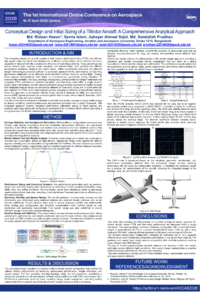
This paper demonstrates a comprehensive analytical approach for initial sizing in the conceptual design of a tiltrotor aircraft. The objective is to incorporate vertical takeoff and landing (VTOL) capability with efficient fixed-wing cruise to achieve high operational flexibility, rapid deployment, and extended mission range. Owing to the hybrid nature of tiltrotor configurations, neither conventional fixed-wing nor rotorcraft design methodologies alone are sufficient; therefore, a unified preliminary design framework is developed by combining elements of both approaches. A representative mission profile for troop transport and search-and-rescue operations is established. Aircraft sizing is performed using a mission-segment fuel fraction analysis that integrates Breguet range and endurance relations for fixed-wing cruise with a known-time fuel burn equation for VTOL, hover, and transition phases. Independent takeoff weight estimations are obtained for both mission types, and the governing maximum takeoff weight is selected for design convergence. The analysis yields a maximum takeoff weight of approximately 59,723.55 lb, governed by the troop transport mission. The resulting configuration achieves an estimated maximum lift-to-drag ratio of 12.3. Additionally, it has a wing loading of 79.5 lb/ft² and a power-to-weight ratio of 0.23 hp/lb. The required installed power is calculated to be 6,987 hp, leading to the selection of the Rolls-Royce T406/AE 1107F turboshaft engine, with a power output of 7,000 hp that satisfies performance requirements while maintaining adequate design margins. The final layout features a high-mounted straight wing utilizing a NACA 23015 airfoil and a conventional empennage with symmetric airfoil sections. This provides a robust quantitative foundation for upcoming aerodynamic, structural, and system-level optimization efforts.
Keywords
tiltrotor aircraft
conceptual design
mission-segment fuel fraction analysis
preliminary weight estimation
wing loading
power-to-weight ratio
lift-to-drag ratio
Poster
Poster- Md. Ridoan Hasan.pdf
Topology-Dependent Evaluation of Automated Homogenization for Lattice Structures in Aerospace Design
Space Application of Austenitic Stainless Steels – DED Possibilities