Event submissions
Published
This submission belongs to the session S1. Next-Gen Aircraft Design & Optimization of the event The 1st International Online Conference on Aerospace
Published date
13 Apr, 2026
Academic Editor
'%3e%3cpath%20d='M12.6657%2010.9104C12.4185%2010.325%2012.0599%209.79327%2011.6097%209.34482C11.1609%208.89508%2010.6293%208.5365%2010.0442%208.28888C10.0389%208.28626%2010.0337%208.28495%2010.0285%208.28233C10.8446%207.69279%2011.3752%206.73249%2011.3752%205.64904C11.3752%203.8542%209.92103%202.39999%208.1262%202.39999C6.33136%202.39999%204.87715%203.8542%204.87715%205.64904C4.87715%206.73249%205.40774%207.69279%206.22393%208.28364C6.21869%208.28626%206.21345%208.28757%206.20821%208.29019C5.62129%208.5378%205.09463%208.89284%204.64265%209.34613C4.1929%209.79493%203.83432%2010.3266%203.58671%2010.9117C3.34345%2011.4845%203.21226%2012.0987%203.20023%2012.7209C3.19988%2012.7349%203.20233%2012.7488%203.20744%2012.7619C3.21255%2012.7749%203.22022%2012.7867%203.22998%2012.7968C3.23975%2012.8068%203.25142%2012.8147%203.26431%2012.8202C3.2772%2012.8256%203.29105%2012.8284%203.30504%2012.8284H4.09109C4.14874%2012.8284%204.19459%2012.7825%204.1959%2012.7262C4.2221%2011.7148%204.62823%2010.7676%205.34617%2010.0497C6.08899%209.30683%207.0755%208.89808%208.1262%208.89808C9.17689%208.89808%2010.1634%209.30683%2010.9062%2010.0497C11.6242%2010.7676%2012.0303%2011.7148%2012.0565%2012.7262C12.0578%2012.7838%2012.1037%2012.8284%2012.1613%2012.8284H12.9474C12.9613%2012.8284%2012.9752%2012.8256%2012.9881%2012.8202C13.001%2012.8147%2013.0126%2012.8068%2013.0224%2012.7968C13.0322%2012.7867%2013.0398%2012.7749%2013.0449%2012.7619C13.0501%2012.7488%2013.0525%2012.7349%2013.0522%2012.7209C13.0391%2012.0947%2012.9094%2011.4855%2012.6657%2010.9104ZM8.1262%207.9024C7.52486%207.9024%206.9589%207.6679%206.53312%207.24211C6.10733%206.81633%205.87283%206.25037%205.87283%205.64904C5.87283%205.0477%206.10733%204.48174%206.53312%204.05596C6.9589%203.63018%207.52486%203.39567%208.1262%203.39567C8.72753%203.39567%209.29349%203.63018%209.71927%204.05596C10.1451%204.48174%2010.3796%205.0477%2010.3796%205.64904C10.3796%206.25037%2010.1451%206.81633%209.71927%207.24211C9.29349%207.6679%208.72753%207.9024%208.1262%207.9024Z'%20fill='%235D1EE1'/%3e%3c/g%3e%3c/svg%3e) Yufei Zhang
Yufei ZhangCitation
Venu Jangam, Ramson Nyamukondiwa, Aerodynamic and Structural Optimization of Additive Manufactured Rocket Fins (Lattice), in Proceedings of The 1st International Online Conference on Aerospace, 16 April–17 April 2026, MDPI: Basel, Switzerland
Share
Email
Facebook
Twitter
LinkedIn
Aerodynamic and Structural Optimization of Additive Manufactured Rocket Fins (Lattice)
'%3e%3cpath%20d='M12.6647%2010.9104C12.4176%2010.325%2012.0589%209.7933%2011.6088%209.34485C11.16%208.89511%2010.6283%208.53653%2010.0432%208.28891C10.038%208.28629%2010.0327%208.28498%2010.0275%208.28236C10.8437%207.69282%2011.3743%206.73252%2011.3743%205.64907C11.3743%203.85423%209.92005%202.40002%208.12522%202.40002C6.33038%202.40002%204.87618%203.85423%204.87618%205.64907C4.87618%206.73252%205.40677%207.69282%206.22296%208.28367C6.21772%208.28629%206.21248%208.2876%206.20724%208.29022C5.62031%208.53783%205.09365%208.89287%204.64167%209.34616C4.19192%209.79496%203.83334%2010.3266%203.58573%2010.9117C3.34247%2011.4846%203.21128%2012.0987%203.19925%2012.721C3.1989%2012.735%203.20135%2012.7489%203.20646%2012.7619C3.21157%2012.7749%203.21924%2012.7868%203.22901%2012.7968C3.23877%2012.8068%203.25045%2012.8148%203.26334%2012.8202C3.27623%2012.8256%203.29007%2012.8284%203.30406%2012.8284H4.09012C4.14776%2012.8284%204.19362%2012.7825%204.19493%2012.7262C4.22113%2011.7148%204.62726%2010.7676%205.34519%2010.0497C6.08802%209.30686%207.07452%208.89811%208.12522%208.89811C9.17592%208.89811%2010.1624%209.30686%2010.9052%2010.0497C11.6232%2010.7676%2012.0293%2011.7148%2012.0555%2012.7262C12.0568%2012.7839%2012.1027%2012.8284%2012.1603%2012.8284H12.9464C12.9604%2012.8284%2012.9742%2012.8256%2012.9871%2012.8202C13%2012.8148%2013.0117%2012.8068%2013.0214%2012.7968C13.0312%2012.7868%2013.0389%2012.7749%2013.044%2012.7619C13.0491%2012.7489%2013.0515%2012.735%2013.0512%2012.721C13.0381%2012.0947%2012.9084%2011.4856%2012.6647%2010.9104ZM8.12522%207.90243C7.52388%207.90243%206.95792%207.66793%206.53214%207.24215C6.10636%206.81636%205.87185%206.2504%205.87185%205.64907C5.87185%205.04773%206.10636%204.48177%206.53214%204.05599C6.95792%203.63021%207.52388%203.3957%208.12522%203.3957C8.72655%203.3957%209.29252%203.63021%209.7183%204.05599C10.1441%204.48177%2010.3786%205.04773%2010.3786%205.64907C10.3786%206.2504%2010.1441%206.81636%209.7183%207.24215C9.29252%207.66793%208.72655%207.90243%208.12522%207.90243Z'%20fill='%235D1EE1'/%3e%3c/g%3e%3c/svg%3e)
Venu Jangam 1
Ramson Nyamukondiwa 1
1. Space Engineering & Applications, Masters of Space Studies, International Space University, Illkirch-Graffenstaden, 67400, France
Abstract
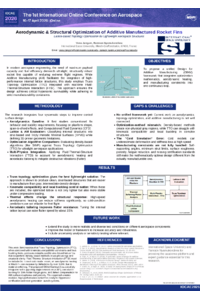
In modern aerospace engineering, the two major factors that define mission success are larger
payload capacity and fuel efficiency. This can be gained by reducing the structural weight
of the rocket fins. The need for ultralight yet structurally sound components has increased as
launch systems move toward greater speed regimes. In this endeavor, Additive Manufactur
ing (AM) has become a crucial facilitator, enabling the creation of complex lattice structures
with remarkable stiffness-to-weight ratios. However, these structures offer specific multi-physics
design problems, including structural mechanics, high-speed aerodynamics, and manufacturing
viability.
The review systematically examines the optimization of AM lattice fins under extreme aero
dynamic and thermal environments. It compares Truss Topology Optimization (TTO) with
density-based topology optimization, emphasizing that although TTO yields superior ultra
light designs, it frequently lacks precise formulations to guarantee kinematic compatibility in
indeterminate frames. The research also emphasizes the importance of Fluid–Thermal–Structure
Interaction (FTSI), pointing out that deflection and stability estimates might differ significantly
if thermal softening effects at supersonic and hypersonic speeds are ignored.
Manufacturing limitations are also discussed, which reveals that despite being simpler to con
struct, modular lattice layouts may result in mass penalties when compared to monolithic
topologies. The research presents a unified Design for Additive Manufacturing (DfAM) frame
work that integrates TTO with temperature-dependent material degradation models, explicit
buckling limitations, and aeroelastic tailoring approaches to overcome these trade-offs. This
all-encompassing strategy aims to create high-performance, manufacturable lattice fins that can
endure coupled aerodynamic and thermal stresses without sacrificing weight economy.
In the end, this research offers a roadmap toward next-generation lightweight fin topologies that
strike a balance between structural integrity, aerodynamic performance, and manufacturability,
opening the door for rockets that can go faster, further, and more effectively.
Keywords
Rocket Fin
Additive Manufacturing
Truss Topological Optimization
Fluid Thermal-Structure Interaction (FTSI).
Poster
IOAA Poster1.5.pdf
AI-Driven Aerospace Ecosystems: Next-Generation Aircraft Design, Sustainable Propulsion and Energy Systems, Intelligent Space Systems and Exploration, and Autonomous Airspace Management
State-Based Estimation of Future Mission Capability for Degrading Unmanned Aerial Vehicles