Event submissions
Published
This submission belongs to the session S4. Digitalization, Autonomy & Airspace Management of the event The 1st International Online Conference on Aerospace
Published date
13 Apr, 2026
Academic Editor
'%3e%3cpath%20d='M12.6657%2010.9104C12.4185%2010.325%2012.0599%209.79327%2011.6097%209.34482C11.1609%208.89508%2010.6293%208.5365%2010.0442%208.28888C10.0389%208.28626%2010.0337%208.28495%2010.0285%208.28233C10.8446%207.69279%2011.3752%206.73249%2011.3752%205.64904C11.3752%203.8542%209.92103%202.39999%208.1262%202.39999C6.33136%202.39999%204.87715%203.8542%204.87715%205.64904C4.87715%206.73249%205.40774%207.69279%206.22393%208.28364C6.21869%208.28626%206.21345%208.28757%206.20821%208.29019C5.62129%208.5378%205.09463%208.89284%204.64265%209.34613C4.1929%209.79493%203.83432%2010.3266%203.58671%2010.9117C3.34345%2011.4845%203.21226%2012.0987%203.20023%2012.7209C3.19988%2012.7349%203.20233%2012.7488%203.20744%2012.7619C3.21255%2012.7749%203.22022%2012.7867%203.22998%2012.7968C3.23975%2012.8068%203.25142%2012.8147%203.26431%2012.8202C3.2772%2012.8256%203.29105%2012.8284%203.30504%2012.8284H4.09109C4.14874%2012.8284%204.19459%2012.7825%204.1959%2012.7262C4.2221%2011.7148%204.62823%2010.7676%205.34617%2010.0497C6.08899%209.30683%207.0755%208.89808%208.1262%208.89808C9.17689%208.89808%2010.1634%209.30683%2010.9062%2010.0497C11.6242%2010.7676%2012.0303%2011.7148%2012.0565%2012.7262C12.0578%2012.7838%2012.1037%2012.8284%2012.1613%2012.8284H12.9474C12.9613%2012.8284%2012.9752%2012.8256%2012.9881%2012.8202C13.001%2012.8147%2013.0126%2012.8068%2013.0224%2012.7968C13.0322%2012.7867%2013.0398%2012.7749%2013.0449%2012.7619C13.0501%2012.7488%2013.0525%2012.7349%2013.0522%2012.7209C13.0391%2012.0947%2012.9094%2011.4855%2012.6657%2010.9104ZM8.1262%207.9024C7.52486%207.9024%206.9589%207.6679%206.53312%207.24211C6.10733%206.81633%205.87283%206.25037%205.87283%205.64904C5.87283%205.0477%206.10733%204.48174%206.53312%204.05596C6.9589%203.63018%207.52486%203.39567%208.1262%203.39567C8.72753%203.39567%209.29349%203.63018%209.71927%204.05596C10.1451%204.48174%2010.3796%205.0477%2010.3796%205.64904C10.3796%206.25037%2010.1451%206.81633%209.71927%207.24211C9.29349%207.6679%208.72753%207.9024%208.1262%207.9024Z'%20fill='%235D1EE1'/%3e%3c/g%3e%3c/svg%3e) Konstantinos Kontis
Konstantinos KontisCitation
Diya Rajeshkumar Pandit, Akshatha A Iyer, Amrutha A Iyer, Mahir Tilokani, Smitraj Solanki, Acoustic sensor-based runway health monitoring system, in Proceedings of The 1st International Online Conference on Aerospace, 16 April–17 April 2026, MDPI: Basel, Switzerland
Share
Email
Facebook
Twitter
LinkedIn
Acoustic sensor-based runway health monitoring system
'%3e%3cpath%20d='M12.6647%2010.9104C12.4176%2010.325%2012.0589%209.7933%2011.6088%209.34485C11.16%208.89511%2010.6283%208.53653%2010.0432%208.28891C10.038%208.28629%2010.0327%208.28498%2010.0275%208.28236C10.8437%207.69282%2011.3743%206.73252%2011.3743%205.64907C11.3743%203.85423%209.92005%202.40002%208.12522%202.40002C6.33038%202.40002%204.87618%203.85423%204.87618%205.64907C4.87618%206.73252%205.40677%207.69282%206.22296%208.28367C6.21772%208.28629%206.21248%208.2876%206.20724%208.29022C5.62031%208.53783%205.09365%208.89287%204.64167%209.34616C4.19192%209.79496%203.83334%2010.3266%203.58573%2010.9117C3.34247%2011.4846%203.21128%2012.0987%203.19925%2012.721C3.1989%2012.735%203.20135%2012.7489%203.20646%2012.7619C3.21157%2012.7749%203.21924%2012.7868%203.22901%2012.7968C3.23877%2012.8068%203.25045%2012.8148%203.26334%2012.8202C3.27623%2012.8256%203.29007%2012.8284%203.30406%2012.8284H4.09012C4.14776%2012.8284%204.19362%2012.7825%204.19493%2012.7262C4.22113%2011.7148%204.62726%2010.7676%205.34519%2010.0497C6.08802%209.30686%207.07452%208.89811%208.12522%208.89811C9.17592%208.89811%2010.1624%209.30686%2010.9052%2010.0497C11.6232%2010.7676%2012.0293%2011.7148%2012.0555%2012.7262C12.0568%2012.7839%2012.1027%2012.8284%2012.1603%2012.8284H12.9464C12.9604%2012.8284%2012.9742%2012.8256%2012.9871%2012.8202C13%2012.8148%2013.0117%2012.8068%2013.0214%2012.7968C13.0312%2012.7868%2013.0389%2012.7749%2013.044%2012.7619C13.0491%2012.7489%2013.0515%2012.735%2013.0512%2012.721C13.0381%2012.0947%2012.9084%2011.4856%2012.6647%2010.9104ZM8.12522%207.90243C7.52388%207.90243%206.95792%207.66793%206.53214%207.24215C6.10636%206.81636%205.87185%206.2504%205.87185%205.64907C5.87185%205.04773%206.10636%204.48177%206.53214%204.05599C6.95792%203.63021%207.52388%203.3957%208.12522%203.3957C8.72655%203.3957%209.29252%203.63021%209.7183%204.05599C10.1441%204.48177%2010.3786%205.04773%2010.3786%205.64907C10.3786%206.2504%2010.1441%206.81636%209.7183%207.24215C9.29252%207.66793%208.72655%207.90243%208.12522%207.90243Z'%20fill='%235D1EE1'/%3e%3c/g%3e%3c/svg%3e)
Diya Rajeshkumar Pandit 1
Akshatha A Iyer 1
Amrutha A Iyer 1
Mahir Tilokani 1
Smitraj Solanki 1
1. Faculty of Engineering & Technology, Parul University, Vadodara 390017, India
Abstract
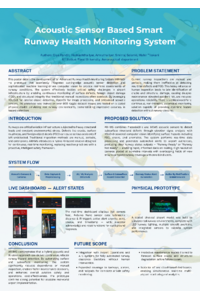
This work presents the development of an Advanced Runway Health Monitoring System (ARHMS) that combines acoustic sensors with machine learning-based computer vision to enable real-time runway condition assessment. The proposed system addresses critical safety issues such as surface defects, foreign object debris, and structural integrity that are often overlooked during conventional manual inspections. By employing YOLOv8 for accurate object detection and OpenCV for image processing, the prototype was trained on over 600 images from Kaggle datasets and evaluated using a scaled physical runway model. The results demonstrate strong accuracy in hazard detection and highlight the system’s potential for mobile deployment and future predictive capabilities. Key contributions include a hybrid acoustic–vision monitoring framework, analysis of real-world runway incidents, and practical recommendations for preventive maintenance. Despite challenges such as daylight dependency and occasional false positives, this study establishes a promising proof-of-concept for non-intrusive, AI-assisted runway monitoring aimed at significantly enhancing aviation safety.
The results showcase impressive accuracy in hazard detection, with exciting potential for
mobile deployment and advanced predictive capabilities in the future. Key contributions of
this research include the development of a hybrid acoustic–vision workflow, in-depth
analysis of real-life incidents, and actionable recommendations for preventive maintenance.
While we acknowledge challenges such as daylight dependency and the occurrence of false
positives, we also outline a clear roadmap for scaling this system to operational use. This
work not only serves as a compelling proof-of-concept for AI-assisted runway safety but also
underscores the critical need for non-intrusive, real-time monitoring to significantly reduce runway-related accidents.
Keywords
Runway Monitoring
Acoustic Sensors
YOLOv8
Object Detection
Structural Health Monitoring,
Poster
IYRC Poster (4).pdf
Multi-Objective Material Selection Framework for Additively Manufactured Aircraft Wing Ribs
Clustered Small Satellite Constellations with Inter-Satellite Communication for Enhanced Global Coverage