Event submissions
Published
This submission belongs to the session S3. Space Systems & Exploration of the event The 1st International Online Conference on Aerospace
Published date
16 Apr, 2026
Academic Editor
'%3e%3cpath%20d='M12.6657%2010.9104C12.4185%2010.325%2012.0599%209.79327%2011.6097%209.34482C11.1609%208.89508%2010.6293%208.5365%2010.0442%208.28888C10.0389%208.28626%2010.0337%208.28495%2010.0285%208.28233C10.8446%207.69279%2011.3752%206.73249%2011.3752%205.64904C11.3752%203.8542%209.92103%202.39999%208.1262%202.39999C6.33136%202.39999%204.87715%203.8542%204.87715%205.64904C4.87715%206.73249%205.40774%207.69279%206.22393%208.28364C6.21869%208.28626%206.21345%208.28757%206.20821%208.29019C5.62129%208.5378%205.09463%208.89284%204.64265%209.34613C4.1929%209.79493%203.83432%2010.3266%203.58671%2010.9117C3.34345%2011.4845%203.21226%2012.0987%203.20023%2012.7209C3.19988%2012.7349%203.20233%2012.7488%203.20744%2012.7619C3.21255%2012.7749%203.22022%2012.7867%203.22998%2012.7968C3.23975%2012.8068%203.25142%2012.8147%203.26431%2012.8202C3.2772%2012.8256%203.29105%2012.8284%203.30504%2012.8284H4.09109C4.14874%2012.8284%204.19459%2012.7825%204.1959%2012.7262C4.2221%2011.7148%204.62823%2010.7676%205.34617%2010.0497C6.08899%209.30683%207.0755%208.89808%208.1262%208.89808C9.17689%208.89808%2010.1634%209.30683%2010.9062%2010.0497C11.6242%2010.7676%2012.0303%2011.7148%2012.0565%2012.7262C12.0578%2012.7838%2012.1037%2012.8284%2012.1613%2012.8284H12.9474C12.9613%2012.8284%2012.9752%2012.8256%2012.9881%2012.8202C13.001%2012.8147%2013.0126%2012.8068%2013.0224%2012.7968C13.0322%2012.7867%2013.0398%2012.7749%2013.0449%2012.7619C13.0501%2012.7488%2013.0525%2012.7349%2013.0522%2012.7209C13.0391%2012.0947%2012.9094%2011.4855%2012.6657%2010.9104ZM8.1262%207.9024C7.52486%207.9024%206.9589%207.6679%206.53312%207.24211C6.10733%206.81633%205.87283%206.25037%205.87283%205.64904C5.87283%205.0477%206.10733%204.48174%206.53312%204.05596C6.9589%203.63018%207.52486%203.39567%208.1262%203.39567C8.72753%203.39567%209.29349%203.63018%209.71927%204.05596C10.1451%204.48174%2010.3796%205.0477%2010.3796%205.64904C10.3796%206.25037%2010.1451%206.81633%209.71927%207.24211C9.29349%207.6679%208.72753%207.9024%208.1262%207.9024Z'%20fill='%235D1EE1'/%3e%3c/g%3e%3c/svg%3e) M. Reza Emami
M. Reza EmamiCitation
Kajetan Gudowski, Maria Komędera, Sakina Hassan, AURORA-HFSM: Autonomous Ultrasound & NIRS Rig for Orbital Redistribution Assessment – Headward Fluid Shift Monitor, in Proceedings of The 1st International Online Conference on Aerospace, 16 April–17 April 2026, MDPI: Basel, Switzerland
Share
Email
Facebook
Twitter
LinkedIn
AURORA-HFSM: Autonomous Ultrasound & NIRS Rig for Orbital Redistribution Assessment – Headward Fluid Shift Monitor
'%3e%3cpath%20d='M12.6647%2010.9104C12.4176%2010.325%2012.0589%209.7933%2011.6088%209.34485C11.16%208.89511%2010.6283%208.53653%2010.0432%208.28891C10.038%208.28629%2010.0327%208.28498%2010.0275%208.28236C10.8437%207.69282%2011.3743%206.73252%2011.3743%205.64907C11.3743%203.85423%209.92005%202.40002%208.12522%202.40002C6.33038%202.40002%204.87618%203.85423%204.87618%205.64907C4.87618%206.73252%205.40677%207.69282%206.22296%208.28367C6.21772%208.28629%206.21248%208.2876%206.20724%208.29022C5.62031%208.53783%205.09365%208.89287%204.64167%209.34616C4.19192%209.79496%203.83334%2010.3266%203.58573%2010.9117C3.34247%2011.4846%203.21128%2012.0987%203.19925%2012.721C3.1989%2012.735%203.20135%2012.7489%203.20646%2012.7619C3.21157%2012.7749%203.21924%2012.7868%203.22901%2012.7968C3.23877%2012.8068%203.25045%2012.8148%203.26334%2012.8202C3.27623%2012.8256%203.29007%2012.8284%203.30406%2012.8284H4.09012C4.14776%2012.8284%204.19362%2012.7825%204.19493%2012.7262C4.22113%2011.7148%204.62726%2010.7676%205.34519%2010.0497C6.08802%209.30686%207.07452%208.89811%208.12522%208.89811C9.17592%208.89811%2010.1624%209.30686%2010.9052%2010.0497C11.6232%2010.7676%2012.0293%2011.7148%2012.0555%2012.7262C12.0568%2012.7839%2012.1027%2012.8284%2012.1603%2012.8284H12.9464C12.9604%2012.8284%2012.9742%2012.8256%2012.9871%2012.8202C13%2012.8148%2013.0117%2012.8068%2013.0214%2012.7968C13.0312%2012.7868%2013.0389%2012.7749%2013.044%2012.7619C13.0491%2012.7489%2013.0515%2012.735%2013.0512%2012.721C13.0381%2012.0947%2012.9084%2011.4856%2012.6647%2010.9104ZM8.12522%207.90243C7.52388%207.90243%206.95792%207.66793%206.53214%207.24215C6.10636%206.81636%205.87185%206.2504%205.87185%205.64907C5.87185%205.04773%206.10636%204.48177%206.53214%204.05599C6.95792%203.63021%207.52388%203.3957%208.12522%203.3957C8.72655%203.3957%209.29252%203.63021%209.7183%204.05599C10.1441%204.48177%2010.3786%205.04773%2010.3786%205.64907C10.3786%206.2504%2010.1441%206.81636%209.7183%207.24215C9.29252%207.66793%208.72655%207.90243%208.12522%207.90243Z'%20fill='%235D1EE1'/%3e%3c/g%3e%3c/svg%3e)
Kajetan Gudowski 1
Maria Komędera 2
Sakina Hassan 3
1. Faculty of Mechanical Engineering, Silesian University of Technology, Gliwice, 44-100, Poland
2. Faculty of Psychology, SWPS University, Kraków, 31-543, Poland
3. The University of Buckingham, Buckingham, MK18 1EG, United Kingdom
Abstract
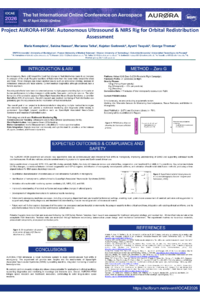
Despite advances in space medicine, astronauts currently lack tools to comprehensively monitor their health in microgravity. This study aimed to demonstrate the potential of multimodal monitoring technologies to track physiological changes in space. The AURORA-HFSM experiment investigates headward fluid shifts and cerebrovascular dynamics during short-term weightlessness.
Healthy volunteers underwent multimodal monitoring during a parabolic flight campaign on the Airbus A310 Zero-G. Measurements integrated ultrasound (US), near-infrared spectroscopy (NIRS), indocyanine green (ICG) impedance tracking, and inertial measurement units (IMU) for motion synchronization. Signals were recorded continuously during each parabola (~22 s microgravity) across three gravity phases: 1.8 g pull-up (baseline), 0 g microgravity, and 1 g recovery. Each flight included 31 parabolas in three blocks, with short intermissions, providing ~11 minutes of cumulative 0 g exposure. This protocol enabled characterization of venous and arterial flow, tissue oxygenation, and thoracic fluid redistribution.
The study will provide the first synchronized multimodal dataset quantifying jugular, cerebral, and thoracic fluid dynamics during parabolic flight. Correlations between US, NIRS, and ICG indices will inform ESA research on intracranial fluid redistribution and guide the design of compact astronaut health-monitoring systems for long-duration missions.
AURORA demonstrates a feasible, safe, and operationally robust platform for multimodal physiological monitoring in microgravity. Medically certified components, low-voltage operation, mechanical robustness, and redundant data acquisition ensure ESA compliance and minimal residual risk. Expected outcomes include novel integrated biomarkers of cerebral hemodynamics, improved diagnostic accuracy, and enhanced monitoring for spaceflight and clinical applications, establishing AURORA as a translational platform bridging space physiology and astronaut health monitoring.
Keywords
Microgravity
Exon
Parabolic
flight
spacER
Ultrasound
Astronaut
health
Tissue
oxygenation
Space
medicine
Multimodal
monitoring
Poster
IOCAE poster.pdf
Optimizing Large-Area Coverage for the LT-4A GEO SAR Satellite: A Hybrid Genetic Algorithm with Adaptive Maneuver Time Control
A systematic review of biomimetic principles inspired by biological flight applied to aircraft and UAV design