Event submissions
Published
This submission belongs to the session S2. Antimicrobials, Antimicrobial Resistance, and One Health of the event Antibiotics 2026—Advances in Antimicrobial Action and Resistance
Published date
04 May, 2026
Academic Editor
'%3e%3cpath%20d='M12.6657%2010.9104C12.4185%2010.325%2012.0599%209.79327%2011.6097%209.34482C11.1609%208.89508%2010.6293%208.5365%2010.0442%208.28888C10.0389%208.28626%2010.0337%208.28495%2010.0285%208.28233C10.8446%207.69279%2011.3752%206.73249%2011.3752%205.64904C11.3752%203.8542%209.92103%202.39999%208.1262%202.39999C6.33136%202.39999%204.87715%203.8542%204.87715%205.64904C4.87715%206.73249%205.40774%207.69279%206.22393%208.28364C6.21869%208.28626%206.21345%208.28757%206.20821%208.29019C5.62129%208.5378%205.09463%208.89284%204.64265%209.34613C4.1929%209.79493%203.83432%2010.3266%203.58671%2010.9117C3.34345%2011.4845%203.21226%2012.0987%203.20023%2012.7209C3.19988%2012.7349%203.20233%2012.7488%203.20744%2012.7619C3.21255%2012.7749%203.22022%2012.7867%203.22998%2012.7968C3.23975%2012.8068%203.25142%2012.8147%203.26431%2012.8202C3.2772%2012.8256%203.29105%2012.8284%203.30504%2012.8284H4.09109C4.14874%2012.8284%204.19459%2012.7825%204.1959%2012.7262C4.2221%2011.7148%204.62823%2010.7676%205.34617%2010.0497C6.08899%209.30683%207.0755%208.89808%208.1262%208.89808C9.17689%208.89808%2010.1634%209.30683%2010.9062%2010.0497C11.6242%2010.7676%2012.0303%2011.7148%2012.0565%2012.7262C12.0578%2012.7838%2012.1037%2012.8284%2012.1613%2012.8284H12.9474C12.9613%2012.8284%2012.9752%2012.8256%2012.9881%2012.8202C13.001%2012.8147%2013.0126%2012.8068%2013.0224%2012.7968C13.0322%2012.7867%2013.0398%2012.7749%2013.0449%2012.7619C13.0501%2012.7488%2013.0525%2012.7349%2013.0522%2012.7209C13.0391%2012.0947%2012.9094%2011.4855%2012.6657%2010.9104ZM8.1262%207.9024C7.52486%207.9024%206.9589%207.6679%206.53312%207.24211C6.10733%206.81633%205.87283%206.25037%205.87283%205.64904C5.87283%205.0477%206.10733%204.48174%206.53312%204.05596C6.9589%203.63018%207.52486%203.39567%208.1262%203.39567C8.72753%203.39567%209.29349%203.63018%209.71927%204.05596C10.1451%204.48174%2010.3796%205.0477%2010.3796%205.64904C10.3796%206.25037%2010.1451%206.81633%209.71927%207.24211C9.29349%207.6679%208.72753%207.9024%208.1262%207.9024Z'%20fill='%235D1EE1'/%3e%3c/g%3e%3c/svg%3e) Jordi Vila
Jordi VilaCitation
Ewelina Skrzypiec, Magdalena Skarżyńska, Magdalena Zając, Renata Kwit, Anna Lalak, Emilia Mikos-Wojewoda, Paulina Pasim, Weronika Koza, Dominika Wojdat, Inga Bona, Dominika Pastuszka, Sylwia Hudzik-Pałosz, Dariusz Wasyl, Antimicrobial resistance of Salmonella Typhimurium in pig production in Poland: phenotypic and genotypic analysis, in Proceedings of Antibiotics 2026—Advances in Antimicrobial Action and Resistance, Barcelona, 11 May–14 May 2026, MDPI: Basel, Switzerland
Share
Email
Facebook
Twitter
LinkedIn
Antimicrobial resistance of Salmonella Typhimurium in pig production in Poland: phenotypic and genotypic analysis
'%3e%3cpath%20d='M12.6647%2010.9104C12.4176%2010.325%2012.0589%209.7933%2011.6088%209.34485C11.16%208.89511%2010.6283%208.53653%2010.0432%208.28891C10.038%208.28629%2010.0327%208.28498%2010.0275%208.28236C10.8437%207.69282%2011.3743%206.73252%2011.3743%205.64907C11.3743%203.85423%209.92005%202.40002%208.12522%202.40002C6.33038%202.40002%204.87618%203.85423%204.87618%205.64907C4.87618%206.73252%205.40677%207.69282%206.22296%208.28367C6.21772%208.28629%206.21248%208.2876%206.20724%208.29022C5.62031%208.53783%205.09365%208.89287%204.64167%209.34616C4.19192%209.79496%203.83334%2010.3266%203.58573%2010.9117C3.34247%2011.4846%203.21128%2012.0987%203.19925%2012.721C3.1989%2012.735%203.20135%2012.7489%203.20646%2012.7619C3.21157%2012.7749%203.21924%2012.7868%203.22901%2012.7968C3.23877%2012.8068%203.25045%2012.8148%203.26334%2012.8202C3.27623%2012.8256%203.29007%2012.8284%203.30406%2012.8284H4.09012C4.14776%2012.8284%204.19362%2012.7825%204.19493%2012.7262C4.22113%2011.7148%204.62726%2010.7676%205.34519%2010.0497C6.08802%209.30686%207.07452%208.89811%208.12522%208.89811C9.17592%208.89811%2010.1624%209.30686%2010.9052%2010.0497C11.6232%2010.7676%2012.0293%2011.7148%2012.0555%2012.7262C12.0568%2012.7839%2012.1027%2012.8284%2012.1603%2012.8284H12.9464C12.9604%2012.8284%2012.9742%2012.8256%2012.9871%2012.8202C13%2012.8148%2013.0117%2012.8068%2013.0214%2012.7968C13.0312%2012.7868%2013.0389%2012.7749%2013.044%2012.7619C13.0491%2012.7489%2013.0515%2012.735%2013.0512%2012.721C13.0381%2012.0947%2012.9084%2011.4856%2012.6647%2010.9104ZM8.12522%207.90243C7.52388%207.90243%206.95792%207.66793%206.53214%207.24215C6.10636%206.81636%205.87185%206.2504%205.87185%205.64907C5.87185%205.04773%206.10636%204.48177%206.53214%204.05599C6.95792%203.63021%207.52388%203.3957%208.12522%203.3957C8.72655%203.3957%209.29252%203.63021%209.7183%204.05599C10.1441%204.48177%2010.3786%205.04773%2010.3786%205.64907C10.3786%206.2504%2010.1441%206.81636%209.7183%207.24215C9.29252%207.66793%208.72655%207.90243%208.12522%207.90243Z'%20fill='%235D1EE1'/%3e%3c/g%3e%3c/svg%3e)
Ewelina Skrzypiec 1
Magdalena Skarżyńska 1
Magdalena Zając 1
Renata Kwit 1
Anna Lalak 1
Emilia Mikos-Wojewoda 1
Paulina Pasim 1
Weronika Koza 1
Dominika Wojdat 1
Inga Bona 1
Dominika Pastuszka 1
Sylwia Hudzik-Pałosz 1
Dariusz Wasyl 1
1. Department of Bacteriology and Bacterial Animal Diseases, National Veterinary Research Institute, Pulawy
Abstract
Introduction:
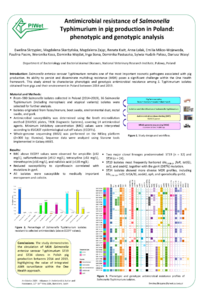
Salmonella enterica serovar Typhimurium remains one of the most important zoonotic pathogens associated with pig production. Its ability to persist and disseminate multidrug resistance (MDR) poses a significant challenge within the One Health framework. This study aimed to characterize phenotypic and genotypic antimicrobial resistance among S. Typhimurium isolates obtained from pigs and their environment in Poland between 2014 and 2019.
Materials and Methods:
From a collection of approximately 580 Salmonella isolates of different serovars collected from pigs and related environments in Poland between 2014 and 2019, 36 Salmonella Typhimurium (including monophasic and atypical variants) isolates were selected for whole-genome sequencing and further analysis. Isolates originated from feces/manure, boot swabs, environmental dust, rectal swabs, and pork. Antimicrobial susceptibility was determined using the broth microdilution method with EUVSEC plates (TREK Diagnostic Systems), covering 14 antimicrobial agents. Minimum inhibitory concentration (MIC) values were interpreted according to EUCAST epidemiological cut-off values (ECOFFs). Whole-genome sequencing (WGS) was performed on the MiSeq platform (2×300 bp; Illumina). Sequence data were analyzed using Staramr tools implemented in Galaxy ARIES.
Results:
MIC above ECOFF values were observed for ampicillin (≥32 mg/L), sulfamethoxazole (≥512 mg/L), tetracycline (≥32 mg/L), trimethoprim (≥16 mg/L), and nalidixic acid (≥128 mg/L). Reduced susceptibility to ciprofloxacin correlated with mutations in gyrA. All isolates were susceptible to medically important meropenem and colistin. Two major clonal lineages predominated: ST19 (n = 12) and ST34 (n = 24). ST19 isolates most frequently harbored blaCARB-2, floR, tet(G), sul1, and aadA2, together with the gyrA (D87N) mutation. ST34 isolates showed more diverse MDR profiles, including blaTEM-1B, sul2, tet(A/B), aadA1, aph, and sporadically qnrS1.
Conclusions:
The study demonstrates the circulation of MDR Salmonella enterica serovar Typhimurium ST19 and ST34 clones in Polish pig production between 2014 and 2019, highlighting the value of integrated AMR surveillance within the One Health approach.
Keywords
Salmonella Typhimurium
antimicrobial resistance
pigs
whole-genome sequencing
One Health
Poster
poster Salmonella Typhimurium 2026 Barcelona A0.pdf
Isolation and characterization of bacterial strains resistant to beta-lactam antibiotics, including carbapenems, from the Polish Baltic Sea coast
STEADY-STATE CONCENTRATIONS OF CLARITHROMYCIN UNDER DIFFERENT ROUTES OF ADMINISTRATION IN PNEUMONIA: RISK FACTORS AND CLINICAL OUTCOMES