Event submissions
Published
This submission belongs to the session S2. Antimicrobials, Antimicrobial Resistance, and One Health of the event Antibiotics 2026—Advances in Antimicrobial Action and Resistance
Published date
04 May, 2026
Academic Editor
'%3e%3cpath%20d='M12.6657%2010.9104C12.4185%2010.325%2012.0599%209.79327%2011.6097%209.34482C11.1609%208.89508%2010.6293%208.5365%2010.0442%208.28888C10.0389%208.28626%2010.0337%208.28495%2010.0285%208.28233C10.8446%207.69279%2011.3752%206.73249%2011.3752%205.64904C11.3752%203.8542%209.92103%202.39999%208.1262%202.39999C6.33136%202.39999%204.87715%203.8542%204.87715%205.64904C4.87715%206.73249%205.40774%207.69279%206.22393%208.28364C6.21869%208.28626%206.21345%208.28757%206.20821%208.29019C5.62129%208.5378%205.09463%208.89284%204.64265%209.34613C4.1929%209.79493%203.83432%2010.3266%203.58671%2010.9117C3.34345%2011.4845%203.21226%2012.0987%203.20023%2012.7209C3.19988%2012.7349%203.20233%2012.7488%203.20744%2012.7619C3.21255%2012.7749%203.22022%2012.7867%203.22998%2012.7968C3.23975%2012.8068%203.25142%2012.8147%203.26431%2012.8202C3.2772%2012.8256%203.29105%2012.8284%203.30504%2012.8284H4.09109C4.14874%2012.8284%204.19459%2012.7825%204.1959%2012.7262C4.2221%2011.7148%204.62823%2010.7676%205.34617%2010.0497C6.08899%209.30683%207.0755%208.89808%208.1262%208.89808C9.17689%208.89808%2010.1634%209.30683%2010.9062%2010.0497C11.6242%2010.7676%2012.0303%2011.7148%2012.0565%2012.7262C12.0578%2012.7838%2012.1037%2012.8284%2012.1613%2012.8284H12.9474C12.9613%2012.8284%2012.9752%2012.8256%2012.9881%2012.8202C13.001%2012.8147%2013.0126%2012.8068%2013.0224%2012.7968C13.0322%2012.7867%2013.0398%2012.7749%2013.0449%2012.7619C13.0501%2012.7488%2013.0525%2012.7349%2013.0522%2012.7209C13.0391%2012.0947%2012.9094%2011.4855%2012.6657%2010.9104ZM8.1262%207.9024C7.52486%207.9024%206.9589%207.6679%206.53312%207.24211C6.10733%206.81633%205.87283%206.25037%205.87283%205.64904C5.87283%205.0477%206.10733%204.48174%206.53312%204.05596C6.9589%203.63018%207.52486%203.39567%208.1262%203.39567C8.72753%203.39567%209.29349%203.63018%209.71927%204.05596C10.1451%204.48174%2010.3796%205.0477%2010.3796%205.64904C10.3796%206.25037%2010.1451%206.81633%209.71927%207.24211C9.29349%207.6679%208.72753%207.9024%208.1262%207.9024Z'%20fill='%235D1EE1'/%3e%3c/g%3e%3c/svg%3e) Jordi Vila
Jordi VilaCitation
Fésüs Adina, STEADY-STATE CONCENTRATIONS OF CLARITHROMYCIN UNDER DIFFERENT ROUTES OF ADMINISTRATION IN PNEUMONIA: RISK FACTORS AND CLINICAL OUTCOMES, in Proceedings of Antibiotics 2026—Advances in Antimicrobial Action and Resistance, Barcelona, 11 May–14 May 2026, MDPI: Basel, Switzerland
Share
Email
Facebook
Twitter
LinkedIn
STEADY-STATE CONCENTRATIONS OF CLARITHROMYCIN UNDER DIFFERENT ROUTES OF ADMINISTRATION IN PNEUMONIA: RISK FACTORS AND CLINICAL OUTCOMES
'%3e%3cpath%20d='M12.6647%2010.9104C12.4176%2010.325%2012.0589%209.7933%2011.6088%209.34485C11.16%208.89511%2010.6283%208.53653%2010.0432%208.28891C10.038%208.28629%2010.0327%208.28498%2010.0275%208.28236C10.8437%207.69282%2011.3743%206.73252%2011.3743%205.64907C11.3743%203.85423%209.92005%202.40002%208.12522%202.40002C6.33038%202.40002%204.87618%203.85423%204.87618%205.64907C4.87618%206.73252%205.40677%207.69282%206.22296%208.28367C6.21772%208.28629%206.21248%208.2876%206.20724%208.29022C5.62031%208.53783%205.09365%208.89287%204.64167%209.34616C4.19192%209.79496%203.83334%2010.3266%203.58573%2010.9117C3.34247%2011.4846%203.21128%2012.0987%203.19925%2012.721C3.1989%2012.735%203.20135%2012.7489%203.20646%2012.7619C3.21157%2012.7749%203.21924%2012.7868%203.22901%2012.7968C3.23877%2012.8068%203.25045%2012.8148%203.26334%2012.8202C3.27623%2012.8256%203.29007%2012.8284%203.30406%2012.8284H4.09012C4.14776%2012.8284%204.19362%2012.7825%204.19493%2012.7262C4.22113%2011.7148%204.62726%2010.7676%205.34519%2010.0497C6.08802%209.30686%207.07452%208.89811%208.12522%208.89811C9.17592%208.89811%2010.1624%209.30686%2010.9052%2010.0497C11.6232%2010.7676%2012.0293%2011.7148%2012.0555%2012.7262C12.0568%2012.7839%2012.1027%2012.8284%2012.1603%2012.8284H12.9464C12.9604%2012.8284%2012.9742%2012.8256%2012.9871%2012.8202C13%2012.8148%2013.0117%2012.8068%2013.0214%2012.7968C13.0312%2012.7868%2013.0389%2012.7749%2013.044%2012.7619C13.0491%2012.7489%2013.0515%2012.735%2013.0512%2012.721C13.0381%2012.0947%2012.9084%2011.4856%2012.6647%2010.9104ZM8.12522%207.90243C7.52388%207.90243%206.95792%207.66793%206.53214%207.24215C6.10636%206.81636%205.87185%206.2504%205.87185%205.64907C5.87185%205.04773%206.10636%204.48177%206.53214%204.05599C6.95792%203.63021%207.52388%203.3957%208.12522%203.3957C8.72655%203.3957%209.29252%203.63021%209.7183%204.05599C10.1441%204.48177%2010.3786%205.04773%2010.3786%205.64907C10.3786%206.2504%2010.1441%206.81636%209.7183%207.24215C9.29252%207.66793%208.72655%207.90243%208.12522%207.90243Z'%20fill='%235D1EE1'/%3e%3c/g%3e%3c/svg%3e)
Fésüs Adina 1
1. University of Debrecen
Abstract
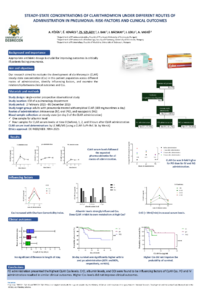
Appropriate antibiotic dosage is crucial for improving outcomes in critically ill patients facing pneumonia. Our research aimed to evaluate the development of the steady-state concentration (Css) of clarithromycin (CLAR) in this specific patient population with different routes of administration, to identify the influencing factors, and to examine the relationship between clinical outcomes and Css. This study was conducted as a single-center prospective observational study in the ICU of a pulmonology department between February 2025 and December 2025. The study target group included all adult patients (n=72) treated primarily with empirical CLAR (2x500mg/day) due to pneumonia. Blood sample collection was performed on day 3 of the CLAR administration, when five samples were taken as follows: at steady-state before drug administration and 1, 2, and 3 hours after intravenous (IV), oral (PO), and nasogastric (NG) administration, and one sample for albumin level. Determination of CLAR serum concentrations was determined by LC-MS/MS using a CLAR European Pharmacopeia Reference Standard by Merck. CLAR serum levels followed the expected pharmacokinetics for all three routes of administration. The CLAR Css was 3-fold higher for PO (n=30) than for IV (n=27) administration and 2.7-fold higher for NG (n=15) administration. Severe reduction in CrCl (˂ 59ml/min) increased serum levels for all administration routes. CLAR serum levels increased proportionally with increasing albumin serum levels and with the increasing CCI (Charles Comorbidity Index). No difference in length of stay (LOS) and survival was found between IV and PO administration (81 and 83%); however, the probability of survival was significantly lower (40%) in the case of NG administration. PO administration presented the highest CLAR Css levels. CrCl, albumin levels, and CCI were found to be influencing factors of CLAR Css. Although PO and IV administration resulted in similar clinical outcomes, the lower survival rate associated with higher Css in the case of NG administration requires further investigation.
Keywords
pneumonia
steady-state concentration
clarithromycin
nasogastric
Poster
A_10_Adina_Fésüs_Poster_166737 .pdf
Antimicrobial resistance of Salmonella Typhimurium in pig production in Poland: phenotypic and genotypic analysis
Identification of an SCCmec-mecC Hybrid in Methicillin-Resistant Mammaliicoccus sciuri from Australian Wildlife