Event submissions
Published
This submission belongs to the session S2. Antimicrobials, Antimicrobial Resistance, and One Health of the event Antibiotics 2026—Advances in Antimicrobial Action and Resistance
Published date
04 May, 2026
Academic Editor
'%3e%3cpath%20d='M12.6657%2010.9104C12.4185%2010.325%2012.0599%209.79327%2011.6097%209.34482C11.1609%208.89508%2010.6293%208.5365%2010.0442%208.28888C10.0389%208.28626%2010.0337%208.28495%2010.0285%208.28233C10.8446%207.69279%2011.3752%206.73249%2011.3752%205.64904C11.3752%203.8542%209.92103%202.39999%208.1262%202.39999C6.33136%202.39999%204.87715%203.8542%204.87715%205.64904C4.87715%206.73249%205.40774%207.69279%206.22393%208.28364C6.21869%208.28626%206.21345%208.28757%206.20821%208.29019C5.62129%208.5378%205.09463%208.89284%204.64265%209.34613C4.1929%209.79493%203.83432%2010.3266%203.58671%2010.9117C3.34345%2011.4845%203.21226%2012.0987%203.20023%2012.7209C3.19988%2012.7349%203.20233%2012.7488%203.20744%2012.7619C3.21255%2012.7749%203.22022%2012.7867%203.22998%2012.7968C3.23975%2012.8068%203.25142%2012.8147%203.26431%2012.8202C3.2772%2012.8256%203.29105%2012.8284%203.30504%2012.8284H4.09109C4.14874%2012.8284%204.19459%2012.7825%204.1959%2012.7262C4.2221%2011.7148%204.62823%2010.7676%205.34617%2010.0497C6.08899%209.30683%207.0755%208.89808%208.1262%208.89808C9.17689%208.89808%2010.1634%209.30683%2010.9062%2010.0497C11.6242%2010.7676%2012.0303%2011.7148%2012.0565%2012.7262C12.0578%2012.7838%2012.1037%2012.8284%2012.1613%2012.8284H12.9474C12.9613%2012.8284%2012.9752%2012.8256%2012.9881%2012.8202C13.001%2012.8147%2013.0126%2012.8068%2013.0224%2012.7968C13.0322%2012.7867%2013.0398%2012.7749%2013.0449%2012.7619C13.0501%2012.7488%2013.0525%2012.7349%2013.0522%2012.7209C13.0391%2012.0947%2012.9094%2011.4855%2012.6657%2010.9104ZM8.1262%207.9024C7.52486%207.9024%206.9589%207.6679%206.53312%207.24211C6.10733%206.81633%205.87283%206.25037%205.87283%205.64904C5.87283%205.0477%206.10733%204.48174%206.53312%204.05596C6.9589%203.63018%207.52486%203.39567%208.1262%203.39567C8.72753%203.39567%209.29349%203.63018%209.71927%204.05596C10.1451%204.48174%2010.3796%205.0477%2010.3796%205.64904C10.3796%206.25037%2010.1451%206.81633%209.71927%207.24211C9.29349%207.6679%208.72753%207.9024%208.1262%207.9024Z'%20fill='%235D1EE1'/%3e%3c/g%3e%3c/svg%3e) Marc Maresca
Marc MarescaCitation
Patrick Philip Atendido Salvador, Kherson P. Gandola, Aryana Lee G. Bertuso, Aira Charlien R. De Guzman, Laurice Beatrice Raphaelle O. dela Peña, Windell L. Rivera, A One Health Assessment of Antimicrobial Resistance Genes in Escherichia coli from Laguna de Bay, Its Tributary Rivers, and Surrounding Backyard Farms in the Philippines, in Proceedings of Antibiotics 2026—Advances in Antimicrobial Action and Resistance, Barcelona, 11 May–14 May 2026, MDPI: Basel, Switzerland
Share
Email
Facebook
Twitter
LinkedIn
A One Health Assessment of Antimicrobial Resistance Genes in Escherichia coli from Laguna de Bay, Its Tributary Rivers, and Surrounding Backyard Farms in the Philippines
'%3e%3cpath%20d='M12.6647%2010.9104C12.4176%2010.325%2012.0589%209.7933%2011.6088%209.34485C11.16%208.89511%2010.6283%208.53653%2010.0432%208.28891C10.038%208.28629%2010.0327%208.28498%2010.0275%208.28236C10.8437%207.69282%2011.3743%206.73252%2011.3743%205.64907C11.3743%203.85423%209.92005%202.40002%208.12522%202.40002C6.33038%202.40002%204.87618%203.85423%204.87618%205.64907C4.87618%206.73252%205.40677%207.69282%206.22296%208.28367C6.21772%208.28629%206.21248%208.2876%206.20724%208.29022C5.62031%208.53783%205.09365%208.89287%204.64167%209.34616C4.19192%209.79496%203.83334%2010.3266%203.58573%2010.9117C3.34247%2011.4846%203.21128%2012.0987%203.19925%2012.721C3.1989%2012.735%203.20135%2012.7489%203.20646%2012.7619C3.21157%2012.7749%203.21924%2012.7868%203.22901%2012.7968C3.23877%2012.8068%203.25045%2012.8148%203.26334%2012.8202C3.27623%2012.8256%203.29007%2012.8284%203.30406%2012.8284H4.09012C4.14776%2012.8284%204.19362%2012.7825%204.19493%2012.7262C4.22113%2011.7148%204.62726%2010.7676%205.34519%2010.0497C6.08802%209.30686%207.07452%208.89811%208.12522%208.89811C9.17592%208.89811%2010.1624%209.30686%2010.9052%2010.0497C11.6232%2010.7676%2012.0293%2011.7148%2012.0555%2012.7262C12.0568%2012.7839%2012.1027%2012.8284%2012.1603%2012.8284H12.9464C12.9604%2012.8284%2012.9742%2012.8256%2012.9871%2012.8202C13%2012.8148%2013.0117%2012.8068%2013.0214%2012.7968C13.0312%2012.7868%2013.0389%2012.7749%2013.044%2012.7619C13.0491%2012.7489%2013.0515%2012.735%2013.0512%2012.721C13.0381%2012.0947%2012.9084%2011.4856%2012.6647%2010.9104ZM8.12522%207.90243C7.52388%207.90243%206.95792%207.66793%206.53214%207.24215C6.10636%206.81636%205.87185%206.2504%205.87185%205.64907C5.87185%205.04773%206.10636%204.48177%206.53214%204.05599C6.95792%203.63021%207.52388%203.3957%208.12522%203.3957C8.72655%203.3957%209.29252%203.63021%209.7183%204.05599C10.1441%204.48177%2010.3786%205.04773%2010.3786%205.64907C10.3786%206.2504%2010.1441%206.81636%209.7183%207.24215C9.29252%207.66793%208.72655%207.90243%208.12522%207.90243Z'%20fill='%235D1EE1'/%3e%3c/g%3e%3c/svg%3e)
Patrick Philip Atendido Salvador 1
Kherson P. Gandola 1
Aryana Lee G. Bertuso 1
Aira Charlien R. De Guzman 1
Laurice Beatrice Raphaelle O. dela Peña 1

Windell L. Rivera 1
1. Pathogen-Host-Environment Interactions Research Laboratory, Institute of Biology, College of Science, University of the Philippines Diliman, Quezon City, Philippines
Abstract
Laguna de Bay, the largest lake in the Philippines, is fed by 21 tributary river systems and serves as a multi-use water resource for economic and recreational purposes. Backyard farms are also prevalent in the communities around the lake. Unregulated use of antibiotics in these farms and local communities contributes to the emergence of antimicrobial-resistant (AMR) bacteria, posing a significant threat to public health and the environment. While there are existing studies on AMR in the Philippines, research on the prevalence of bacteria harboring antimicrobial-resistance genes (ARGs) in environmental waters and animals remains limited. Therefore, this study aimed to determine the antibiotic resistance profiles of Escherichia coli isolated from selected stations of Laguna Lake, 11 surrounding tributary rivers, and backyard farms near the lake. Environmental water and fecal samples were collected from these sites, and a total of 5,051 E. coli were isolated and genotypically screened for the presence of ARGs: β-lactamase (blaCTX-M, blaSHV, blaTEM, and blaOXA-1), carbapenemase (blaNDM), sulfonamide (sul1 and sul2), and tetracycline (tetA). Among these, tetA was the most frequently detected gene in both environmental water (31%) and animal hosts (41%), followed by blaTEM (27%; 32%), sul2 (16%; 19%), sul1 (9%; 5%), blaSHV (4%; 2%), and blaCTX-M (2%; 2%). blaOXA-1 and blaNDM had lower detection frequencies (>1%) in environmental water and were absent in any animal hosts. Among isolates harboring at least two ARGs, the blaTEM/tetA (n=405) combination was the most frequently detected in water samples. In animals, tetA/blaTEM gene combination was most frequent in poultry and swine, while tetA-blaTEM-sul2 combination dominated in ducks. Overall, the results confirm the presence of ARGs in E. coli isolates from Laguna de Bay, its tributaries, and surrounding farms, which can be used as a reference to monitor environmental contamination and mitigate the spread of antimicrobial resistance.
Keywords
Antimicrobial resistance genes
Escherichia coli
One Health
Laguna Lake
Environmental water
Tributary rivers
Backyard farms
Poster
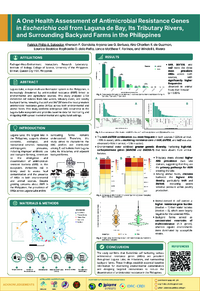
Salvador, Patrick_Antibiotics 2026 Poster.pdf
Extracellular and Intracellular Activity of Rifaximin α Against Bovine Staphylococcus aureus: Implications for Early Mastitis Therapy
Isolation and Characterization of Peptide molecules from Levilactobacillus brevis and their application as Antimicrobials