Event submissions
Published
This submission belongs to the session S1. Antimicrobial Resistance Mechanisms of the event Antibiotics 2026—Advances in Antimicrobial Action and Resistance
Published date
04 May, 2026
Academic Editor
'%3e%3cpath%20d='M12.6657%2010.9104C12.4185%2010.325%2012.0599%209.79327%2011.6097%209.34482C11.1609%208.89508%2010.6293%208.5365%2010.0442%208.28888C10.0389%208.28626%2010.0337%208.28495%2010.0285%208.28233C10.8446%207.69279%2011.3752%206.73249%2011.3752%205.64904C11.3752%203.8542%209.92103%202.39999%208.1262%202.39999C6.33136%202.39999%204.87715%203.8542%204.87715%205.64904C4.87715%206.73249%205.40774%207.69279%206.22393%208.28364C6.21869%208.28626%206.21345%208.28757%206.20821%208.29019C5.62129%208.5378%205.09463%208.89284%204.64265%209.34613C4.1929%209.79493%203.83432%2010.3266%203.58671%2010.9117C3.34345%2011.4845%203.21226%2012.0987%203.20023%2012.7209C3.19988%2012.7349%203.20233%2012.7488%203.20744%2012.7619C3.21255%2012.7749%203.22022%2012.7867%203.22998%2012.7968C3.23975%2012.8068%203.25142%2012.8147%203.26431%2012.8202C3.2772%2012.8256%203.29105%2012.8284%203.30504%2012.8284H4.09109C4.14874%2012.8284%204.19459%2012.7825%204.1959%2012.7262C4.2221%2011.7148%204.62823%2010.7676%205.34617%2010.0497C6.08899%209.30683%207.0755%208.89808%208.1262%208.89808C9.17689%208.89808%2010.1634%209.30683%2010.9062%2010.0497C11.6242%2010.7676%2012.0303%2011.7148%2012.0565%2012.7262C12.0578%2012.7838%2012.1037%2012.8284%2012.1613%2012.8284H12.9474C12.9613%2012.8284%2012.9752%2012.8256%2012.9881%2012.8202C13.001%2012.8147%2013.0126%2012.8068%2013.0224%2012.7968C13.0322%2012.7867%2013.0398%2012.7749%2013.0449%2012.7619C13.0501%2012.7488%2013.0525%2012.7349%2013.0522%2012.7209C13.0391%2012.0947%2012.9094%2011.4855%2012.6657%2010.9104ZM8.1262%207.9024C7.52486%207.9024%206.9589%207.6679%206.53312%207.24211C6.10733%206.81633%205.87283%206.25037%205.87283%205.64904C5.87283%205.0477%206.10733%204.48174%206.53312%204.05596C6.9589%203.63018%207.52486%203.39567%208.1262%203.39567C8.72753%203.39567%209.29349%203.63018%209.71927%204.05596C10.1451%204.48174%2010.3796%205.0477%2010.3796%205.64904C10.3796%206.25037%2010.1451%206.81633%209.71927%207.24211C9.29349%207.6679%208.72753%207.9024%208.1262%207.9024Z'%20fill='%235D1EE1'/%3e%3c/g%3e%3c/svg%3e) Manuel Simões
Manuel SimõesCitation
Saloni Sahu, Zuoyu Zhang, Umama Qasim, Gregory Koningstein, Ruben Martin Romo, Jordi Vila, Peter van Ulsen, Joen Luirink, Progress on CPD 14, a potential Bam complex inhibitor, in Proceedings of Antibiotics 2026—Advances in Antimicrobial Action and Resistance, Barcelona, 11 May–14 May 2026, MDPI: Basel, Switzerland
Share
Email
Facebook
Twitter
LinkedIn
Progress on CPD 14, a potential Bam complex inhibitor
'%3e%3cpath%20d='M12.6647%2010.9104C12.4176%2010.325%2012.0589%209.7933%2011.6088%209.34485C11.16%208.89511%2010.6283%208.53653%2010.0432%208.28891C10.038%208.28629%2010.0327%208.28498%2010.0275%208.28236C10.8437%207.69282%2011.3743%206.73252%2011.3743%205.64907C11.3743%203.85423%209.92005%202.40002%208.12522%202.40002C6.33038%202.40002%204.87618%203.85423%204.87618%205.64907C4.87618%206.73252%205.40677%207.69282%206.22296%208.28367C6.21772%208.28629%206.21248%208.2876%206.20724%208.29022C5.62031%208.53783%205.09365%208.89287%204.64167%209.34616C4.19192%209.79496%203.83334%2010.3266%203.58573%2010.9117C3.34247%2011.4846%203.21128%2012.0987%203.19925%2012.721C3.1989%2012.735%203.20135%2012.7489%203.20646%2012.7619C3.21157%2012.7749%203.21924%2012.7868%203.22901%2012.7968C3.23877%2012.8068%203.25045%2012.8148%203.26334%2012.8202C3.27623%2012.8256%203.29007%2012.8284%203.30406%2012.8284H4.09012C4.14776%2012.8284%204.19362%2012.7825%204.19493%2012.7262C4.22113%2011.7148%204.62726%2010.7676%205.34519%2010.0497C6.08802%209.30686%207.07452%208.89811%208.12522%208.89811C9.17592%208.89811%2010.1624%209.30686%2010.9052%2010.0497C11.6232%2010.7676%2012.0293%2011.7148%2012.0555%2012.7262C12.0568%2012.7839%2012.1027%2012.8284%2012.1603%2012.8284H12.9464C12.9604%2012.8284%2012.9742%2012.8256%2012.9871%2012.8202C13%2012.8148%2013.0117%2012.8068%2013.0214%2012.7968C13.0312%2012.7868%2013.0389%2012.7749%2013.044%2012.7619C13.0491%2012.7489%2013.0515%2012.735%2013.0512%2012.721C13.0381%2012.0947%2012.9084%2011.4856%2012.6647%2010.9104ZM8.12522%207.90243C7.52388%207.90243%206.95792%207.66793%206.53214%207.24215C6.10636%206.81636%205.87185%206.2504%205.87185%205.64907C5.87185%205.04773%206.10636%204.48177%206.53214%204.05599C6.95792%203.63021%207.52388%203.3957%208.12522%203.3957C8.72655%203.3957%209.29252%203.63021%209.7183%204.05599C10.1441%204.48177%2010.3786%205.04773%2010.3786%205.64907C10.3786%206.2504%2010.1441%206.81636%209.7183%207.24215C9.29252%207.66793%208.72655%207.90243%208.12522%207.90243Z'%20fill='%235D1EE1'/%3e%3c/g%3e%3c/svg%3e)
Saloni Sahu 1
Zuoyu Zhang 2
Umama Qasim 3
Gregory Koningstein 1
Ruben Martin Romo 2

Jordi Vila 4
Peter van Ulsen 1
Joen Luirink 1
1. Dept. Molecular Microbiology, AIMMS, VU Amsterdam, NL
2. ICIQ, Catalonia, Spain
3. Dept. of Clinical Microbiology, Hospital Clinic, Spain
4. Department of Clinical Microbiology, Hospital Clinic, Spain
Abstract
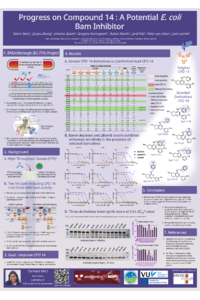
The β-barrel assembly machinery (Bam complex) is essential for folding and inserting outer-membrane proteins (OMPs) in Gram-negative bacteria (GNB) and represents a structurally conserved antibacterial target. In a previous screen for OM disruption, CPD14 exhibited phenotypes consistent with Bam perturbation, including reduced porin abundance, hypersensitivity of envelope biogenesis mutants, robust activation of envelope-stress reporters typical of impaired OMP assembly, and inhibition in a Bam functionality assay. But, limited availability of CPD14 restricted definitive target validation.
CPD14 was synthesized in collaboration with consortium partner to enable validation. CPD14-resistant E. coli isolates were generated by stepwise selection at increasing compound concentrations, and whole-genome sequencing of resistant mutants identified a single nucleotide mutation. Genomic analysis identified a single-nucleotide substitution in basS, encoding the histidine kinase of the BasSR two-component system, in CPD14-resistant isolates. BasS modulates lipid A remodelling and outer-membrane charge; disruption of BasSR signalling can alter OM integrity and envelope stress responses. To be noted, is that resistance appeared to arise via a specific, low-frequency route: while initial CPD14 resistance mapped to basS, subsequent selections did not reproduce the mutation, suggesting limited accessible resistance pathways and possible alternative or compensatory mechanisms.
A panel of 30 CPD14 variants were synthesized and evaluated for antibacterial activity against E. coli, B. subtilis, and S. aureus to determine specificity to GNBs. Phenotypic assays included an envelope-stress (Rcs) response readout, minimum inhibitory concentration (MIC) determinations, and haemolysis assays to assess selectivity and toxicity. Among the variants, a few displayed significantly enhanced antibacterial activity relative to CPD14, providing productive starting points for SAR optimization. Ongoing work focuses on identifying variants with preserved GNB specificity, as these are more likely to engage Bam, the primary target in this context.
These findings establish a starting framework for CPD14’s mechanism of action, guiding the refinement of Bam-targeting antibacterial compounds.
Keywords
AMR
Antimicrobials
OM stress
GNB
Bam complex inhibitors
Poster
MDPI Antibiotics 2026_sahu_updated.pdf
Evaluating the Influence of Interactions Among Selected Enterobacteriaceae on Antibiotic Resistance Profiles
Drug resistance of M. tuberculosis to pyrazinamide among drug-resistant clinical isolates, including MDR/XDR strains in Kazakhstan.